How Often Should You Have One-on-One Meetings? The Real Cadence Benchmark
How often should you have one-on-one meetings? Monthly is the research floor, weekly is where the engagement effect lives — and manager time decides which one you get.
How often should you have one-on-one meetings? It's the question that shows up in every manager Slack thread and first-time-management forum. Monthly feels responsible. Biweekly feels realistic. Weekly feels like something the engaged companies do, whatever that means. People ask as if the answer is a preference — a personality trait of the organization, somewhere between a standup and an appraisal. It isn't. Cadence is a math problem.
There are two numbers hiding inside that question. One is an engagement floor pinned by a large body of research: below some frequency, the conversation stops mattering no matter how good you are at having it. The other is a ceiling pinned by your calendar: a cadence that ignores how much time managers actually have to spend per direct report gets skipped, quietly, and becomes a monthly meeting wearing a weekly badge. Get the math wrong in either direction and the meeting is just theater with a nicer agenda.
Here is what the data says about the cadence itself — and why the disagreement over "how often" says more about what managers think a one-on-one is for than about any research finding.
What the research actually says about frequency
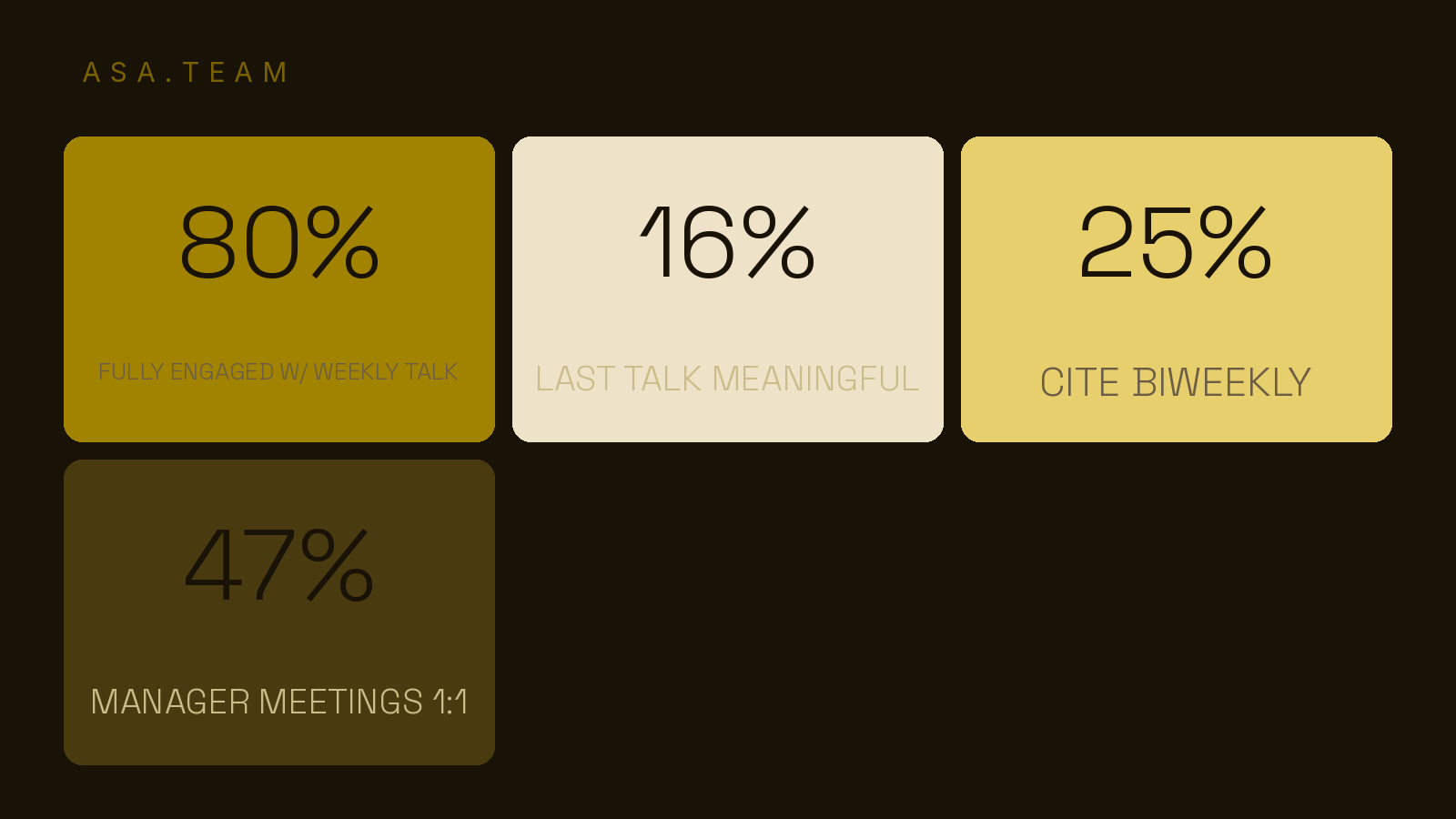
The strongest evidence comes from Gallup, whose meta-analysis of employee experience draws on seven studies representing 44,025 responses that measured whether employees had received meaningful feedback in the past week, alongside team size and engagement. The headline finding is hard to misread: 80% of employees who received meaningful feedback in the previous week were fully engaged — and this held regardless of how many days they worked from the office. Gallup puts it bluntly: the boost from meaningful feedback delivers four times the engagement lift of getting the "right number" of office days right.
The word carrying the load is weekly. The question wasn't "do people like feedback" — it was asked at a one-week recall window, which means recency is part of the finding. Employees don't report on conversations they had three months ago; they report on what happened in the last week. And in the same research family, only 16% of nearly 15,000 employees said their most recent conversation with their manager was extremely meaningful. Whatever cadence most organizations run today, it is nowhere near the cadence the engagement numbers describe.
The floor is set by a different study. Researchers at the University of North Carolina at Charlotte found that meeting quality mattered more to engagement than meeting quantity — but only when meetings happened at least monthly. Below that, quality can't compensate. Two data points, one direction: monthly is the floor where quality can still carry the load, and weekly is where the engagement multiplier actually lives.
Why everyone says "it depends" — and what that hides
Ask the question publicly and the answers spread across daily, weekly, biweekly, monthly, and "it depends." That spread looks like confusion, but it's actually a disagreement about what a one-on-one is. An analysis of real conversations about meeting cadence by Workleap found the most-cited answer — appearing in 25% of messages analyzed — was biweekly or monthly, while 22% pointed to weekly or several times a week. And Quantum Workplace reports that 1 in 3 employees have weekly one-on-ones with their manager and prefer it that way.
A meaningful conversation doesn't require a bigger calendar block. Gallup's research, as summarized in the one-on-one statistics literature, is that 15 to 30 minutes is enough — when it happens consistently.
| Cadence | What it's actually for | What the research says | How it behaves in practice |
|---|---|---|---|
| Monthly | Feedback ritual | The engagement floor — below it, quality can't compensate (UNC Charlotte) | Often the real cadence of a team that started weekly |
| Biweekly | Calendar compromise | Most-cited answer: 25% of cadence conversations (Workleap) | Workable, but outside the one-week recall window where engagement effects appear |
| Weekly | Conversation channel | Where the effect lives: 80% of weekly-meaningful-feedback recipients fully engaged (Gallup) | Survives only if the manager's report count and IC load can pay for it |
| 3–4 per cycle | Performance feedback | Encouraged by 47% of 250+ organizations surveyed (Talent Strategy Group) | A formal review ritual — not a cadence, and never enough on its own |
The disagreement is legible once you sort it. Groups answering "3 to 4 times per cycle" are describing the performance feedback ritual — the Talent Strategy Group's 2026 survey of more than 250 organizations found 47% encourage three to four formal feedback conversations per performance cycle. Groups answering "weekly" are describing a conversation channel — the thing that produces Gallup's weekly-recall engagement effect. Those are genuinely different meetings wearing the same name. If you think a one-on-one is a status report with two chairs, biweekly is correct. If you think it's how a manager knows what's going on, weekly is correct. Even the meeting-medium data hints at the confusion: one review of the field found that nearly 47% of workplace meetings are one-on-ones, which is one reason the "it depends" answer feels so muddy — the medium is already saturated with meetings that call themselves this.
The real constraint: what the cadence costs in manager time
Here is the part the cadence threads never mention: weekly one-on-ones are not skipped because managers don't care. They are skipped because the arithmetic is hostile. Gallup measured average U.S. team sizes rising nearly 50% since 2013, with the growth driven by big teams of 25-plus reports — while about 37% of managers still oversee fewer than five people and roughly two-thirds manage fewer than ten. Twenty-two percent have between 10 and 24 direct reports.
Run the weekly math for a manager with eight reports: eight conversations a week, even at 25 focused minutes, is more than three hours of pure one-on-one time — before preparation, before notes, before the project work the same manager owns personally. And it is personally: Gallup finds 97% of managers carry individual-contributor responsibilities alongside leading others. That number explains the gap between what the research prescribes and what the calendar permits.
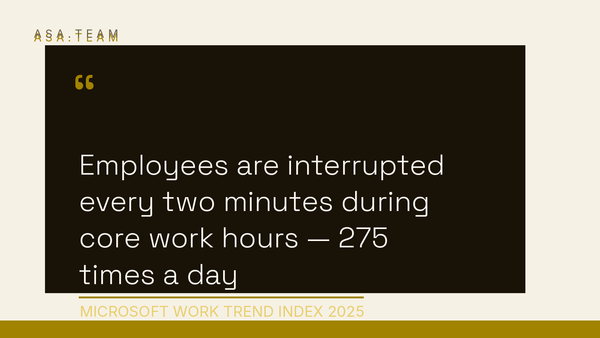
So the honest cadence answer is two lines. The floor is monthly — below it, no amount of quality rescues engagement, per the UNC Charlotte finding. The ceiling is whatever weekly times your report count survives. A manager with five reports can run meaningful weekly conversations and still deliver projects. A manager with fifteen probably runs "weekly" one-on-ones that are really 20-minute status checks that slip to biweekly every quarter-closing week — and lands at the 16%-last-conversation-was-shallow statistic without ever deciding to. The cadence fails quietly, as a supply problem, not a will problem. And when it slips, the failure mode is familiar: the manager's only recurring window on their team's reality starts competing with the 10-plus interruptions per hour that make one focused block rare. Cadence is only real if the minutes inside it do.
What good cadence actually looks like
The teams that make this work don't argue about frequency in the abstract — they change what fills the minutes. The pattern: keep the weekly slot because that's where the engagement effect lives, but stop spending it on replaying status. If the majority of a one-on-one is "what did you work on" recapped out of channels that already captured it anyway, the cadence doesn't matter — you're just scheduling the same meeting you could have sent.
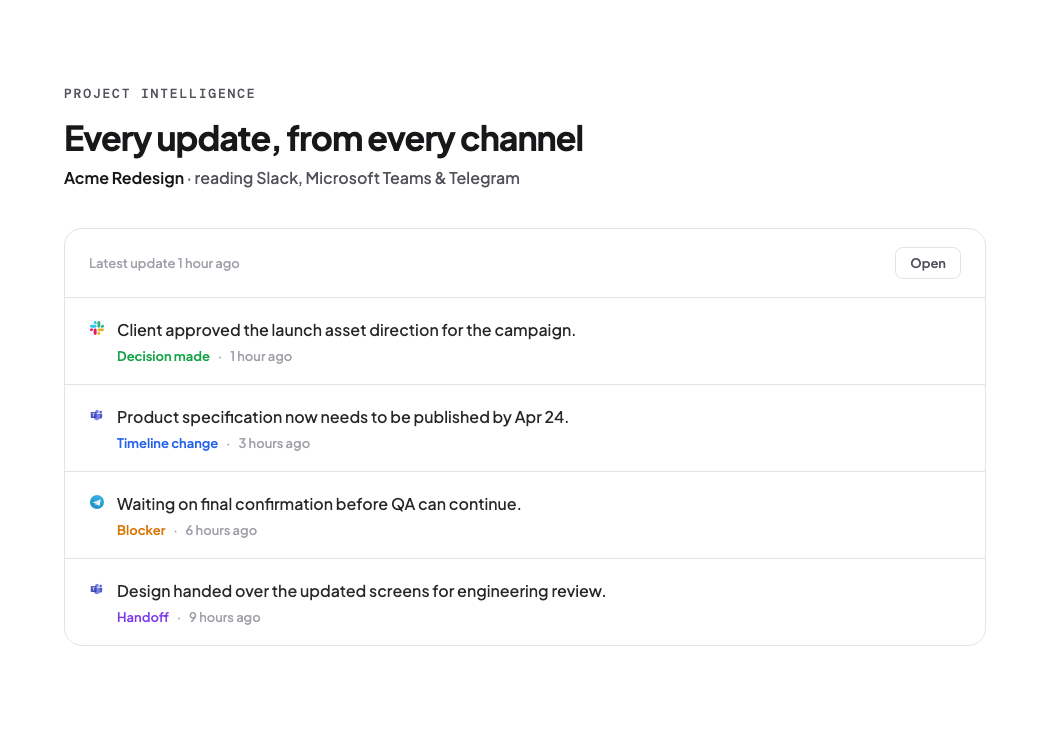
What good looks like: routine project status arrives asynchronously as it happens — as the async shift itself predicts — so the weekly one-on-one is free to be what research says it should be: a 15-to-30-minute conversation about blockers, career, and the stuff nobody flags. Asa.Team's Project Intelligence is built exactly around this trade: it surfaces project updates from Slack, Teams, Telegram, and WhatsApp threads so leaders get the status layer without spending their one recurring human window on it. The minutes go back into the conversation. Cadence stops being a calendar compromise.
Frequently Asked Questions
Is biweekly better than weekly for one-on-ones? If weekly genuinely doesn't fit the manager's time budget, biweekly beats a weekly that silently slips to monthly. But the engagement data — Gallup's meta-analysis — is measured at a one-week recall, and weekly is where the effect lives. Biweekly is a compromise, not the target.
How long should a one-on-one meeting be? Short. Gallup's research points to 15 to 30 minutes being sufficient when it happens consistently. A weekly 25-minute conversation beats a monthly hour and outperforms any cadence filled with status replay.
What if my manager has 10 or more direct reports? The weekly math gets harder, not impossible — but expect the status layer to eat the minutes unless it's handled asynchronously between meetings. That is the practical difference between managers who hold cadence and managers who reschedule it.
Can async check-ins replace one-on-ones? They can replace the status report that disguises itself as a one-on-one. They cannot replace the conversation itself — engagement comes from feeling personally known, which is exactly what Gallup's "meaningful feedback" measures.
So — how often should you have one-on-one meetings?
Monthly minimum. Weekly target. Both numbers come from research, not vibes, and the gap between them is where real managers live. Pick weekly, then check whether your report count and individual-contributor load can pay for it; if they can't, fix the minutes before you change the cadence. If most of your one-on-one time goes into status recaps, no frequency saves the meeting. If the status layer moves async, weekly becomes affordable for almost everyone — and the conversation can finally be about the work that needs a human being.
The next time someone asks "monthly or weekly?", the sharper question is: what is the meeting for — and can your calendar afford that answer? The data is patient. It has been waiting for the calendar to catch up.