How Many Times a Day Do Employees Get Interrupted at Work? The Real Ping Benchmark
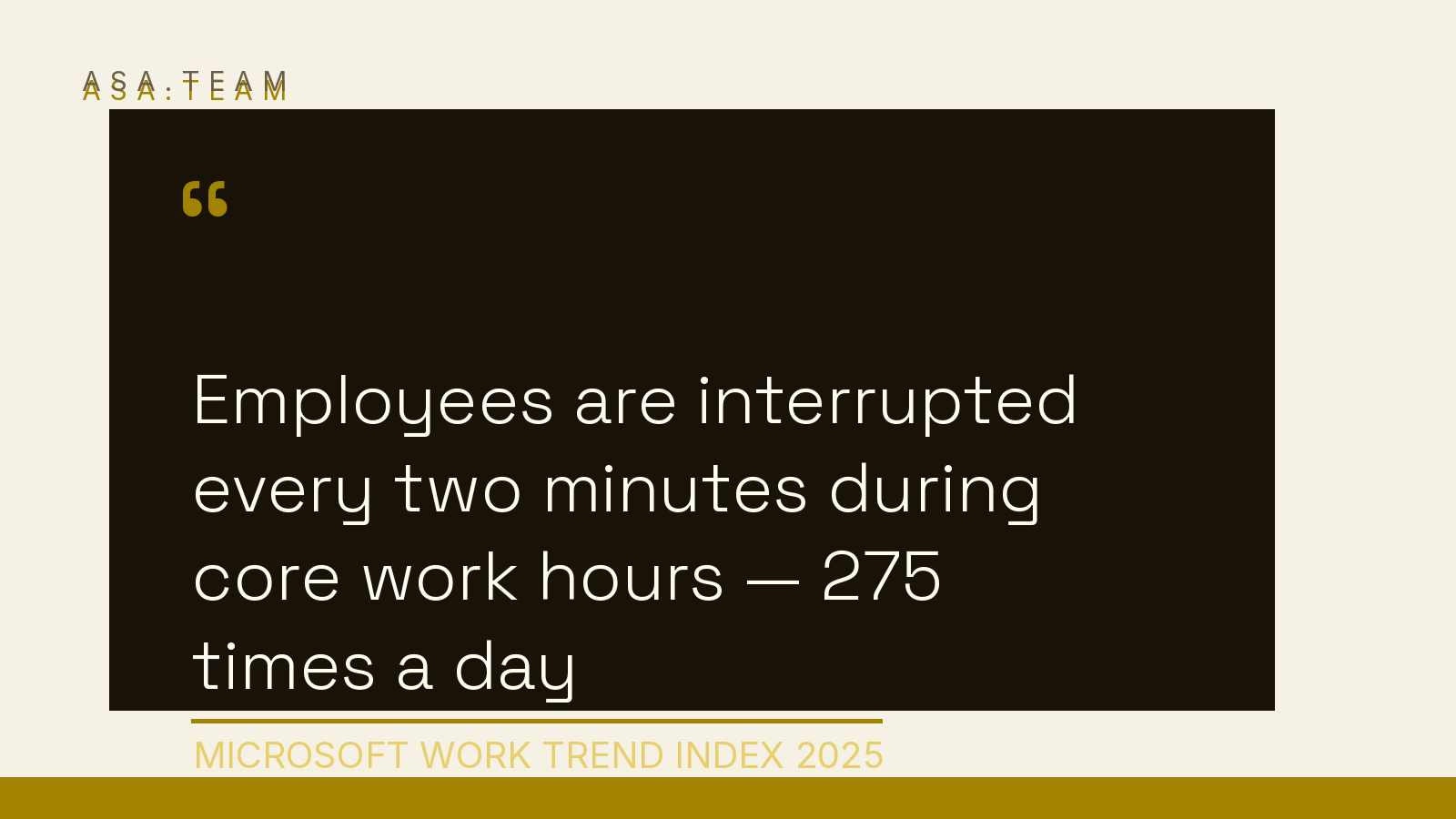
Knowledge workers are interrupted every two minutes during core hours — 275 times a day for the heaviest pinged. Here's the real benchmark and what one interruption actually costs.
How many times a day do employees get interrupted at work by pings, chats, ad-hoc calls and drop-ins? It's 9:14 a.m.: you've opened a design file when a Slack ping drags you into a thread about a client logo. You reply in twenty seconds. At 9:27 a Teams notification asks you to "quickly confirm" a number. By 10:00 you've answered four messages, attended zero meetings, and still haven't finished the first task of the day. This is not a badly organized morning. This is the average modern workday, and the data behind it is more extreme than the feeling.
The honest answer is uncomfortable: knowledge workers are now interrupted roughly every two minutes during core hours, and at the heavier end of Microsoft 365 usage, the total crosses 275 interruptions a day. This post breaks down the real benchmark numbers — alongside related numbers like time spent in Slack and daily notification counts — what one interruption actually costs in recovery time, and why the coordination layer, not individual focus, is what needs fixing.
The 275-hour question: how the interruption benchmark is actually measured
The most widely quoted number comes from Microsoft's 2025 Work Trend Index. Analyzing telemetry from Microsoft 365 users, the research team found that employees are interrupted every two minutes during core work hours by a meeting, email, or notification. Extend that across a full 24-hour day and the count reaches 275 interruptions for the most heavily contacted 20% of users — a rolling 28-day average of pings per user.
Read the methodology carefully, because this is where the "275" headline gets sloppy in most summaries. The every-two-minutes figure is the gap between pings during an eight-hour workday. The 275 figure is the same cohort across a 24-hour cycle — a dramatic number, but one that belongs to employees whose ping volume is already in the top quintile, not the median worker. Media coverage like Fast Company's "Workers are interrupted up to 275 times a day" leans on the top-20% framing while the typical employee sits in a quieter but still brutal band.
For a population-level baseline, older research still offers a useful floor. A widely cited Time Magazine summary of Basex research put the typical worker at about seven interruptions an hour — roughly 56 a day — and noted that 80% of those interruptions are considered trivial. The gap between 56 and 275 isn't a contradiction; it's a range defined by role, tools, and definition. The lowest defensible estimate is still one meaningful interruption every ten minutes.
Twenty-three minutes: the recovery tax nobody budgets for
Frequency is only half the story. The second verified benchmark is the recovery cost, and it is the number that should scare every team lead. Gloria Mark's field research at UC Irvine — originally presented at the 2005 ACM CHI conference — shadowed managers, financial analysts, and software developers and logged every activity to the second. Her findings, carefully re-examined in a 2026 write-up of the original study, showed that about 57% of working-sphere segments were interrupted, and when work was resumed the same day, the average delay was around 23 minutes and 15 seconds.
The nuance matters: that 23 minutes is the time until a person returns to the original task — not necessarily the time until they're thinking as deeply as before. The same analysis found enormous variance, with a standard deviation near 55 minutes. Some interruptions cost a few minutes; some derail an afternoon. Either way, the arithmetic is unforgiving. At the 56-interruption baseline, a 23-minute recovery tax implies roughly 21 hours of fragmented recovery per day per worker — which is why the real world resolves the paradox not by recovering from each ping but by resuming work at a shallow level and never fully descending into focus again.
Two minutes of work, 23 minutes of recovery — the ratio that means sustained focus is now the exception, not the baseline.
RescueTime's behavioral data makes the same point from a different angle. Across 50,000+ users, the average knowledge worker checked email or instant messaging every six minutes; 35.5% checked every three minutes or less, and only 18.6% could go more than twenty minutes without being pulled into communication. In a separate survey of its users, 98% said they were interrupted at least a few times every single day, with 64% naming a face-to-face drop-in as their most common interruption.
The stress you can't feel: what constant interruption does to the body
The productivity math alone should be enough, but there's a biological layer that quietly compounds the cost. In a controlled experiment at ETH Zurich's Mobiliar Lab, an interdisciplinary team simulated a group office and compared participants who worked uninterrupted against those who also fielded chat messages from a "superior" urgently requesting information. The interrupted group produced almost twice the level of cortisol — the primary stress hormone — yet reported feeling less stressed and in a better mood. The physical wear accumulates silently, beneath a subjective experience of "fine."
That silent accumulation connects directly to the engagement and burnout numbers. When people feel their day is fragmented and out of their control, they stop treating any single task as meaningful; they manage input instead of doing work. Microsoft's own survey found that nearly half of employees (48%) — and more than half of leaders (52%) — say their work feels chaotic and fragmented. That shared feeling of fragmentation is the psychological signature of the interruption benchmark: a day that never lets you finish anything.
| Benchmark | Source | Who it describes |
|---|---|---|
| Every 2 minutes between pings (core hours) | Microsoft 2025 Work Trend Index | M365 users, average gap, 8-hour workday |
| 275 interruptions/day | Microsoft 2025 Work Trend Index | Top 20% of users by ping volume, 24h basis |
| ~56 interruptions/day | Time Magazine / Basex | Typical worker, all interruption types |
| 23 min 15 s to resume the original task | Gloria Mark, UC Irvine (2005 CHI) | Managers, analysts, developers when resumption happens same-day |
| Check-in every 6 minutes | RescueTime (50k+ users) | Average knowledge worker's self-interruption pattern |
What good looks like
The instinctive fix is individual: close Slack, put on headphones, block the calendar. Those tactics work for a morning, but they fail structurally because the interruption flow is mostly other people trying to get information from you. The teams that actually fix this don't ask people to be more disciplined — they change where status and answers live, so the ping isn't the only way to learn what's happening.
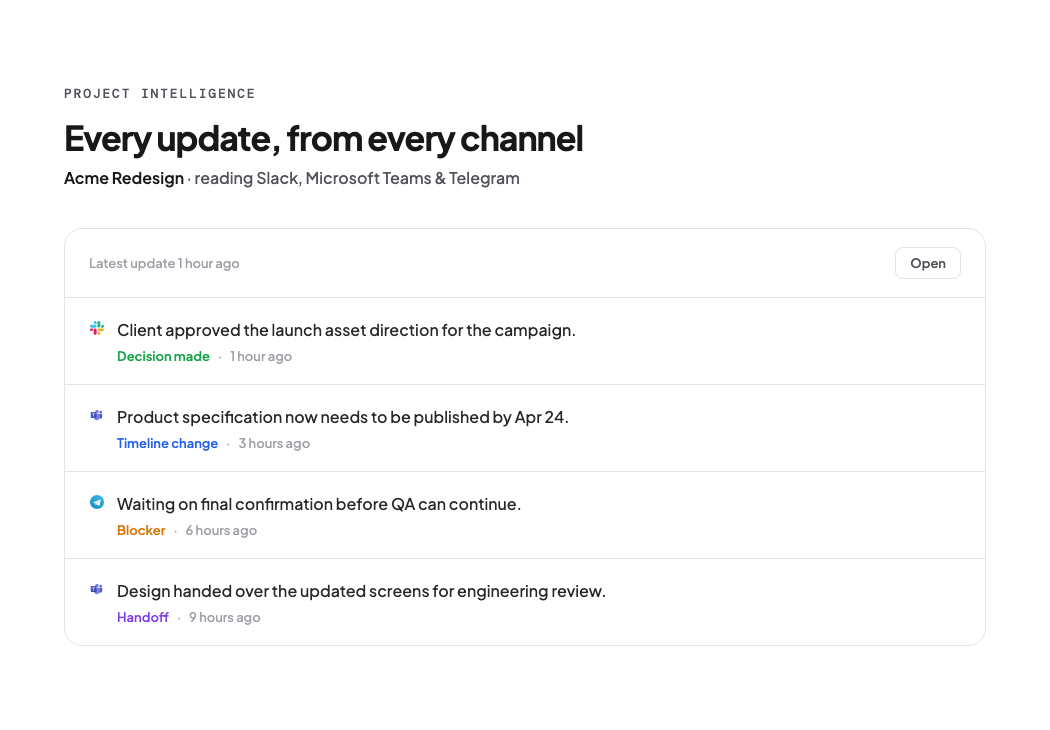
That's what Project Intelligence is for: it watches project updates in Slack, Teams, Telegram, and WhatsApp and turns them into a single readable status feed — so the answer to "where is this at?" is already visible, instead of requiring a fresh interruption to a colleague. The founder who used to ping three people per project per day finds the thread in one glance.
The benchmark to aim for is not zero interruptions — coordination is real work, and some pings are genuinely urgent. The target is a punctuation shift: from a ping every two minutes to a handful of deliberate check-ins per day, with the recovery tax that used to eat 20 minutes per interruption reclaimed as focus time. Teams that put their status in a visible place report the same output with a fraction of the original coordination pings.
Frequently asked questions
How many times a day do employees get interrupted at work? The benchmark range runs from roughly 56 interruptions per day for a typical worker (Basex research) up to 275 per day for the most heavily pinged 20% of Microsoft 365 users (Microsoft's 2025 Work Trend Index). The median experience sits between the two — an interruption roughly every 6 to 15 minutes of focused work time.
How long does it take to refocus after an interruption? Around 23 minutes and 15 seconds, based on Gloria Mark's UC Irvine field research: when workers resumed an interrupted task the same day, that was the average delay. The variance is large — some interruptions cost minutes, others derail the whole afternoon — and the 23-minute figure measures returning to the task, not regaining full depth of focus.
Are digital pings or in-person interruptions more disruptive? Digital pings are more frequent in the Microsoft telemetry, but RescueTime's survey found face-to-face drop-ins were the most common single interruption (64% of respondents) and the hardest to ignore. The common thread is that both pull attention away and carry a recovery cost — the same reason employees now spend hours a week simply attending meetings on top of the interruption stream.
What reduces workplace interruptions? The most effective changes are structural: making project status visible without asking, batching communication, protecting focus blocks on the calendar, and moving routine status questions out of the ping stream entirely.
Conclusion
If you ask how many times a day employees get interrupted at work, the honest answer spans two minutes, six minutes, and 56 to 275 counts — and every one of those numbers lands the same way: fragmented attention, shallow work, and a stress response nobody volunteered for. The benchmark is real, and it's getting worse as message volume keeps climbing.
The reflection worth carrying into your next team meeting is not "who should focus harder" but "what are we pinging each other about?" If most interruptions are status-chasing — asking what's done, what's next, where the file is — then the fix isn't discipline, it's visibility. The teams that make the answer permanently visible stop paying the 23-minute tax for every two-minute question.