How Many Direct Reports Should a Manager Have? The Real Span-of-Control Benchmark
How many direct reports should a manager have? 'It depends' is technically correct and functionally useless — the research says 5 to 7, and the U.S. average manager now carries 12.1.
How many direct reports should a manager have? It is one of the first questions a founder faces after their first two promotions, and one of the most common questions leadership blogs answer with a shrug. "It depends" is technically correct and functionally useless. What is not useless is the data: Gallup has been measuring how many people report to American managers since 2013, Pave has aggregated span-of-control records for 135,000 managers and executives at companies with over 100 employees, and a decades-old management heuristic keeps surviving every org redesign.
Those sources disagree in a way that tells you more than any single number could. Research says a manager is most effective with somewhere between five and seven people. The average U.S. manager now carries twelve. That gap is not an accounting curiosity — it is where coaching, feedback, and honest project status quietly die.
What the benchmarks actually say
Gallup's latest measurement, published in January 2026, found the average number of people reporting to a manager rose from 10.9 in 2024 to 12.1 in 2025 — a nearly 50% increase in average team size since Gallup first measured it in 2013. Government figures Gallup cites track the same story from a different angle: roughly one manager for every 11.5 employees.
The best-practice side of the ledger says something different. Pave's benchmark research treats a 1:5 ratio of managers to direct reports as a common ceiling: beyond it, managers lose time for strategic work, and reports end up under-coached or unclear on priorities. The classic "rule of seven" — the old heuristic that a manager's effectiveness starts dropping past about seven people — lands in the same range, as does European tech headcount research cited alongside it.
The median U.S. manager oversees about six people, right where the research says they should be. The average is nearly double. Put the numbers side by side and the disagreement is stark:
| Measure | Number | Source |
|---|---|---|
| Best-practice ceiling | 5 reports | Pave job-architecture data |
| Classic effectiveness heuristic | ~7 reports | "Rule of seven" |
| U.S. median manager | ~6 reports | Gallup, 2026 |
| U.S. average manager (2024) | 10.9 reports | Gallup, 2026 |
| U.S. average manager (2025) | 12.1 reports | Gallup, 2026 |
| Pave benchmark, 1,000+ employee companies | 5.89 reports | Pave span-of-control data |
Two of these clocks are measuring healthy organizations. Two are measuring what actually happened to management between 2013 and now.
Why the average climbed while the median stood still
Here is the detail that most span-of-control articles skip: the median hasn't moved. Gallup found the median team size has held steady at about five to six employees per manager even as the average hit 12.1. The gap between the two numbers is not drift — it is concentration.
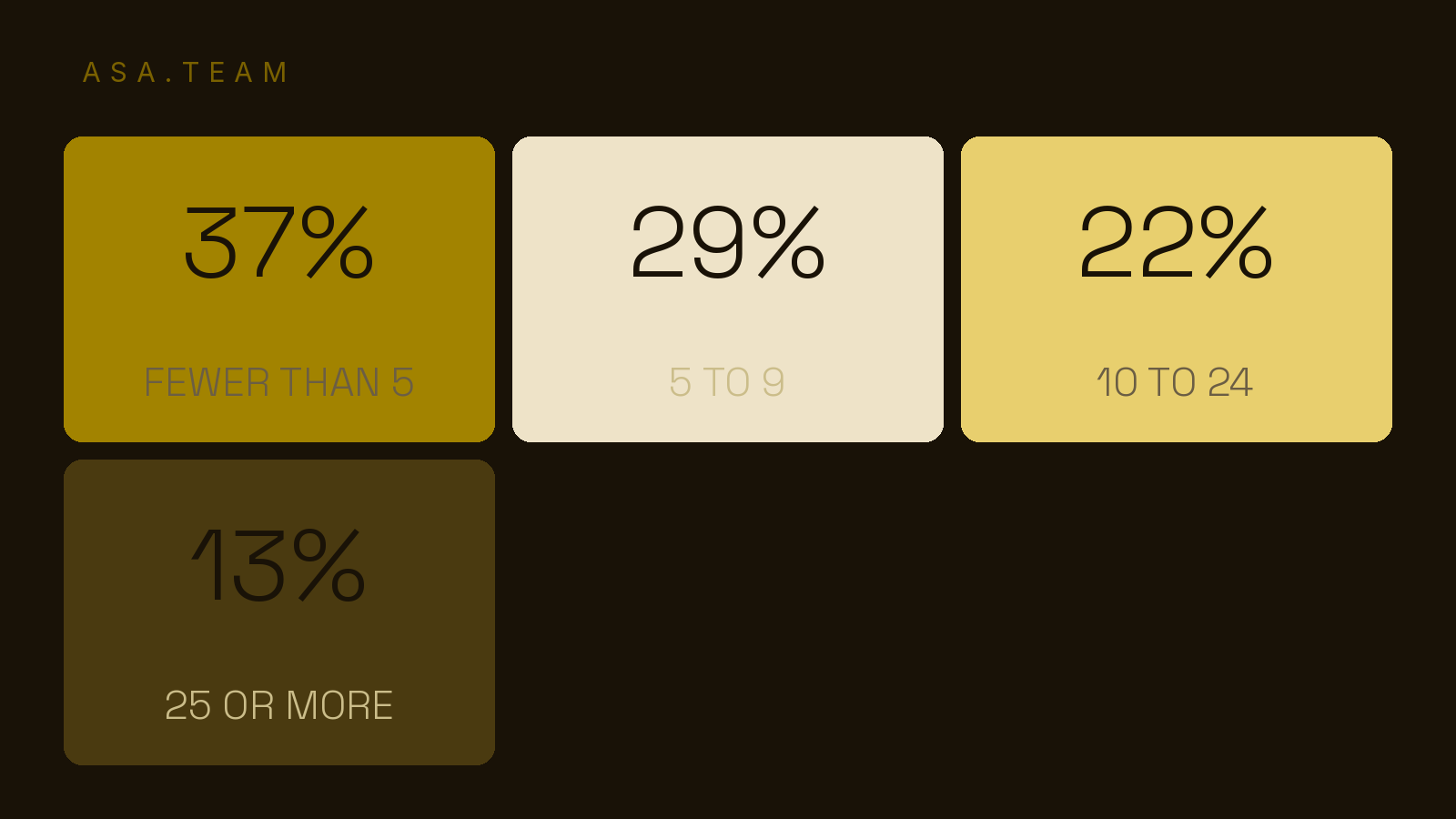
Gallup's distribution shows the mechanism. Thirty-seven percent of managers oversee fewer than five people. Two-thirds manage fewer than ten. But 22% carry between 10 and 24 reports, and 13% — more than one in nine managers — oversee 25 or more. A minority of very large teams is pulling the national average up while most managers keep leading teams the research would endorse.
Why is that minority growing? Partly deliberate strategy. Big tech companies have been eliminating layers of middle management to accelerate decision-making — every flattened layer redistributes its headcount onto the managers who remain. Partly it is economics: fewer managers is a cheaper org chart on paper, and headcount reviews rarely ask what the surviving managers' calendars look like afterward. Pave's data notes that a manager's average span at a company with 1,000 or more employees runs nearly double that of a manager at a 1-to-25-person company — scale, not science, is doing some of the assigning.
The average manager in 2025 leads nearly twice as many people as the research says a manager can lead well — and the median manager, doing fine, is living next door to them.
If you want a healthy organization, the median tells you what works. The average tells you what cost nobody has invoiced yet.
What actually breaks past seven
Span of control is ultimately an arithmetic of attention. A manager with 12 reports who spends half the week doing their own work has roughly ten productive hours left to lead. Divide that across twelve people and you get under an hour per person per week — once you subtract your own email, not the coaching conversation, the blocker conversation, or the career conversation.
The first thing that thins is feedback, and feedback is the whole ballgame. Across seven studies representing 44,025 responses, Gallup found that employees were highly engaged — about seven in ten — regardless of team size when they strongly agreed they had received meaningful feedback in the past week. Team size only crushed engagement when that weekly feedback wasn't happening. The manager of fifteen who gives weekly feedback is running a healthier team than the manager of five who doesn't. (The cadence side of this is its own question — we broke down how often one-on-one meetings should happen separately.)
The second thing that breaks is retention. Gallup's study of 7,272 U.S. adults found that one in two had left a job to get away from their manager at some point. Manager quality is the biggest retention variable in most teams, and attention is how manager quality is delivered. Thin attention across twelve people is a quiet attrition generator.
The third is visibility. A manager carrying 25 reports cannot sit in every channel, every thread, every thread where a project quietly stalled. Status degrades from observed to self-reported, and self-reported status drifts — which is why daily standups miss the blockers that actually derail projects. And the maladaptive response to lost visibility is worse: turning to surveillance. Wide-span managers under pressure are exactly the population most likely to install monitoring, which is how you land on the statistics we covered in what percentage of employees are micromanaged.
The variables that move the right number
"Five to seven" is the baseline, not a law. Four variables legitimately shift the target, and all four are measurable before you assign people.
- Level. Pave's data shows front-line managers (M3 and M4 levels) carry the widest teams; spans narrow at director level, where managers are managing managers, then widen again at SVP.
- Function. Engineering and customer support managers have the most direct reports in Pave's dataset; finance and legal managers the fewest. Highly procedural work tolerates wider spans than work needing constant coaching.
- Company size. Larger companies run wider spans — Pave's benchmark for 1,000+ employee companies averages 5.89 reports per manager, and its job-architecture guidance flags any org where more than 23% of employees are managers as top-heavy.
- Manager talent. Gallup's meta-analysis of more than 200,000 manager-led teams found the manager's own capability, not team size alone, decides whether a wide span works. Highly talented managers who spend little time doing individual-contributor work can lead much larger teams and stay engaged.
That last point carries a warning label: managers who carry a heavy individual-contributor workload on top of their people responsibility struggle even at moderate spans. The title is manager; the calendar says senior doer.
What good looks like
Compare two managers who each just inherited twelve reports. The first rebuilds their week around information: status meetings to chase updates, channel-scrolling to catch what slipped, escalations surfacing late because nobody was watching. Feedback is whatever survives the calendar. This is what a 12-person span looks like when it is built on pull.
The second manager builds on push. Status flows to them from where the work already happens — no standing status meeting, no chasing, no monitoring software. Their weekly rhythm is reserved for the one thing Gallup's data says actually predicts engagement: meaningful feedback, every person, every week. Exceptions and stalled threads surface themselves; the manager's attention goes to judgment, not collection.
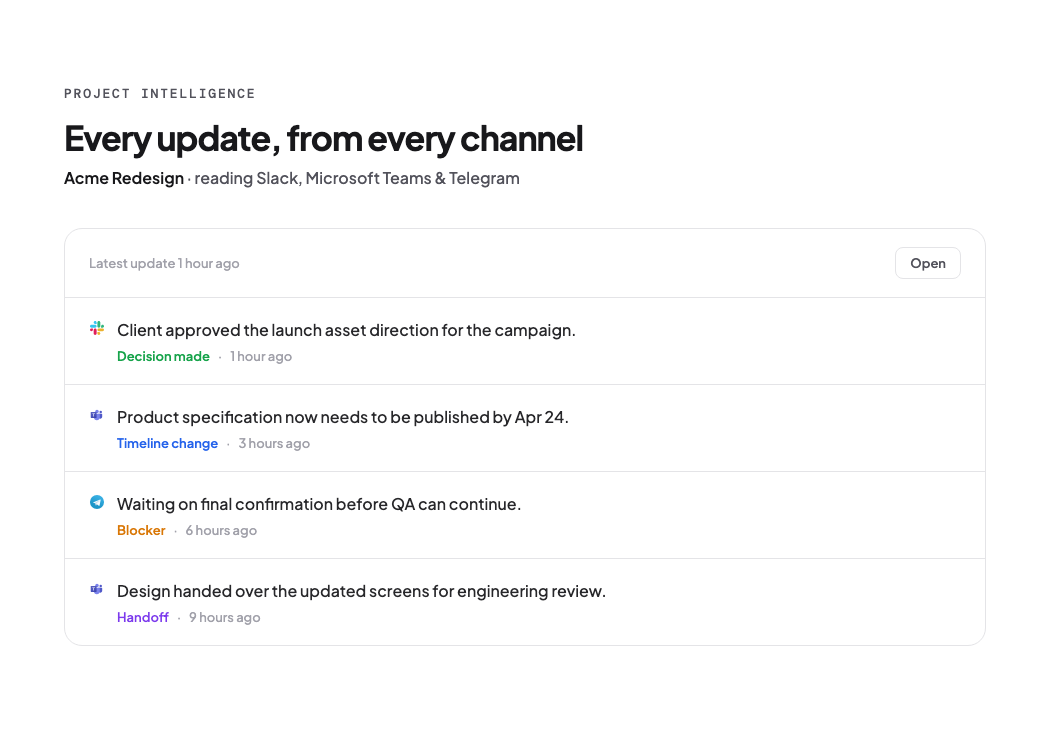
This is the operating model behind Asa.Team's Project Intelligence, which reads project conversations across Slack, Teams, Telegram, and WhatsApp and turns them into an always-current picture of what is moving, stalled, or blocked — so a wide-span manager can lead by exception instead of by interrogation.
The right span is the number your feedback cadence can survive. If it's seven, assign seven. If you're stuck with twelve, the honest fix is not a monitoring tool — it's removing everything the manager was doing that wasn't managing.
Frequently Asked Questions
Is 12 direct reports too many? By research standards, yes for most managers: the rule of seven and Pave's 1:5-to-1:7 range both flag it, and Gallup's own data shows the median manager leads only about six. But manager capability is the modifier — Gallup's research found high-talent managers who spend little time on individual-contributor work can lead larger teams without losing engagement.
What is the rule of seven? A long-standing management heuristic that a manager is most effective with roughly seven direct reports. Below seven there is usually enough time for coaching and feedback; above it, attention per person drops. It is a guideline, not a hard ceiling, and it agrees closely with Pave's five-to-seven practical range.
How many direct reports should a startup manager have? Tighter than the corporate average. Pave's data shows early-stage companies run narrow spans — a manager at a 1,000+ employee company carries nearly double the reports of a manager at a 1-to-25-person company. Early-stage coaching load is higher, so five to seven is the practical range.
Does remote work change the ideal span of control? It changes the failure mode, not the arithmetic. Remote work removes hallway visibility, so wide-span managers either replace observation with push-based status (healthy) or with monitoring and forced check-ins (the micromanagement path). The number that matters stays the same: how many people you can give meaningful feedback to every week.
The number is not the answer
"How many direct reports should a manager have?" has a defensible answer: five to seven, wider only when the manager is strong, the work is procedural, and the calendar protects the managing. The more useful question is the one underneath it — what is your manager actually doing with the time between standups? If it is coaching and judgment, the span can stretch. If it is chasing status, no number on an org chart will save the team, because the bottleneck was never the reporting line. It was the reporting.