Asynchronous Communication Statistics: The Real 2026 Numbers Behind the Async Shift
Asynchronous communication statistics make async look inevitable. The real 2026 numbers: workers want more async, but most teams still run sync. Here's the gap.
Asynchronous communication statistics make async look inevitable. The team spans four time zones, the "quick sync" call ran forty minutes, and the one person who actually needed the answer was in a meeting the entire time. Someone finally says what everyone is thinking: why wasn't this a written update?
The strongest async advocates have the numbers on their side. But most asynchronous communication statistics you'll see are adoption numbers — what workers say they want. The practice numbers tell a different story, and the gap between them is where teams either win or quietly sink back into the meeting default.
Here are the real 2026 numbers: how much workers want async, how little most teams actually run async, what the gap costs, and what separates the teams that close it from the ones that don't.
The Adoption Numbers: Workers Want More Async, Not Less
Start with what workers actually say. The Whimsical State of Async 2026 survey found that 52.8% of workers want more async work in their day, while only 8.3% want less. That is roughly six people pushing for more async for every one person pushing back. A separate Miro analysis of 2,228 knowledge workers lands in the same place: only 14% want less async work (42% want more, 44% want the same).
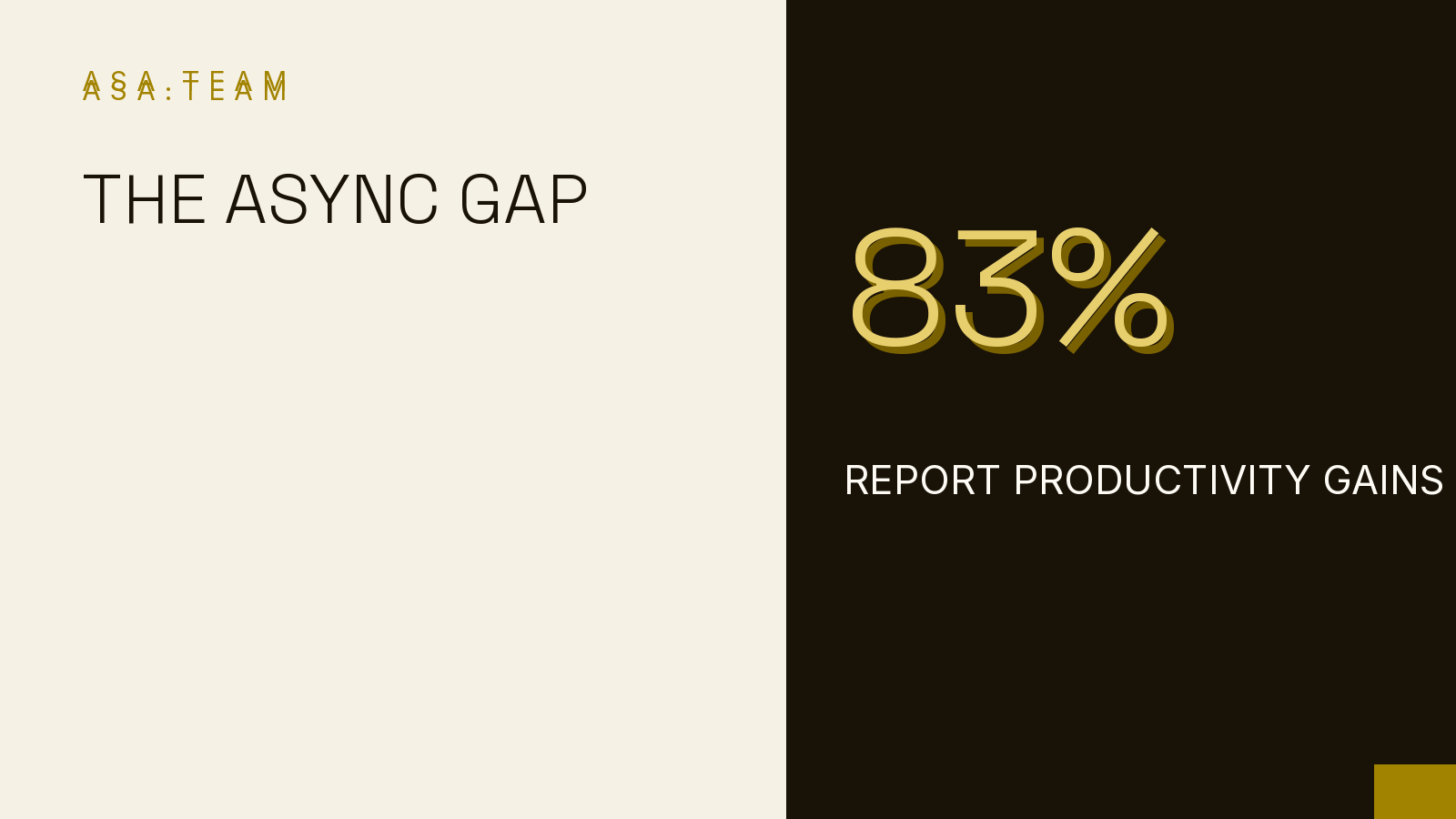
The productivity argument is just as lopsided. In the Whimsical survey, 82.9% of respondents reported productivity gains from async work against 10.6% who reported losses — an eight-to-one ratio. And 8 in 10 workers said the meetings they attend could have been handled asynchronously, while only 1.9% felt their company completely avoids unnecessary meetings.
Workers can see where the trend is heading, too. Seventy percent believe async work will become more prevalent, and only 6% think it will decline. People managers are the biggest advocates of all: 70% want more async, compared with roughly a fifty-fifty split among individual contributors and leadership.
The preference gap shows up in company policy surveys as well. Buffer's 2022 State of Remote Work found that only 38% of respondents worked at a company with an async-first policy, while 52% wanted their company to adopt one. The desire for async is not a niche view held by a vocal minority; it is the majority position of the workforce.
The Practice Gap: Only a Third of Remote Teams Actually Work Async
Here's the number that changes the conversation. In Buffer's 2023 survey, only 32% of remote workers said their work was mostly or fully asynchronous — 14% all synchronous, 23% mostly synchronous, 31% evenly split, 29% mostly async, and just 3% all async. The share who said they'd prefer mostly or fully async work was 37%.
The conditions that make async necessary are already everywhere. Buffer found that 62% of remote workers work directly with teammates across multiple time zones, and 74% work at companies operating across time zones. A written update moves between those zones without forcing anyone to start early or stay late. Yet most distributed teams still coordinate a substantial share of their week in real time.
Put the desire and the practice side by side and the gap is plainly visible:
| Measure | Number | Source |
|---|---|---|
| Workers who want more async in their day | 52.8% (only 8.3% want less) | Whimsical State of Async 2026 |
| Workers reporting productivity gains from async | 82.9% vs 10.6% losses | Whimsical State of Async 2026 |
| Workers who say their meetings could have been async | 8 in 10 | Whimsical State of Async 2026 |
| Remote workers whose work is actually mostly/fully async | 32% | Buffer State of Remote Work 2023 |
| Companies with an async-first policy | 38% (52% of workers want one) | Buffer State of Remote Work 2022 |
| Time spent communicating vs creating | 57% vs 43% | Microsoft Work Trend Index 2023 |
Microsoft's 2023 Work Trend Index shows why the synchronous default is so sticky. Across Microsoft 365, the average employee spends 57% of their time communicating — meetings, email, and chat — and only 43% creating. Heaviest email users (top 25%) spend 8.8 hours a week in email; heaviest meeting users spend 7.5 hours. Sixty-eight percent of people say they don't have enough uninterrupted focus time.
Atlassian's State of Teams 2024 found the underlying norm: 65% of knowledge workers say it's more important to respond quickly to messages than to make progress on top priorities. Async tools support delayed responses; team norms still demand immediate attention. That is the gap in one line.
The time cost is measurable. Research has pegged the average knowledge worker's daily focus time at just two to three hours, built on analysis of 140,000+ users. Teams that run the status-update loop as a live call are spending their scarcest resource — uninterrupted focus — on information that could be consumed on each person's own schedule.
The Meeting Tax Pushing Teams Toward Async
The clearest driver of async adoption is not preference — it's the failure of the synchronous default. In Atlassian's survey of 5,000 knowledge workers, 77% frequently attend meetings that end by scheduling another meeting, and 54% leave without a clear idea of next steps or who owns which task, per Atlassian's page-led meetings research.
The scale of the tax is brutal. Atlassian's earlier research found that 78% of surveyed workers say they're expected to attend so many meetings it's hard to get their actual work done, and 51% work overtime at least a few days a week because of meeting overload — rising to 67% for directors and above, per Atlassian's workplace woes research.
A meeting that ends by scheduling another meeting isn't a decision — it's a tax. The async alternative isn't fewer decisions; it's decisions that stick in writing.
Atlassian put its own money behind the fix. Over two weeks, 43% of Atlassians had a meeting replaced by a recorded video, which freed up 5,000 hours of focus time. At product level, the numbers compound: Loom users recorded 88 million videos in 2024, reducing the need for an estimated 202 million meetings.
Status updates, decisions, and FYIs are the natural async candidates. Atlassian's State of Teams research reports that 55% of knowledge workers struggle to track down information even when they know it exists — a retrieval problem that a written decision log fixes and a meeting never does. The habit of reporting project state in a recurring call is one of the biggest culprits: when the update lives in a meeting, it dies in the meeting. We've covered why status update meetings waste time and how project updates get lost in Slack — the same coordination tax, different channels.
The honest objection to async is real, too. Whimsical's survey found that 22% of workers say async work hinders alignment, compared with 55% who say it improves it. Alignment — the confidence that everyone shares direction and goals — is async's biggest vulnerability. It's also the exact problem a meeting was supposed to solve, poorly. The fix is not more meetings; it's making the async record authoritative — which is what the teams below actually do.
What Good Looks Like
Teams that make async work are not the ones with the most tools. They are the ones with explicit norms. Whimsical found that high-performing teams are 2.7x more likely to have documented communication guidelines — and 57.9% of all workers say their organization has no documented communication guide at all.
In practice, the winning pattern is a bounded swap: move status updates and routine coordination to a written channel, keep live conversation for the genuinely ambiguous or urgent, and write down the rules for response time. One survey found 36.2% of workers believe they're expected to respond to messages within an hour, including 9.3% who think they have to reply immediately — which is the real-time default sneaking into an async tool.
It's also worth noting what async does not require: giving up connection. Whimsical found that fully async companies report the highest levels of team connection — 78.6% feel highly connected — while the lowest connection scores show up in teams that only half-adopted async without clear norms. The format is not the problem; ambiguity is.
For the format question itself — whether to run a sync or async standup, and how asynchronous leadership works when every ping competes for priority — the answer follows the same rule: write down the norm, then audit whether the meeting still earns its slot.
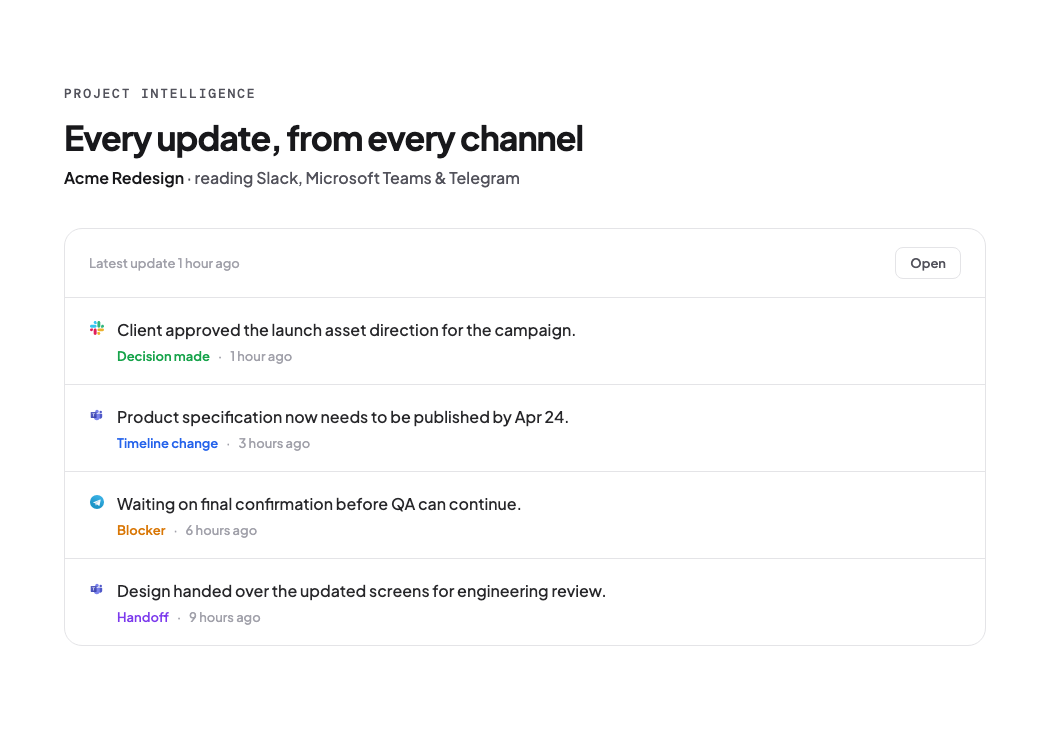
This is where the promise of async and the reality of project status collide. Async only helps if the written update is actually findable, current, and read. That's exactly what Project Intelligence is for: it surfaces the updates teams already write across Slack, Teams, Telegram, and WhatsApp, and turns them into a live project picture — so a status update written asynchronously actually lands as status, instead of disappearing into a thread no one reopens.
Frequently Asked Questions
How many workers want asynchronous communication? A majority. Whimsical's State of Async 2026 survey found 52.8% of workers want more async work in their day, while only 8.3% want less. Buffer's 2022 survey found 52% of remote workers wanted their company to adopt an async-first policy, while only 38% said their company had one.
What percentage of remote teams actually work asynchronously? Only about a third. Buffer's 2023 survey found 32% of remote workers described their work as mostly or fully asynchronous — while 37% said they'd prefer that balance. Most distributed teams still run a substantial share of their coordination in real time.
Does asynchronous communication improve productivity? The majority says yes. In Whimsical's 2026 survey, 82.9% of workers reported productivity gains from async work against 10.6% who reported losses, and high-performing teams were 2.7x more likely to have documented communication guidelines. The caveat: 22% of workers say async hinders alignment, which is why written norms and a reliable status record matter.
Why do async teams still end up in meetings? Because the response-time norm survived the channel change. Whimsical found 36.2% of workers believe they're expected to reply within the hour, including 9.3% who think they must respond immediately — which recreates a synchronous expectation inside an async tool. The fix is documented response-time expectations, not another tool.
The Bottom Line
The asynchronous communication statistics say demand is not the problem. Workers want more async, they report productivity gains from it, and they can see that the meetings they attend don't need to happen. The bottleneck is practice: only a third of remote teams actually run mostly-async work, most companies have no written communication guidelines, and the instant-response norm survives inside async tools.
The change starts small — one status update moved from a call to a written channel, one documented rule for response time, one guarantee that the written update gets read. The teams that close the gap between wanting async and running async are the ones that treat the written update as infrastructure, not as a substitute for talking.
Does your team's async actually produce a project picture anyone can trust, or does it just produce more threads?