What Percentage of Projects Fail Due to Poor Communication? The Real Numbers
PMI's own data puts the share of failed projects tied to poor communication between 30% and 56%. Here is what each number really counts — and where the fix is.
Projects fail for a thousand reasons, but the post-mortem always ends the same way. The budget bled out, the deadline slipped twice, and somewhere between "nobody told me" and "I thought you knew" the thread simply snapped. Ask the room what went wrong and you get a version of the same answer: communication. The frustrating part is that the room is right — there are decades of data saying so — but the number everyone quotes is all over the place. One source says a third of failed projects. Another says more than half. A third says almost all of them.
That spread is not sloppy journalism. It is the same underlying finding measured three different ways, and knowing which number answers which question tells you where the fix actually is. This is the benchmark you need before your next kickoff: what percentage of projects fail due to poor communication, what each figure is really counting, and what the gap between them says about your team.
The "one in three" number that won't die
The most repeated answer to "what percentage of projects fail due to poor communication" is about one in three. It traces back to Project Management Institute research in the Pulse of the Profession 2015. When PMI asked which factors contributed to the projects that failed in the past 12 months, 30% of respondents named inadequate or poor communication — right alongside undefined risks and an inadequate vision, and behind only inaccurate requirements gathering (38%) and a change in project objectives (35%).
That 30% is why the "third of failures" figure keeps circulating: it is PMI's own survey data, and it is easy to remember. It is also deliberately conservative. It counts communication only when people on the ground named it as a primary cause, not every project where miscommunication made things worse. If you hold every project to that test, the answer to the headline question is roughly 30–35% of failed projects.
Standish Group's CHAOS data tells a compatible but wider story. Across two decades of reports, roughly 70% of projects fail to fully meet their original goals, and only about 35% of IT projects finish on time, on budget, and on scope. Communication is not the only cause in that 65% — but it is the one that shows up in almost every decomposition. A 2026 roundup of project-management statistics found that 86% of employees cite lack of collaboration as a main reason for project failure, and that teams lose roughly 5.6 hours per week to unclear communication.
The higher number — and what it really counts
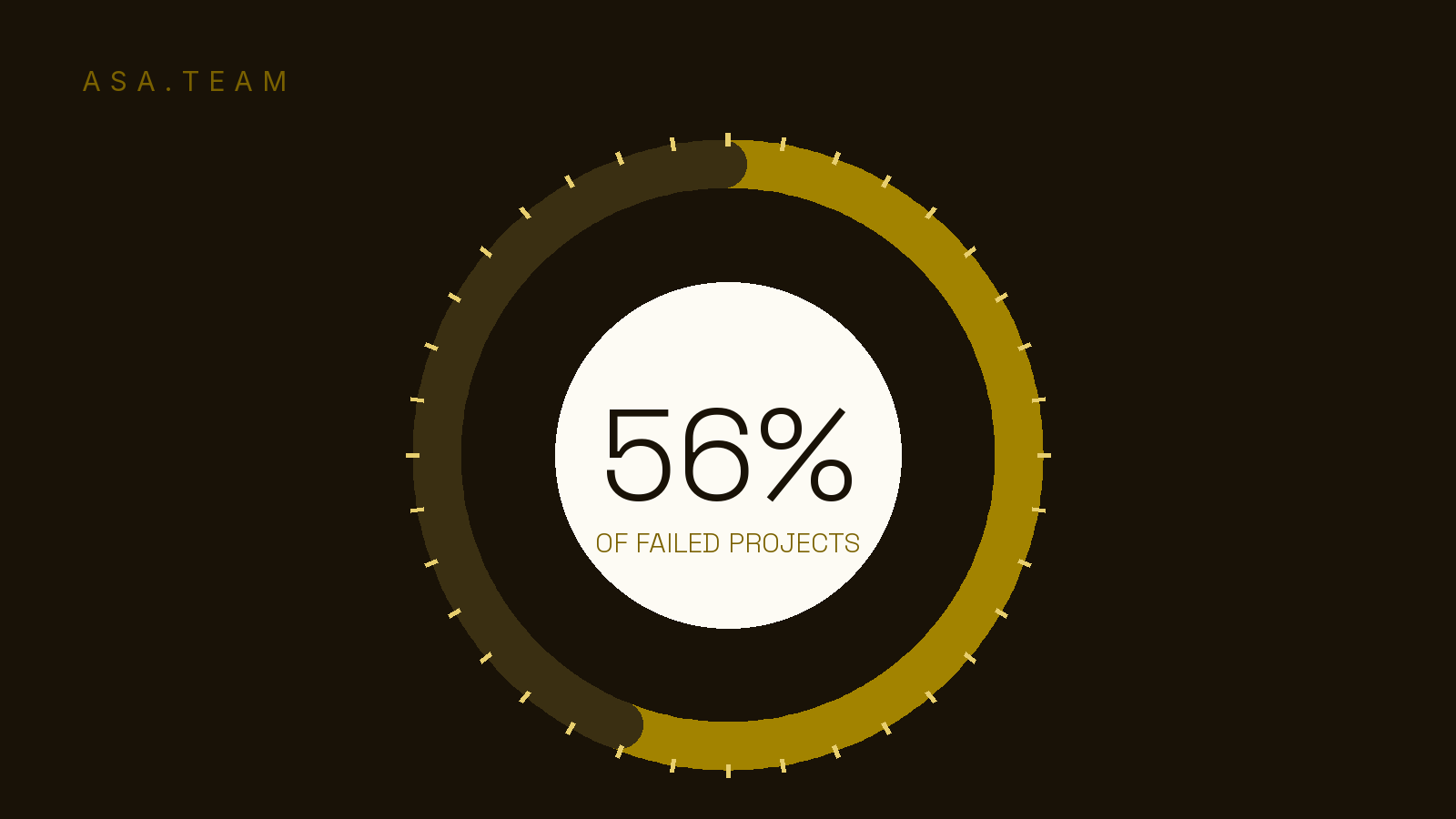
Now for the figure that disagrees: PMI reported in the Pulse of the Profession 2013 that poor communication was a contributing factor in 56% of failed projects — and called it the number one reason projects fail. Fifty-six percent is not a contradiction of 30%. It is a broader definition. The 2013 survey counted communication as a contributing factor — any project where bad updates, missed context, or a channel breakdown made failure more likely. The 2015 number counted only projects where it was the primary cause cited. Same institute, same failure population, and the difference between 30% and 56% is mostly the difference between "this played a part" and "this was the main thing."
That distinction matters more than the exact figure. When someone tells you "projects fail because of communication," the truthful reply is: poor communication is a primary cause in roughly one in three failures, and a contributing factor in well over half of them. Both statements come from PMI's own report series. Pick the one that matches the decision you are making — the conservative number for estimating how often communication is the main villain, the higher one for how often it makes a weak project worse.
| Stat | What it measures | Source |
|---|---|---|
| 30% | Failed projects citing inadequate/poor communication as a primary cause | PMI Pulse of the Profession 2015 |
| 56% | Failed projects where poor communication was a contributing factor | PMI Pulse of the Profession 2013a |
| 70% | Projects failing to fully meet their original goals, all causes | Standish CHAOS via industry roundups |
| 86% | Employees citing lack of collaboration as a main reason for failures | Salesforce survey, via PM-statistics roundups |
The honest headline is not a single number. It is a range: one in three failures is communication-driven, and more than half involve it.
The dollar cost behind the percentages
Percentages undersell the damage, so the cost figures are worth sitting with. PMI's 2013 research quantified the waste directly: for every US$1 billion spent on a failed project, US$135 million is lost forever — unrecoverable budget, not a delay you absorb. At the economy level, Grammarly and The Harris Poll estimated in 2022 that U.S. businesses lose up to $1.2 trillion annually to ineffective communication. Analyses cited by SHRM put the average hit at $62.4 million per year for large companies and roughly $420,000 per 1,000 employees.
Zoom in from the macro numbers and the pattern is the same at team scale: 60% of managers cite poor communication as the top reason for project failures, and about 25% of IT projects fail due to poor communication between teams, according to 2026 workplace-communication roundups. These are not abstract macro figures — they are the budget line for the exact failure mode this blog keeps documenting: status reporting that burns meeting time, project updates that vanish inside Slack threads, and status cadences nobody actually follows.
Where communication failures actually happen
Here is the part the percentages never show: communication does not usually fail in the big meeting where the roadmap is announced. It fails in the hundreds of small handoffs between. A developer finishes a task and posts a note in one channel. A client message lands in an email thread nobody monitors. The status sheet is last updated on a Tuesday. None of these look catastrophic, and each one removes a fact from the shared picture. By the time the project is visibly off track, the team is not disagreeing about facts — they each hold a different, confident version of reality.
That is why the 30%-vs-56% argument is worth having once and then moving past. The real lever is not "communicate more." It is making the current status of work visible in one place, so the percentage of failures caused by missing context stops applying to your team. The data says the cheapest fix is structural, not motivational: fewer channels to watch, fewer status rituals to remember, one thread of truth that updates itself from the tools people already use.
What good looks like
Teams that fail less are not the ones with more elaborate status charts. They are the ones where a leader can answer "where are we?" without asking anyone — because updates surface where work already happens instead of requiring people to file them. That is the whole job of Project Intelligence: it reads the project updates teams already post across Slack, Teams, Telegram, and WhatsApp, and pulls the signal into a single timeline so nobody has to chase a thread to know what shipped, what is stuck, and what changed. The updates exist; the problem was always that they were scattered.

That is the difference between a team that argues about which number describes its failures and one that stops generating the data for the statistic. The percentages above are the price of scattered context. The fix is not a new meeting about communication — it is a shared surface where the project's real status is visible without a single status update being chased.
Frequently asked questions
What percentage of projects fail due to poor communication? PMI research puts the number between 30% and 56% of failed projects depending on definition: 30% name poor communication as a primary cause (Pulse 2015), while 56% had it as a contributing factor (Pulse 2013). Related survey data suggests up to 86% of employees blame collaboration failures for workplace failures.
Is poor communication the number one cause of project failure? PMI's 2013 Pulse called it the number one reason projects fail. In the 2015 survey it trailed inaccurate requirements gathering (38%) and changes in objectives (35%), and tied with undefined risks at 30%. It is consistently in the top three controllable causes.
How much does poor communication cost companies? PMI measured US$135 million lost per US$1 billion spent on a failed project. Grammarly and The Harris Poll estimated a $1.2 trillion annual loss for U.S. businesses, and SHRM-cited analyses put the average at $62.4 million per year for large companies.
How can teams reduce communication-driven project failure? The reliable fix is structural: centralize project status so updates surface automatically from the tools teams already use — Slack, Teams, Telegram, WhatsApp — instead of requiring manual status reporting that drifts stale.
The number that matters
Thirty percent or 56% — the precise figure changes with the definition, and the definition changes with the decision. What does not change is that communication failure is a top-ranked, controllable cause of project failure in every major study that has looked. The question worth carrying into your next project is not "which percentage applies to us?" It is "can any member of the team state the current status of the work without asking someone?" If they cannot, you are already inside the statistic — and the fix is not another meeting about communicating better. It is making the project's reality visible in one place, continuously, without anyone having to file a report.