How Much Time Do Employees Spend in Meetings? The Real Video-Call Hours Benchmark
The average remote worker now spends 2.3 hours a day on video calls. Here is the real benchmark for time in meetings, why it tripled since 2020, and where the fix is.
One recurring meeting got cancelled this month and the calendar still looks full. That is the quiet story of remote work: nobody consciously decided that the workday should become a row of camera-on calls, and yet the average remote worker now sits in video calls for 2.3 hours every day — and one in ten spends five hours or more. The same Microsoft telemetry that tracks how we actually work shows average weekly meeting time has nearly tripled since early 2020. The question "how much time do employees spend in meetings" now has a very different answer than it did five years ago, and the gap between what the calendar says and what the work needs is where team energy quietly drains.
This post collects the real benchmarks: current video-call hours per employee, how that load has grown since February 2020, what it costs in focus and context, and where the fix actually lives.
The 2026 benchmark: 2.3 hours a day on video calls
The freshest full-workforce measurement comes from a January 2026 survey of 1,005 U.S. employees conducted by Payless Power, which tracked remote and on-site work habits in detail. The headline: remote workers average 2.3 hours per day on video calls, which works out to 598 hours — roughly 75 working days — every year. One in ten remote workers spends five or more hours per day in video calls, and nearly a third (32%) keep their camera on for every meeting.
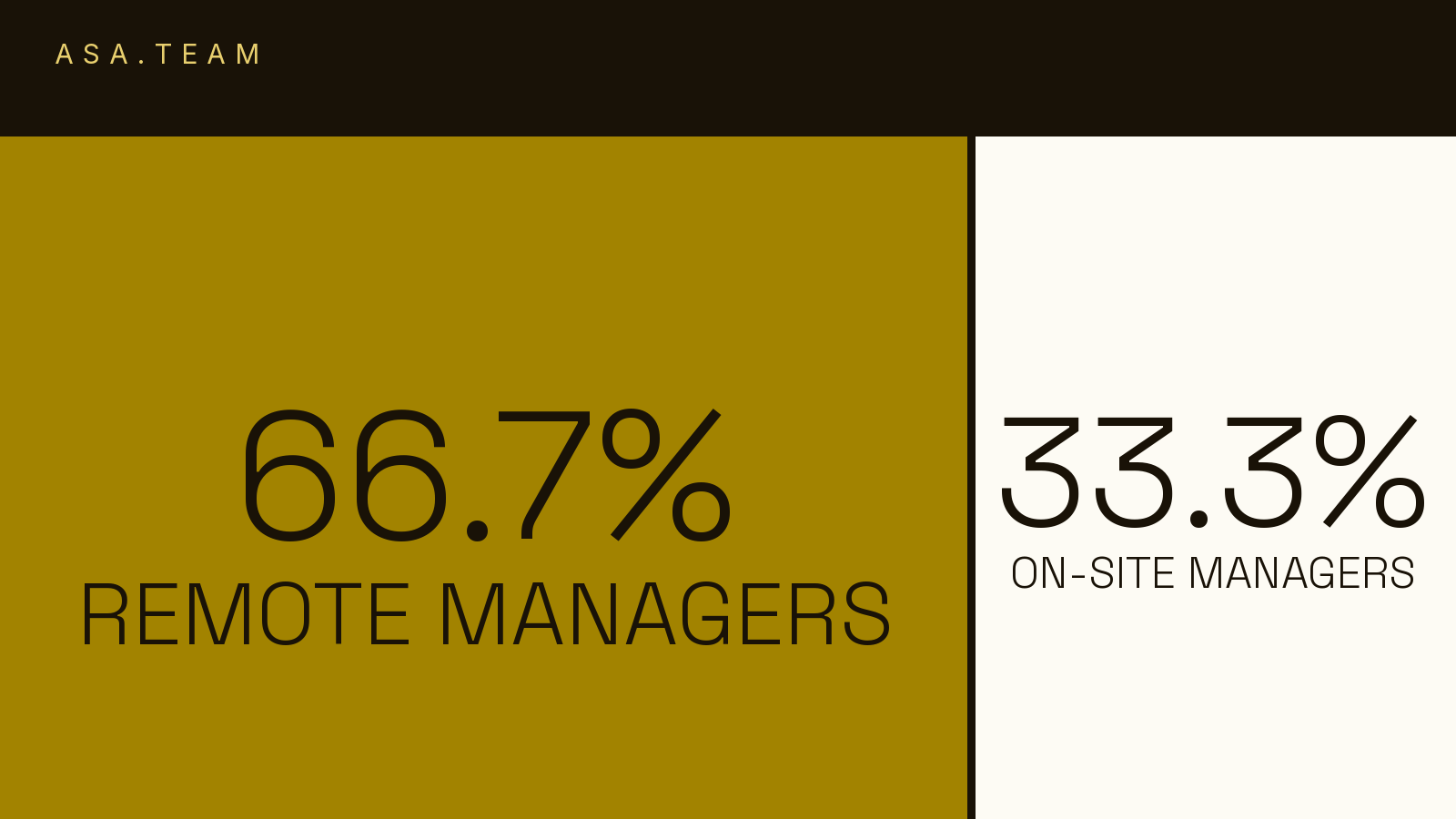
The role gap is where the number stops feeling abstract. The same study found remote managers spend 2.4 hours a day on video calls — exactly twice the 1.2 hours of on-site managers. In other words, the more of your team is distributed, the more of every manager's day becomes a sequence of faces on a grid. The data was covered by HRSEA's independent report in March 2026, which confirmed the same 2.3-hour average and the 1-in-10 tail.
| Benchmark | Number | Source |
|---|---|---|
| Average video-call time, remote worker | 2.3 hours / day (~598 hrs / year) | Payless Power survey, Jan 2026 |
| Remote workers on calls 5+ hrs / day | 1 in 10 | Payless Power survey, Jan 2026 |
| Remote manager daily call time | 2.4 hrs — 2× on-site managers (1.2 hrs) | Payless Power survey, Jan 2026 |
| Weekly meeting time growth since Feb 2020 | +153% for average Teams user | Microsoft Work Trend Index, 2022 |
This is the benchmark that matters when someone asks "how much time do employees spend in meetings": a full working day every single week, and more for the people carrying the most coordination burden. Earlier pandemic-era data pointed the same direction. A 2025 Zoom roundup of video-conferencing statistics notes that video-call participation hit roughly 66% of U.S. internet users by late 2023 — video went from a department tool to the default way work happens, fast enough that the habits never got renegotiated.
How meeting time tripled since 2020
The 2.3-hour day did not appear from nowhere. Microsoft's 2022 Work Trend Index, built on trillions of Microsoft 365 productivity signals plus a 20,000-person survey, found that the number of meetings per week increased by 153% globally for the average Teams user since the start of the pandemic — and warned that the "spike" had become the new baseline. A year later the same research line reported that people now spend 57% of their work time in communication — Teams meetings (23%), Teams chat (19%), and email (15%) — with only 43% left for the work itself.
That shift is visible in the daily rhythms of the 2026 workday. The 2025 Work Trend Index found that half of all meetings are scheduled in the two most productive windows of the day (9–11 am and 1–3 pm), Tuesdays carry the heaviest meeting load at 23% of the week, and the average worker receives 117 emails and 153 Teams messages every weekday — on top of the email time we measured separately in our email-hours benchmark. The meeting load did not simply get bigger — it colonized the hours that circadian research says are best for deep work, and then the message channels filled in the gaps.
The honest framing for leaders: you are not imagining the increase. Weekly meeting time for a typical knowledge worker has roughly tripled in five years, and for remote-heavy teams the video call is now the default for everything from a two-minute status question to a quarterly review. That is not a culture problem your team created on purpose; it is an infrastructure choice that quietly became policy.
The average remote worker spends 2.3 hours a day in video calls — and one in ten spends five or more. Meeting time has tripled since 2020, and most of it is coordination that never gets written down.
What the video-call load really costs
The cost is not the calendar space. It is what the calendar space displaces. Microsoft's 2023 Work Trend Index found that 68% of people say they do not have enough uninterrupted focus time during the workday, and people who struggle with time and energy are 3.5× more likely to report struggling with innovation and strategic thinking. When 57% of the week is communication, the deep-work window shrinks to the leftover hours — and "leftover" is late evening and weekends for a large share of knowledge workers.
The second cost is context. Video calls are synchronous and ephemeral: once the call ends, the decision, the rationale, and the "who does what by when" exist only in whoever's memory held them. The 2022 Work Trend Index measured a related symptom — in an average week, 42% of participants multitask during meetings by sending email or pings. People are not doing this because they are rude; they are doing it because the call contains the part they need and the part they do not, and there is no offline record to catch the part that gets skimmed. Every status call that could have been a written update is a meeting that produces no artifact — which is why we found status-update meetings waste so much time in the first place. An artifact is exactly what a distributed team needs to stay aligned.
And the third cost is the one Payless Power was actually measuring: video calls are a measurable energy drain on workers and on office infrastructure. The survey found remote workers cost up to $317 a year in home energy (versus about $460 on-site), and that 26% of remote workers leave conferencing apps open all day. The physical fatigue of back-to-back calls compounds on top of the cognitive fatigue; Stanford research traced "Zoom fatigue" to nonverbal overload and mirror anxiety, and while the novelty has faded, the overload largely remains the same.
What good looks like
Teams that keep distributed work sustainable do not simply ban meetings. They sort the cargo: decisions get a call; status gets a written update; questions get an async thread. The meeting-time benchmark drops when routine coordination stops requiring presence — and it drops most where the status of work is visible without a single "quick sync" being scheduled.
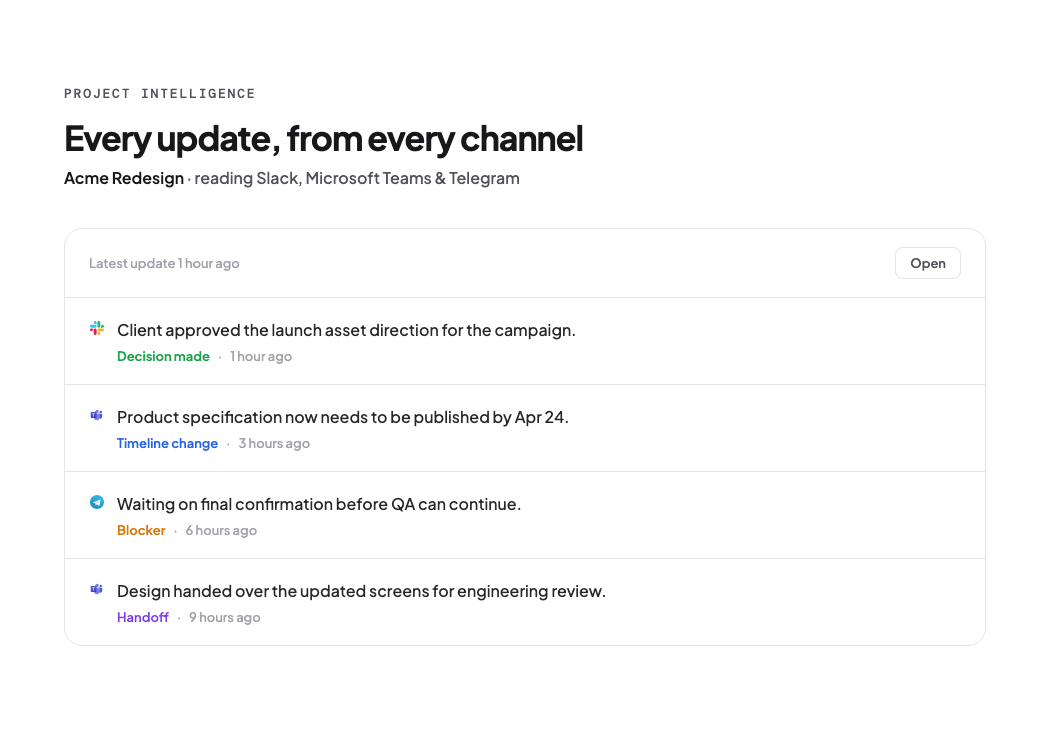
That is exactly the gap Project Intelligence exists to close: it reads the project updates teams already post across Slack, Teams, Telegram, and WhatsApp, and assembles them into one timeline so leaders can answer "where are we?" without booking another call. When a leader can see what shipped, what is stuck, and what changed by glancing at a single surface, the recurring status meeting stops being necessary — and the two or three hours a week it was taking get returned to the team.
The math is ordinary. Cutting one hour-long weekly status sync returns roughly 260 hours a year for a five-person team — two months of a single person's working life. This complements the role-by-role benchmarks in our meetings-too-many analysis: the teams that look least overloaded are not the ones with fewer topics to coordinate; they are the ones that stopped paying synchronous prices for asynchronous information.
Frequently asked questions
How much time do employees spend in meetings? In 2026, the average remote worker spends about 2.3 hours per day on video calls (roughly 598 hours a year), and 1 in 10 spends five or more hours a day. Weekly meeting time overall is up about 153% since February 2020, per Microsoft Work Trend Index data.
How many hours a week does the average person spend in meetings? Combining the daily video-call benchmark with Microsoft's 153% growth figure implies a typical knowledge worker now spends the equivalent of 10–12 hours a week in scheduled meetings — with remote managers at the top of the range at 2.4 hours per day.
Do remote workers spend more time in meetings than office workers? Yes, especially managers. Remote managers average 2.4 hours a day on video calls versus 1.2 hours for on-site managers — exactly double — and one in ten remote workers exceeds five hours daily.
Why has meeting time increased so much? The shift to hybrid work made the video call the default coordination mechanism; Microsoft measured meeting frequency up 153% globally since the pandemic began. Status updates that once happened in hallways now require scheduled calls, and those calls leave no written record.
The benchmark that matters
Ask the average remote team how many hours a week they spend in calls and the number will cluster around a workday. That is the 2026 reality, and it was not a choice anyone made deliberately — it is what happens when coordination has no other home. The question worth carrying into the next planning cycle is not "how do we cut 20% of meetings" but "how much of our meeting cargo could be a written update instead?" Every status update that lives in a shared timeline instead of a call is a meeting that never had to happen — and a team that gets its hours back.