How Much Time Do Employees Spend on Administrative Tasks? The Real Benchmark by Role
How much time do employees spend on administrative tasks? Across roles it's 10–36% of the week. The real benchmarks by role—and how to cut the admin tax.
It's 9:14 a.m. and you've already replied to a scheduling ping, reformatted an invoice, submitted an expense claim, and re-synced a calendar — before touching the work you were hired to do. That gap between "started the day" and "started the work" is administrative time, and it is the least measured tax on a modern team.
How much time do employees spend on administrative tasks? The honest answer is not one number — it's a range that depends on role, industry, and how "administrative" is defined. This post breaks down the real benchmarks: doctors who lose nearly a fifth of their week to paperwork, managers who spend 3–4 hours a day on admin, and owners who burn 16 hours a week on small tasks that never make it onto a timesheet.
The short version: the average professional spends somewhere between 10% and 36% of their working time on administrative work, and the number has been climbing for a decade.
The admin benchmark nobody quotes
Administrative tasks are the non-production work that keeps operations moving: scheduling, email triage, billing prep, payroll review, expense reports, status updates, and filing. The trouble with measuring them is that every study defines them differently — which is exactly why the range below is so wide.
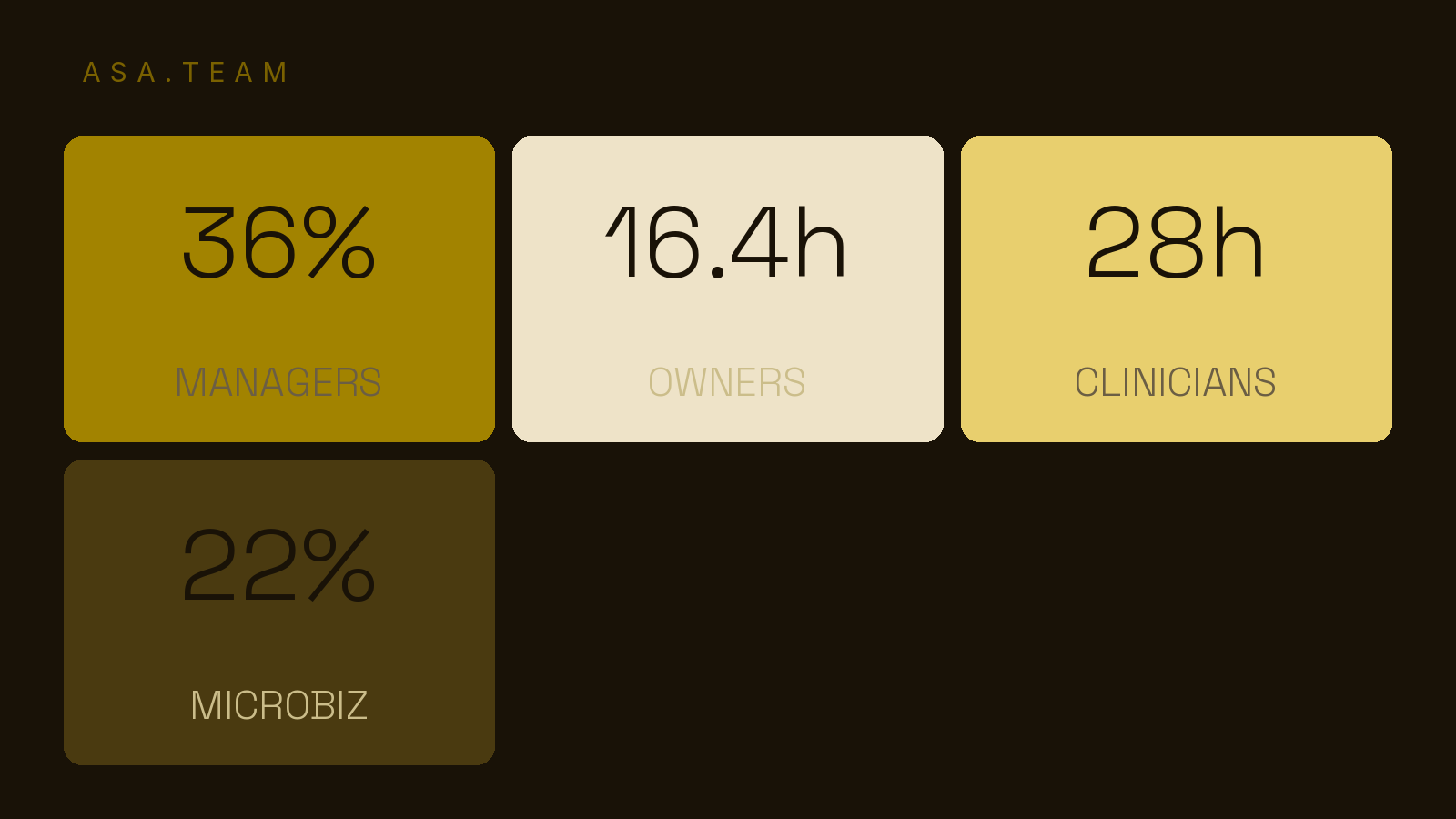
In healthcare, Harvest's time-tracking data shows the burden is heaviest: clinicians spend nearly 28 hours a week on administration, medical office staff average 34 hours, and claims personnel reach 36 hours. A U.S. doctor typically spends 8.7 hours per week on administrative duties — 16.6% of their working hours — and psychiatrists allocate 20.3% of their time to paperwork, leaving less for patients.
For managers, a West Monroe survey of 500 U.S. managers found that 36% spend 3–4 hours a day on administrative tasks like responding to emails and submitting expense claims. A close second — 34% — spend 1–2 hours a day, 23% report 5+ hours a day, and only 7% get away with an hour or less. Almost half (44%) say they are frequently overwhelmed at work, and one in four believes a lighter administrative load is the single change that would let them actually manage people.
| Role | Weekly admin time | Share of work time | Source |
|---|---|---|---|
| Claims personnel | 36 hours | ~70% | Harvest |
| Medical office staff | 34 hours | ~65% | Harvest |
| Clinicians | 28 hours | ~55% | Harvest |
| Psychiatrists | — | 20.3% | Harvest |
| Physicians | 8.7 hours | 16.6% | Harvest |
| Managers (36% of sample) | 15–20 hours | 3–4 hours/day | West Monroe |
| Entrepreneurs | 16.4 hours | 36% of 45.5-hr week | Time etc / Censuswide |
| Microbusiness owners | 13.4 hours | 22.4% | UENI Research |
| Executives | 6–12 hours | 10–20% | HBR |
The pattern is the point: the further you are from direct production work, the more of your week quietly goes to admin. Executives lose a relatively small share of their time — but their 10–20% is the most expensive 300–600 hours a year their company buys.
Why the admin tax keeps climbing
Administrative work is not a fixed cost — it compounds. Every new collaboration tool adds another login to manage, another notification to triage, another status field to keep current. A review of executive time-use research cites Harvard Business Review data placing administrative tasks at 10–20% of total executive working time, and calls out scheduling as the single biggest drain: 4–8 hours a week spent on calendar coordination alone, more than 200 hours a year that a trained assistant could absorb.
The same review points to McKinsey's automation research: roughly 60% of occupations have at least 30% of their activities that are technically automatable with tools that already exist. Yet most teams still do this work by hand — because automating it requires deciding who owns it, and nobody does.
The invisible part is worse than the visible part. A 2023 survey of 251 U.S. entrepreneurs (Time etc and Censuswide) found owners spend 36% of their week — about 16.4 hours — on small administrative tasks, and 99% of them did at least some admin work in a typical week. Logging expenses (59%), conducting research (49%), managing schedules (45%), creating invoices (44%), and entering data (43%) topped the list. These are fifteen-minute tasks, and they add up to two full workdays every week.
Smaller businesses are hit hardest: UENI's 2024 survey of 837 U.S. microbusinesses found administration plus legal and compliance work consumed 22.4% of owner time, against a median 60-hour workweek. A fixed compliance burden — the IRS estimates 40–50 hours for a small business's federal filing — spreads across fewer people in a five-person firm, so each owner absorbs more of it.
Admin time is regressive: the smaller the team, the larger the share of everyone's week that goes to keeping the business running instead of doing the work.
What actually eats the hours
It's worth being precise about where the hours go, because "administrative tasks" is a bucket, not a task. Everhour's time-tracking team defines the category as internal work that supports operations rather than direct production: scheduling, billing prep, payroll review, internal coordination, vendor communication, and reporting. Their sample week: 3 hours on payroll review, 2 hours on scheduling, 1.5 hours on invoice prep — 6.5 hours of admin against 32 hours of client delivery before the week even starts to feel productive.
Managers carry a double load. The West Monroe data shows the same people who are supposed to be coaching, reviewing, and unblocking are instead spending their scarcest resource — the uninterrupted morning block — on the inbox and the expense queue. When 23% of managers report 5+ hours a day of admin, their direct reports absorb the cost in slower decisions: a request sits, waiting for the manager to surface from the paperwork. That is not a productivity quirk; it is a structural tax on anyone whose role sits between the work and the person who pays for it.
Two measurement traps make the problem worse than the raw hours suggest:
- The denominator changes. Compare admin hours to total working time and you get an operations burden metric; compare them to billable hours and you get a margin metric. The same 6.5 hours looks like 17% or 20% of the week depending on which you pick.
- One-off events distort the average. A payroll correction week, quarterly tax prep, or a system migration spikes admin time without signaling a real shift in the workload. Track the regular weekly average separately from the exceptional crunch.
This is why "just use a timesheet" is not a fix: end-of-week reconstruction reliably forgets the 12-minute vendor reply and the 18-minute approval review. The admin tax survives time tracking because the small tasks are the ones people forget to log.
What good looks like
The teams that actually tame administrative overhead don't hire their way out of it — they change where status and answers live. Reporting disappears when a project's current state is visible without asking. Scheduling shrinks when the coordination layer stops being a back-and-forth. Expense, invoice, and payroll busywork automates once a process owner exists.
That is what Project Intelligence is for: it watches project updates in Slack, Teams, Telegram, and WhatsApp and turns them into a single readable status feed — so the answer to "where is this at?" is already visible instead of generating another round of status-chasing email. Time lost hunting for information and time lost in Slack both feed the same admin bucket — and both shrink when the project picture lives in one place.
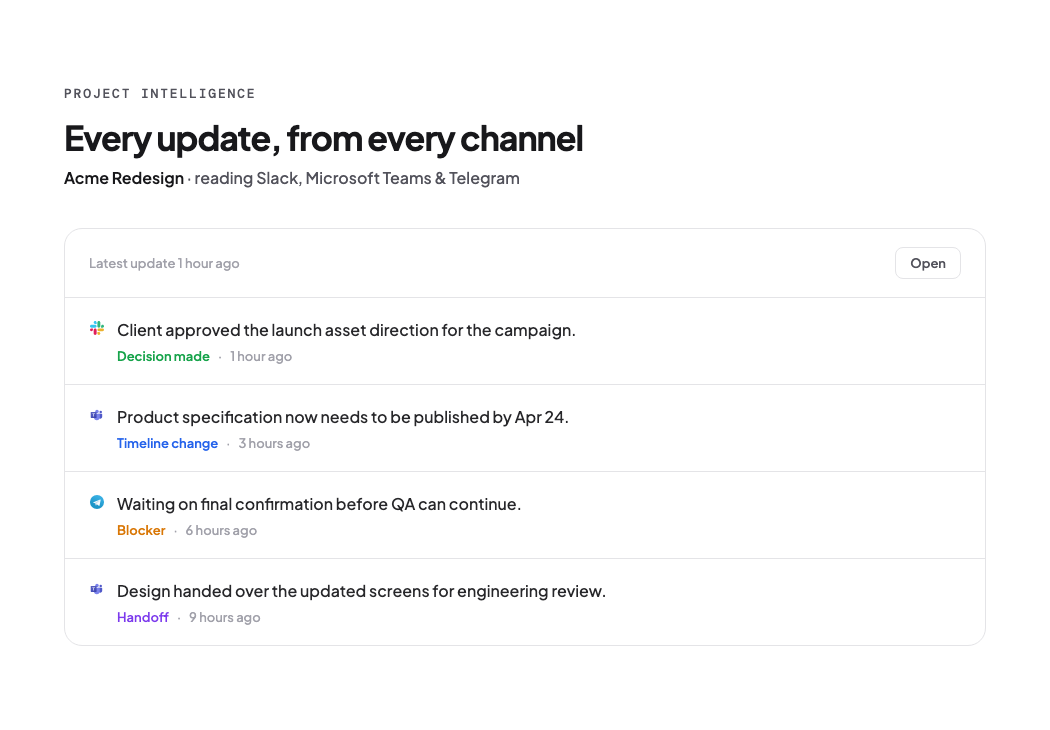
The operational target, benchmark aside, is simple: subtract the recording-and-chasing layer, and the admin share of the week drops toward the 10% floor instead of the 36% ceiling. That matches the pattern across every study — the firms with a visible, current project state are the ones whose admin hours stay low.
Frequently asked questions
How much time do employees spend on administrative tasks on average? Across roles, the defensible range is 10–36% of working time: executives lose 10–20% (HBR), managers commonly spend 1–4 hours a day (West Monroe), physicians spend 16.6% (Harvest), and entrepreneurs reach 36% of a 45.5-hour week (Time etc / Censuswide). There is no single "average" because the definition and the denominator change between studies.
Which administrative tasks take the most time? Scheduling and calendar coordination lead for executives (4–8 hours a week per Calendly/Doodle data), while owners report expense logging, research, and invoice creation as their top recurring admin (Time etc 2023). Email triage is the common thread across every role.
How can a team reduce administrative time? Three moves repeat across the studies: track a baseline week instead of guessing, separate the regular weekly average from one-off crunch, and move status reporting out of one-to-one asks into a visible shared view — the last one is where Project Intelligence fits.
The question of how much time employees spend on administrative tasks has no single answer — but that's the correct answer. The useful benchmark is the spread: 10% to 36% of the week, with the low end belonging to teams that made their work visible and the high end to teams still running on status asks, manual invoices, and calendar ping-pong.
Your team is somewhere on that curve. The question worth asking this week is not "how disciplined are we?" but "how much of our admin is actually coordination work that could simply be visible?" If the status meetings, status emails, and status-chasing disappear, most of the 16 hours goes with them — and the work you were hired to do comes back.