How Many Hours Do Employees Spend on Email? The Real Weekly Benchmark
How many hours do employees spend on email? Roughly 11 hours a week — more than a quarter of a 40-hour workweek. Here's the benchmark, what that time is made of, and what good looks like.

How many hours do employees spend on email? The honest, research-backed answer is roughly 11 hours a week — more than a quarter of a 40-hour workweek, once you count triage, drafting, and the recovery time after every interruption. It's 9:04 a.m. and you've already "answered" forty messages you didn't compose, skimmed a hundred more, and decided what can wait. The inbox isn't a communication tool anymore; it's the workday's biggest silent line item. The number matters because it isn't fixed: it compounds with every notification, every "just checking in" thread, and every status question that should have been answerable without an email. Below, the benchmark, what that time is actually made of, and what good looks like when leaders stop treating the inbox as the place where work happens.
The benchmark: about 11 hours a week, triangulated three ways
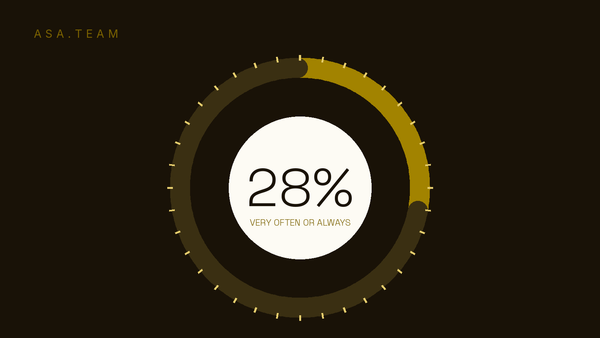
The most-cited figure in this territory comes from McKinsey's research on the social economy, which found that professionals spend about 28% of the workweek on email — 11.2 hours out of a 40-hour week, or roughly 2.2 hours a day. That number is from 2012, but it keeps getting confirmed rather than refuted.
In 2023, Slack commissioned a survey of 8,000 small-business employees in the US and UK. NY Post reported the results: the average employee spent 10 hours and 47 minutes a week just drafting emails — 112 messages a week at roughly five and a half minutes each. Drafting alone, before reading the 120-plus messages arriving daily. In 2025, another workplace survey pegged knowledge workers at 11.7 hours per week processing email, and a breakdown of that time puts the picture in proportion.
| Source | What was measured | Result |
|---|---|---|
| McKinsey social-economy research | Share of workweek spent on email | 28% — about 11.2 hours/week |
| Slack survey via NY Post (2023) | Time drafting emails, 8,000 small-business employees | 10h 47m/week; 112 emails drafted |
| 2025 workplace survey | Knowledge-worker email processing time | 11.7 hours/week |
| Microsoft Work Trend Index | Intentional email activity in Microsoft 365 | 15% of work time; 8.8h/week for top 25% |
The one number that looks smaller — Microsoft's finding that email takes 15% of the average employee's time in its 365 apps — measures only intentional email activity and excludes the recovery cost of switching in and out of the inbox. Microsoft itself frames the larger picture: the average employee now spends 57% of their work time communicating — email, chat, and meetings — and just 43% creating. Email is the largest single slice of that 57%. The thoughtful range for "how many hours do employees spend on email" is therefore 9 to 12 hours a week for most roles, and higher for managers.
What the 11 hours are actually made of
Email time isn't one block of focused writing. Break down a typical inbox day and you get a stack of small, draining activities. One analysis of the daily inbox routine puts it this way:
- Triage: 45–60 minutes scanning subject lines and deciding what matters — 120-plus micro-decisions before any real work.
- Reading: 45–60 minutes on messages that are longer than they need to be.
- Composing: 60–90 minutes writing replies; a professional email takes 3–5 minutes to compose.
- Search and recovery: 20–60 minutes hunting for old threads — plus the 23-minute refocus cost researchers at UC Irvine measured after every interruption.
The volume underneath that routine is staggering. The average professional receives 120–150 emails a day, and faraday.email's time-tracking analysis notes that each one — even the ones dismissed in a second — costs a decision. People check email an average of 15 times a day, and 42% of workers check it 3–5 times daily, on top of the dozens of notifications the average person already gets each day. Each check is an interruption, and each interruption taxes the deep-work time the entire organization depends on. The searching slice alone is its own tax: employees spend hours a week hunting for information — much of it buried in old email threads.
Microsoft's Work Trend Index adds the consequence: 64% of people say they struggle to find the time and energy to do their job, and 68% report not having enough uninterrupted focus time. That's the real cost of the benchmark. The 11 hours on email aren't just hours; they're the hours that fragment everything around them. Focus time doesn't survive 15 daily trips to the inbox.
Why the number keeps climbing for the people who decide things
The benchmark has a tier problem: the people who carry the most project context absorb the most email. Missive's analysis of email time among knowledge workers found that managers and communication-heavy roles land at 12–14 hours a week, versus 8–10 for individual contributors. Over a year, the average office worker spends 400–500 hours on inbox work — ten to twelve full working weeks. A manager carrying five workstreams spends closer to a month and a half of pure inbox time.
Here's the uncomfortable part: most of that email exists because status wasn't visible somewhere else. "Quick update?" "Where are we on X?" "Can you confirm?" — each one is a tiny coordination request that got sent because the answer lives in someone's head. It's the same coordination tax that makes status update meetings burn through the week: when progress isn't visible, people schedule a meeting or send a thread to find it. The 2023 Slack survey found employees delete or ignore emails based on subject line alone about eight times a day. Meanwhile, Inbox Zero's review of email-time research reports that roughly half of inbox volume is newsletters, notifications, and pure junk — email that exists to be filtered, not read. The inbox has become a coordination tax with a high processing fee: heavy volume, heavy cognitive load, and a long recovery period every time you dip in.
This is not an argument that email is evil. It's an argument that email is the wrong default for anything that repeats — and the most repeated email in most companies is the status question.
What good looks like
Teams that escape the 11-hour inbox don't become email purists; they move recurring coordination out of the inbox and into a place where status is visible by default. Three shifts consistently work:
- Batch, don't drip. Two or three scheduled email sessions a day, notifications off in between. The world does not end if a reply takes two hours.
- Kill the "just checking in" thread. If a status question gets asked weekly, it's a signal the answer should be somewhere the team can see it without asking.
- Make status an artifact, not an event. When project updates live in a shared channel — with who did what, and what's blocked — the email thread asking "where are we?" stops existing.
That third shift is where tools earn their keep. Project Intelligence is built around exactly this: it surfaces project updates from the channels teams already use — Slack, Teams, Telegram, WhatsApp — so leaders see progress without requesting it. The status question that used to generate a five-message email chain becomes a card that updates itself. The inbox keeps its real job: external communication, decisions with paper trails, and things that genuinely need a thread.

The goal isn't inbox zero. It's an inbox where every message earns its place, because the coordination load moved somewhere better. Teams that make this shift report the email benchmark dropping to a fraction of the old number — not because they answered faster, but because there was less to ask.
The 11-hour email week is mostly coordination in disguise: the same status questions, asked one thread at a time, because the answers weren't visible anywhere else.
Frequently Asked Questions
How many hours do employees spend on email per day? Most estimates land between 2 and 2.6 hours a day for knowledge workers — about 11 hours across a five-day week. Managers and communication-heavy roles run higher, at 12–14 hours weekly.
How many emails does the average employee receive per day? Research puts it at 120–150 incoming messages daily, of which a significant portion are newsletters, notifications, and automated mail that require triage rather than thoughtful replies. Employees draft roughly 100–120 emails per week.
Is the 28% of the workweek figure really accurate? The 28% figure comes from McKinsey's research on the social economy and has been triangulated since: a 2023 Slack survey of 8,000 employees measured 10 hours 47 minutes of drafting alone, and a 2025 survey measured 11.7 hours of email processing for knowledge workers. Microsoft's narrower measurement — intentional email activity in its apps — comes in at 15% of work time, which excludes drafting in other clients and the refocus cost of switching.
What's the fastest way to reduce time spent on email? Batch email into two or three sessions a day, turn off inbox notifications during focus blocks, and move recurring status conversations into a shared channel where updates are visible without asking. The status email chain is the most removable email there is. See it in action on the Asa.Team demo.
The inbox is a coordination tax — the question is what you're paying for
The benchmark is settled: employees spend over a quarter of their workweek in email, and the number has been stable across a decade of studies. What varies is the response. One team treats the inbox as weather — something to endure — and keeps paying 11 hours a week in triage, drafting, and refocus time. Another treats it as a symptom: every status thread that recurs is a process failure, and every "where are we?" is a signal that visibility broke somewhere.
Before you read another batch of messages, ask the question that matters more than the benchmark: how much of your inbox exists only because status wasn't visible somewhere else? The teams that answer it stop asking — and get hours back every week. That's a better metric than inbox zero anyway.