How Many Hours Do Small Business Owners Work? The Real Founder Workweek
How many hours do small business owners work? The research-backed answer is more than you think — and the more uncomfortable finding is what those hours are made of.
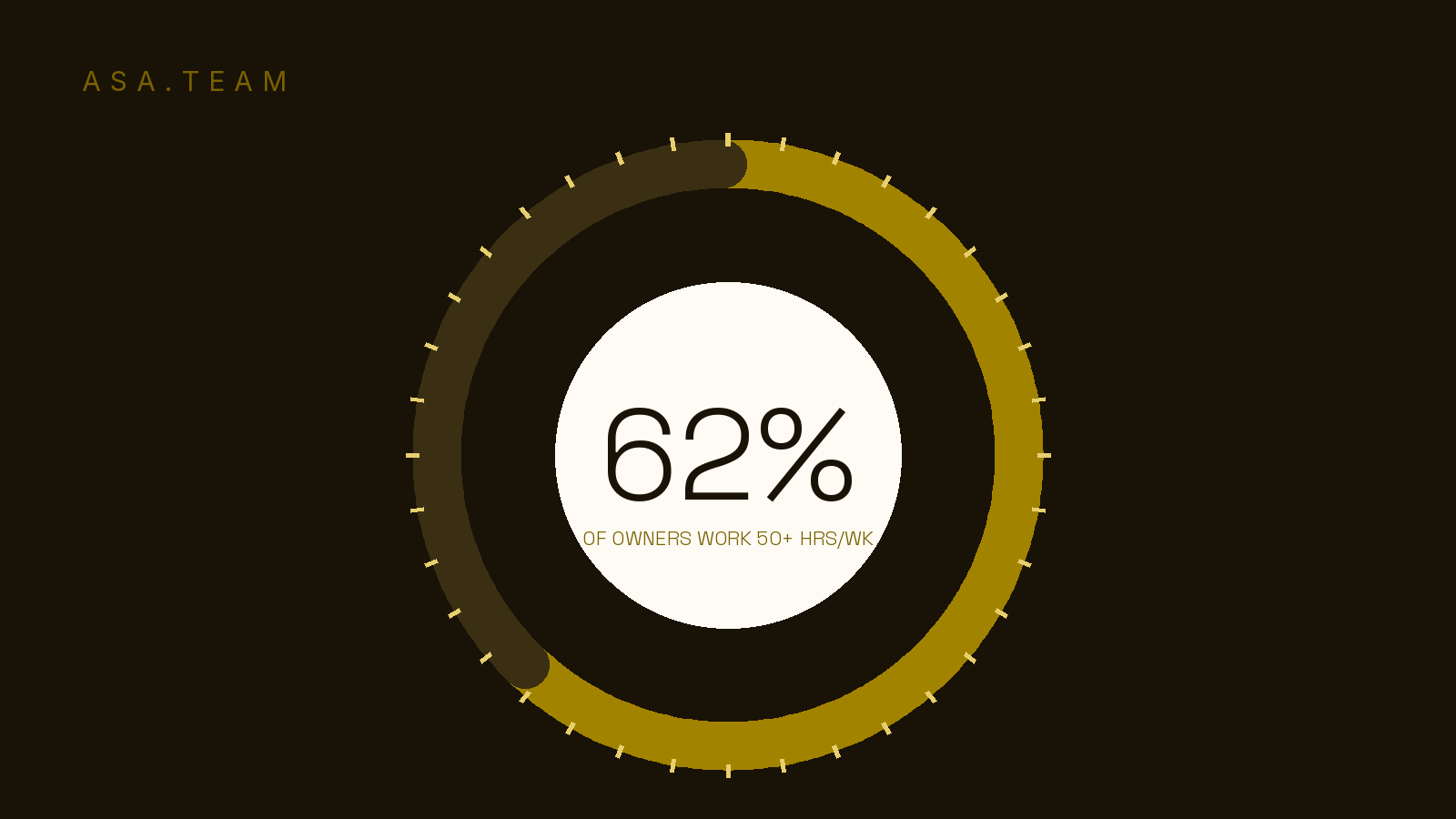
How many hours do small business owners work? The research-backed answer is more than you think — and the more uncomfortable finding is what those hours are made of. Gallup's long-running small business index puts the average owner's workweek at 52 hours, with nearly two in three owners clocking 50 hours or more. Yet when you break that week apart, a third of it never touches the business itself: it disappears into email, paperwork, scheduling, and the quiet admin tax of ownership. This post gives you the real benchmarks, shows where the hours actually go, and explains why the founders who fix this don't just work fewer hours — they work on the right ones.
The benchmark: a 50-hour week is the default, not the exception
Every serious survey of small business owners lands in the same territory. The Wells Fargo/Gallup Small Business Index found that 62% of small business owners work 50 or more hours each week, putting the average at 52 hours — and 57% work six or more days per week. That was not a one-off: the New York Enterprise Report, cited by SCORE, found owners work roughly twice as much as regular employees, with 33% reporting more than 50 hours a week and 25% more than 60.
The comparison with employees makes the gap visible. In the 2025 American Time Use Survey, full-time employed people worked an average of 8.1 hours on the days they worked — roughly a standard 40-hour frame. Owners live in a different arithmetic. Venturu's analysis of the surveys shows only 33% of owners fit inside a 40-49 hour week; 30% work 50-59 hours, and 19% cross into 60 or more. Add the weekend layer the Inc. study quoted by Patriot Software surfaced, and 70% of small business owners work at least one weekend on a regular basis.
The consistent picture across studies:
| Source | Finding on owner work hours |
|---|---|
| Wells Fargo / Gallup Small Business Index | 62% work 50+ hrs/wk; average 52 hrs; 57% work 6+ days |
| New York Enterprise Report (via SCORE) | Owners work ~2x employees; 33% over 50 hrs; 25% over 60 hrs |
| Inc. study (via Patriot Software) | 70% regularly work at least one weekend |
| Venturu aggregation | Only 33% stay in 40-49 hrs; 19% exceed 60 hrs |
None of this is a surprise to anyone who owns a business. The surprise is what happens inside those 52 hours.
The admin tax: where the hours actually disappear
When you ask owners what their week is made of, the answer is not selling, serving clients, or building. It's administration. Venturu's analysis of time-use research found that administrative tasks alone consume roughly 36% of an average entrepreneur's workweek — scheduling, email triage, paperwork, and the unglamorous mechanics of keeping a business running.
The 2026 roundup from Stealth Agents pulls the allocation apart with a sharper lens: 30-37% of a founder's week goes to administrative tasks, 25-32% to client and customer work, 12-18% to sales and business development, and just 8-14% to strategic planning. The asymmetry is brutal. In the McKinsey small business productivity data Stealth Agents aggregates, founders rate strategic planning 9.1 out of 10 in importance — then spend five to six times more hours on the category they rate 4.2: administration.
The average founder spends more hours on email, scheduling, and paperwork than on strategy — while rating strategy the most important thing they could do.
This tracks earlier findings. The same body of research shows solo entrepreneurs spend 68.1% of their time working in the business — handling immediate tasks — and just 31.9% working on it, on growth and strategy. That split is the difference between a job you own and a business you own, and most owners never see it because they experience the workweek as one undifferentiated blur.
The admin tax is also where information hunting lives. The benchmarks on time spent searching for information show workers losing more than an hour a day to it — and for owners, the hunt is worse because the information is scattered across client portals, inboxes, and chat threads no one else maintains. That time counts nowhere, but it is exactly the coordination overhead researchers say workers massively underestimate.
Why the hours don't shrink as the business grows
Common assumption: bring on employees and the founder's week gets sane. The data says the opposite. According to the Hiscox DNA of an Entrepreneur research aggregated by Stealth Agents, solopreneurs average 44-52 hours a week; businesses with 1-5 employees push owners to 52-60 hours; and 6-20 employee companies run 55-65. First Round Capital's founder survey shows seed-to-Series-A founders between 62 and 72 hours. The growth-stage peak is real: hours climb through early revenue and only compress once management infrastructure exists to absorb them.
Why don't owners delegate their way out? Patriot Software's summary of the Alternative Board study lists the reasons owners give: they feel they're the most capable person for the task, their employees don't have the right skills, they're in a hurry, or they simply like doing the work. Each reason is individually rational. Together they create a compounding tax — the owner becomes the bottleneck for exactly the tasks that scale worst.
The cost shows up outside the business too. SCORE's review of the research found only 57% of small business owners take vacations at all, and even then 67% check in with work at least once a day. In Gallup's survey, 39% of owners who took a recent vacation did work-related tasks while away — and 8 in 10 of them made or returned business calls.
And the load has a measurable wellbeing line. A Bank of the West study cited by SCORE found 62% of small business owners say the stress of ownership is worse than they imagined. It compounds with the burnout signs managers miss in distributed teams — the same mechanics of being always-on, always-accountable, always reachable. Founders simply live that state without anyone else holding the pager. And the workload has hard limits: the research on how many projects you can manage at once shows attention fractures well before the 50th hour of a week.
What good looks like
Better isn't working fewer hours by decree — it's changing what the hours contain. The founders who escape the trap don't get more disciplined at email; they get less available to it. Three moves make the practical difference.
First, measure the split, not the total. Track a week in 30-minute blocks and count how many hours went to administration versus client work versus strategy. The gap between expectation and reality is usually the whole problem — founders systematically overestimate strategy time and underestimate the admin tax by multiples.
Second, make status visible without a meeting. Most admin time is not actually work — it's the work of finding out what's happening. Waiting for a status update, chasing a thread, assembling "where does this stand" from five different places: that coordination overhead is what burns otherwise-solid hours. Teams that adopt async report the update as the norm end the week with the same truck of information and a fraction of the chasing.
Third, protect one strategic block ruthlessly. If strategic planning is the 9.1-in-importance category that gets 8-14% of the week, it needs a calendar anchor, not leftover attention. Founders who win do the growth work when they're fresh and route everything else around it.
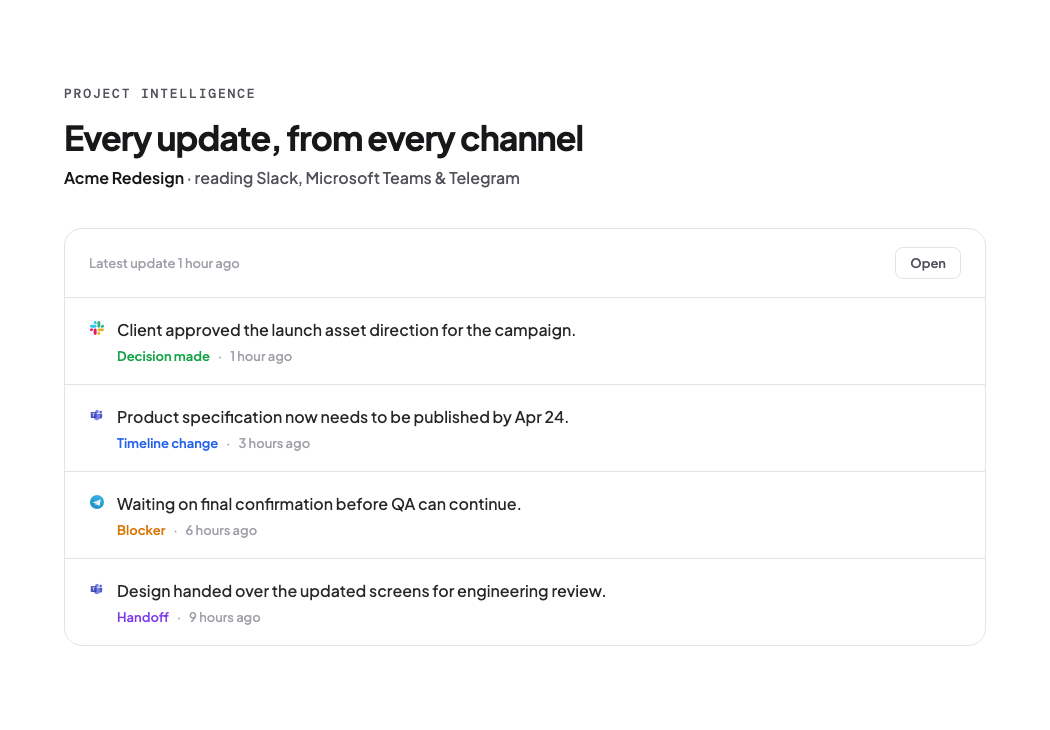
This is precisely where Project Intelligence fits. Asa.Team surfaces project updates from Slack, Teams, Telegram, and WhatsApp — the four channels where work actually happens — and consolidates them into one view, so a founder sees what's on track, what's slipping, and what needs a decision without assembling it by hand. The status-chasing hours go back to the business, and the 30-37% admin block stops eating the 8-14% that matters. For a look at how that works in practice, the interactive demo walks through a week where updates surface instead of being hunted.
Frequently asked questions
How many hours do small business owners work per week? Most surveys land between 50 and 60 hours for the average owner. Gallup's index puts the average at 52 hours, with 62% of owners at 50+ hours and 57% working six or more days.
Do small business owners work more than employees? Yes — roughly twice as much by the New York Enterprise Report measure. Where the average full-time employee works about 8.1 hours on working days, owners routinely add weekend work on top of a 50-hour core week.
Why do small business owners work so much? Three compounding reasons: ownership concentrates responsibility, delegation is hard to execute (skills, trust, urgency), and the administrative burden of running a business — email, scheduling, paperwork — is far larger than founders expect when they start.
Do founder work hours drop as the company grows? Not automatically. Research shows hours climb from solopreneur (44-52) to 6-20 employee companies (55-65), and only compress once management infrastructure — including async status practices — absorbs the coordination load.
The hours were never the point
Every benchmark in this post answers the surface question: how many hours do small business owners work? The deeper answer is that 52 hours is survivable, but a 52-hour week that is one-third administration is a business slowly converting its owner into a clerk. The fix is not counting hours more carefully — it's reallocating them, and the lever that moves fastest is killing the coordination overhead that exists only because status is scattered.
So the question worth sitting with this week is not "how many hours did I work" but "how many of those hours could have been a 60-second glance at a single view?" For most founders, the number is uncomfortably large — and it's the only metric on this page that is entirely fixable.