How Long Does It Take a New Employee to Become Productive? The Real Ramp-Up Benchmark
How long does it take a new employee to become productive? If you've ever hired for a senior role, you know the feeling: you set a 90-day plan, assigned a buddy, and waited.
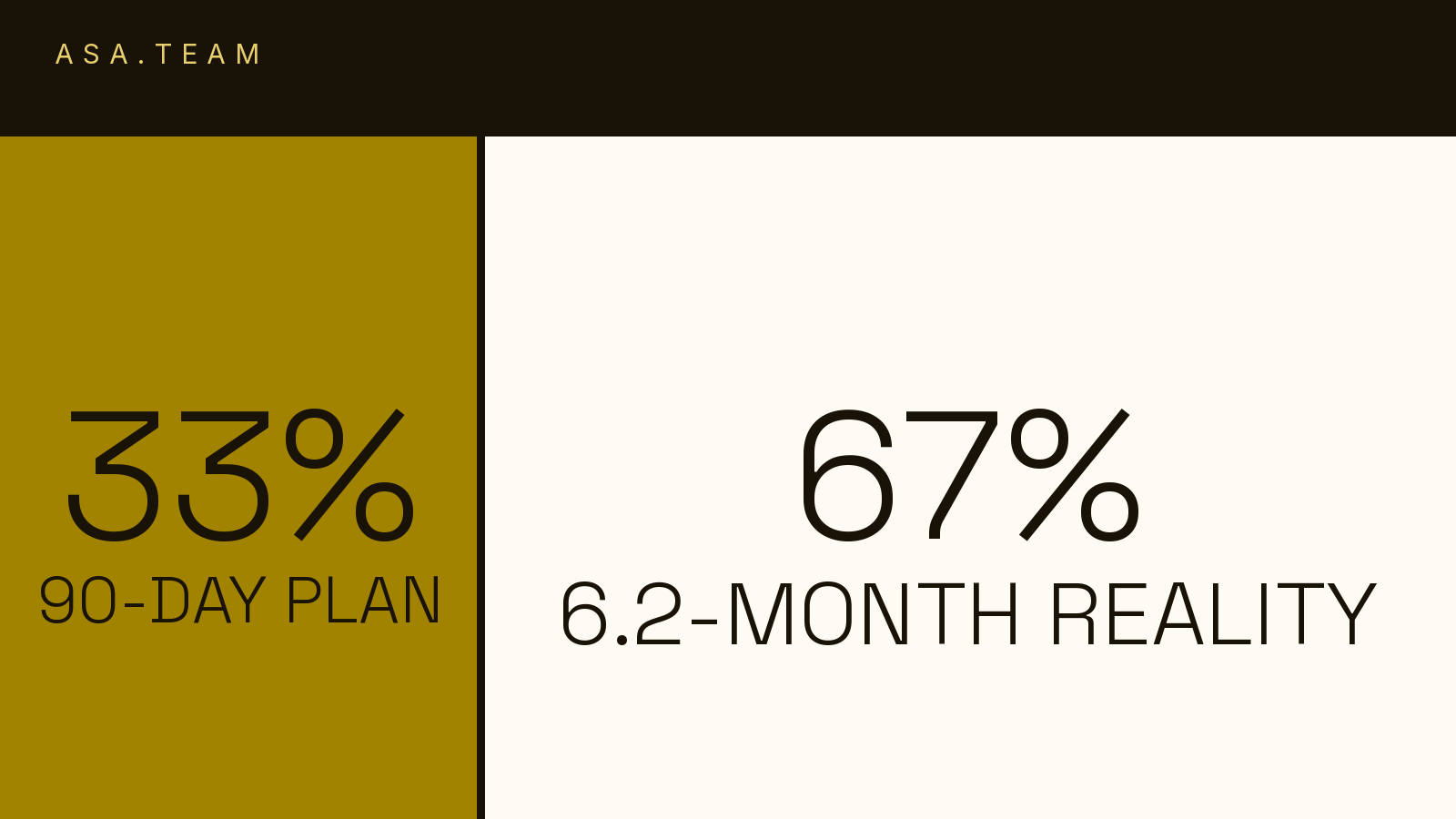
How long does it take a new employee to become productive? If you've ever hired for a senior role, you know the feeling: you set a 90-day plan, assigned a buddy, and waited. Six months later your new hire is still asking where the project decisions live, who owns what, and what actually happened in the last sprint. The person was right. The ramp was wrong.
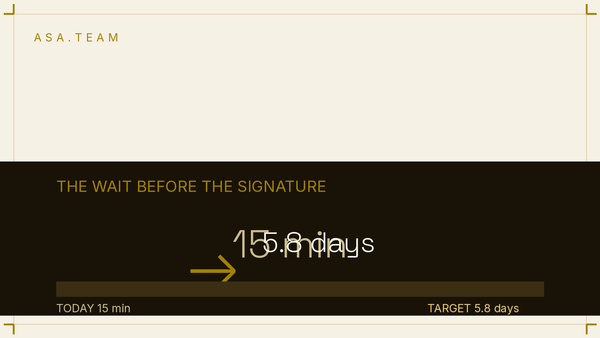
The uncomfortable truth is that the 90-day plan maps onto a six-to-eight-month reality. Benchmark data compiled from SHRM, Gallup, and the BLS puts new-hire time-to-productivity at about six months on average for professional roles — and a year or more for complex and leadership roles. That gap between expectation and reality is not a hiring failure. It is a context problem: people cannot be productive until they can see where the work actually stands. This post gives you the real benchmark, the cost of a slow ramp, and the fix that shortens it — because the number you plan around determines the ramp you actually get.
The Real Benchmark: 6.2 Months to Full Productivity
The most current cross-industry reading is 6.2 months. That figure comes from SHRM human-capital benchmarking as aggregated in the 2026 time-to-productivity roundup, which draws on SHRM, Brandon Hall Group, Gartner, and the Association for Talent Development (ATD). A widely repeated consensus line puts it slightly wider — "six to eight months to full productivity, and 12+ for complex or leadership roles" — citing SHRM, Harvard Business Review, and Gallup research.
The definition of "productive" varies across studies — first useful output, minimum independent performance, and full performance potential are different milestones months apart. But the band is real: most professional hires do not hit full output inside six months, and the range by role matters more than the average.
| Role | Typical ramp to full productivity | Source |
|---|---|---|
| Customer support / operations | 2.8 months | ATD Research |
| Finance / accounting | 4.6 months | SHRM Human Capital |
| Cross-industry professional average | 6.2 months | SHRM Human Capital |
| Software engineering / systems | 7.4 months | Brandon Hall Group |
| Executive leadership | 8.1 months | Brandon Hall Group |
| Enterprise B2B sales | 9.4 months | Gartner Sales Practice |
Read the table as a spread, not a ranking. The same company can have a 2.8-month role and a 9.4-month role sitting a few desks apart. If you benchmark your own hiring against a single number, you will mis-plan half your teams. The role-by-role spread is the benchmark.
Why the 90-Day Plan Is the Wrong Clock
The 30-60-90 format became the default because it is easy to administer, not because it matches how people actually learn a job. The research consistently splits the ramp into two very different phases. A 2026 review of the primary studies notes that Microsoft's research on software teams found skilled hires could match existing contributors within several weeks; LinkedIn reported its employees generally started adding value around six months; and Microsoft Viva's onboarding analysis uses a 12-month window because full performance potential lands at about one year.
None of these studies contradict each other — they are measuring different milestones. The useful summary is: weeks to first output, months to full independence. The 90-day plan only covers the first phase, which is why managers declare onboarding "done" while the hire is still ramping.
Weeks to first output, months to full independence. The ramp does not end at 90 days — it usually has not even passed the halfway point.
The second phase is dominated by context acquisition, not skill acquisition. The same 2026 roundup reports that workers spend 8.2 hours per week searching for internal information and that 47% cite outdated or fragmented documentation as their primary ramp obstacle. This is the same information-hunting tax we documented in how much time employees spend searching for information: when project updates live across Slack threads, chat apps, and shared drives, a new hire's ramp is spent hunting context instead of producing work. It is also why project updates get lost in Slack in the first place — the channel that is supposed to carry status is the same channel that buries it under a hundred other messages a day.
What a Slow Ramp Actually Costs
Slow ramps are not just annoying — they predict attrition. Gallup finds that only 12% of employees strongly agree their organization does a great job onboarding, and cites SHRM's finding that turnover can reach 50% in the first 18 months of employment — with a replacement costing six to nine months of the departed employee's salary to identify and onboard.
New hires are the most fragile cohort in your company. U.S. Bureau of Labor Statistics data from January 2026 shows 20.6% of wage and salary workers had been with their employer a year or less (down from 22.2% in 2024, but still roughly one in five). SHRM's own guidance on measuring onboarding success treats time-to-productivity as a first-class KPI and points out that some organizations lose half their new hires inside 90 days.
The good news is that the ramp responds to structure. The same benchmark roundup reports 34% faster ramps at companies with formalized, multi-phase onboarding, 82% higher first-year retention with structured journeys, and a 42% faster ramp for hires paired with a dedicated buddy. SHRM data adds that employees who experienced great onboarding are 69% more likely to stay three years. Yet 58% of organizations end onboarding after the first week — the exact point where the real ramp is just beginning. The same logic explains why status-update meetings waste so much time: teams keep spending coordination hours re-transmitting project state instead of fixing the underlying visibility gap, and that gap is precisely what extends the new-hire ramp.
What Good Looks Like: Context First, Not Paperwork First
Weak onboarding is a firehose: compliance forms, org charts, and a drive full of docs. Strong onboarding is context-first: the new hire can see what each project is doing right now, why, and who is accountable — without asking five people and reading nine threads. When ramp time is mostly context acquisition, the highest-leverage fix is making project context findable.
This is where Project Intelligence enters a genuine onboarding workflow. Instead of expecting a new hire to reconstruct project state from scattered Slack and chat messages, the team surfaces project updates automatically from the platforms people already work in. The new hire gets a live picture of what each project is doing, what changed, and what is blocked — the same picture your best employee has in their head, without the six-month apprenticeship required to build it.
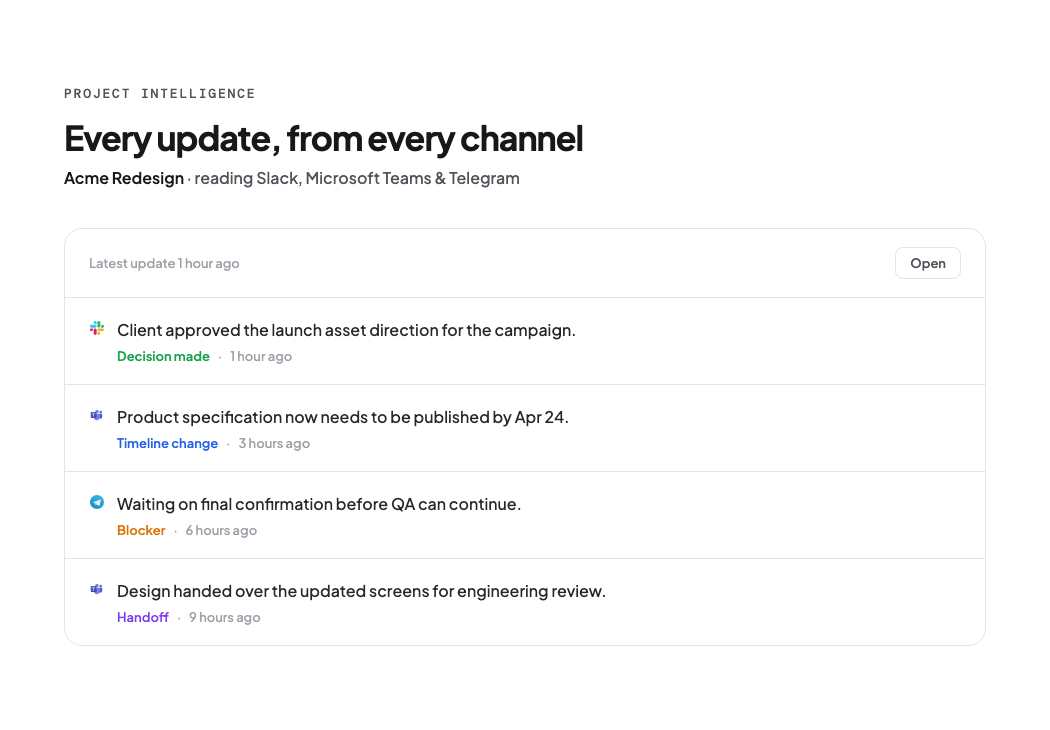
The mechanics matter less than the principle: the context a new hire needs already exists — it is just scattered. Teams that consolidate it cut the single biggest variable in time-to-productivity. Everything else — the 90-day plan, the buddy, the check-ins — works better once the hire can see the actual state of the work. Ramps measured in months shrink when context stops being a scavenger hunt, and the effect compounds: faster ramps mean fewer early exits, which means fewer replacements at six-to-nine months of salary each. Measured per hire, even a one-month ramp reduction is worth more than most onboarding programs cost to run.
Frequently Asked Questions
How long does it take a new employee to become fully productive? On average, 6.2 months for professional roles, with the common range cited as six to eight months. Complex and leadership roles routinely take 12 months or more.
Why does time-to-productivity vary so much by role? The definition of productive differs (first useful output vs full independence), and the role itself matters: customer-support roles ramp in under three months while enterprise sales and senior engineering roles pass nine months.
What actually shortens the ramp? Formalized multi-phase onboarding (34% faster), a dedicated buddy (42% faster), and — most importantly — making project context findable so new hires stop hunting for the information they need.
How do you measure time-to-productivity? Pick a defined milestone ("full performance" means something different per role), record the date each new hire reaches it, and track the median and 75th percentile. Track manager hours spent on the ramp too — that is where the cost hides.
The Ramp Is a Measurement Problem First
The takeaway is not that your hiring is broken. It is that most teams are planning on a 90-day clock for a six-to-eight-month reality, and then wondering why new hires take a year to feel senior. The fix starts with measurement: define full productivity per role, record when people actually reach it, and treat the spread — not the average — as your benchmark.
Then ask the question this data keeps raising: how much of that six months was spent learning the job, and how much was spent trying to find out what the job's status even was? For most new hires, the honest answer is deeply uncomfortable — and it is the part you can actually fix. Your next hire will still take months to ramp. The question is whether those months are spent producing value or chasing context.