What Percentage of Employees Are Engaged at Work? The Real Number
Gallup's latest data shows just 31% of U.S. employees are engaged at work in 2025, down from a 36% peak in 2020 — and only 20% globally. Here are the real numbers and what's driving the decline.
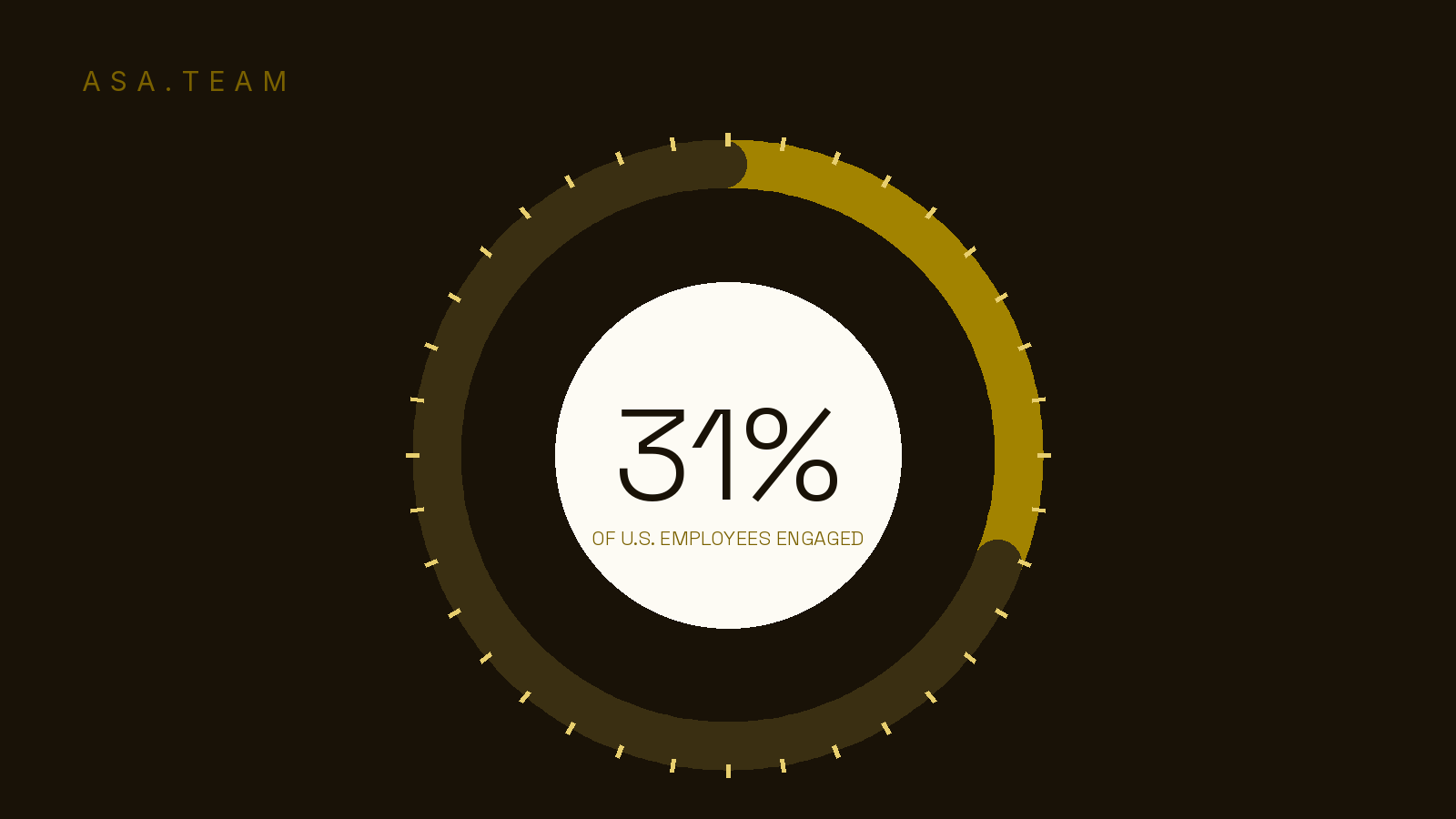
What percentage of employees are engaged at work? The honest answer is lower than most leaders assume. Your weekly one-on-one runs long. People are hitting deadlines, answering in Slack, showing up to the review. Everything looks normal — so it's easy to assume the team is engaged. Then a resignation lands out of nowhere, and you start wondering if you missed something obvious.
You probably did. Employee engagement is measurable, and the real percentage is much lower than most leaders assume. Gallup's annual survey of U.S. workers found that 31% of employees were engaged at work in 2025 — unchanged from a decade-low 2024 and down from a high of 36% in 2020. Globally the picture is worse: just 20% of workers worldwide are engaged, the lowest since 2020. Two-thirds of your team may be physically present but psychologically disconnected, and the trend is headed the wrong way.
This article breaks down the real employee engagement numbers: the current U.S. and global percentages, how they've moved since 2020, what's actually driving the decline, and what managers who hold engagement near the world-class threshold (~70%) do differently.
Key insight: engagement is not a personality trait of your team — it's a management output. Gallup finds managers account for at least 70% of the variance in team engagement, and the single biggest driver of the current decline is that expectations have gone vague.
How Many Employees Are Engaged at Work? The U.S. Number
Gallup has tracked U.S. engagement with its Q12 survey since 2000, and the headline number has been sliding for five years. Actively engaged employees — those who are involved in, enthusiastic about, and committed to their work — averaged 31% in 2025, according to Gallup's January 2026 analysis of its annual engagement survey.
That sits below the 36% peak reached in 2020, which capped a decade of steady growth. Since then, engagement has declined in most years. Each percentage point of U.S. engagement represents roughly 1.6 million employees, so the drop since 2020 equates to about 8 million fewer engaged workers — including 3.2 million fewer compared with 2023 alone.
Dig one year deeper and the story is starker. In Gallup's January 2025 report, engagement finished 2024 at 31% with 17% of employees actively disengaged — the worst reading since 2014 and the first time both figures matched that year's levels. For context, engagement in 2000 was 26% with 18% actively disengaged. The U.S. essentially gave back a decade of progress in five years.
The composition matters as much as the headline. Gallup splits respondents into three buckets: engaged, not engaged, and actively disengaged. The "not engaged" middle — employees who show up and do the work but feel no real commitment — makes up roughly half of the workforce, and it's the group that drives turnover risk when job markets improve. Only about three in ten workers are genuinely engaged, and the share of actively disengaged workers hasn't fallen below 15% in over two decades.
Who's falling fastest is also telling. Engagement among Gen Z and younger millennials dropped eight points since 2020, and older millennials fell nine — the largest of any generation. In 2024 alone, Gen Z workers were five points less engaged than the year before, with the sharpest declines on the most basic elements: clarity of expectations, recognition, being provided the materials to do the work, and having someone care about their development. The workers who entered the workforce most recently are the ones feeling the ambiguity most acutely.
What About Global Engagement? The Worldwide Number Is Worse
If 31% feels low, the global figure will reset your expectations again. In 2025, 20% of employees worldwide were engaged while 16% were actively disengaged, per Gallup's employee engagement indicator tracking its annual World Poll of more than 100 countries.
The global number has now declined two years in a row to its lowest level since 2020, with no region of the world improving over the past year. South Asia saw the largest drop, down five percentage points. Because each point of global engagement represents roughly 21 million employees, the decline compounds quickly.
Regional spreads are enormous and worth knowing before you compare your team to "average":
| Region | Engaged | Note |
|---|---|---|
| Uzbekistan | 46% | Highest country in Gallup's 2026 State of the Global Workplace report |
| U.S. and Canada | 31% | Highest major region, still below its 2020 peak |
| Global average | 20% | Down two years in a row; lowest since 2020 |
| Europe | 12% | Lowest major region Gallup tracks |
| Egypt and Pakistan | ~4% | Lowest countries measured |
Gallup estimates low engagement cost the world economy approximately $10 trillion in lost productivity in 2025 — about 9% of global GDP. That figure makes the abstract "engagement problem" concrete: a workforce that is two-thirds disconnected is a structural drag on output, not a soft HR metric.
The global decline is also a warning about how dispersed work interacts with engagement. In 2025, job-market optimism fell five points among fully remote workers and 14 points among remote-capable employees forced back on-site, while hybrid workers saw no change. And the rise of AI is adding a new layer of ambiguity: 18% of U.S. employees now say it's likely their job will be eliminated in the next five years because of automation — a figure that climbs to 23% in organizations where AI has been implemented, and to nearly a third in finance, insurance, and technology. Uncertainty about the future lands on the same axis as unclear expectations: people disengage when they can't see what's next.
Why Engagement Keeps Falling: Clarity, Care, and Communication
The decline isn't random noise — Gallup's analysis points to three specific elements of the work experience that have deteriorated most since 2020, and they should sound familiar to anyone running a dispersed team.
1. Role clarity has collapsed. Just 46% of employees strongly agree they know what's expected of them at work, down from 56% in March 2020 — the single largest drop of any Q12 item. When expectations are ambiguous, engagement doesn't just dip; it compounds daily across every status check, handoff, and deadline.
2. People feel less cared about. The share who strongly agree someone at work cares about them as a person fell from 47% to 39% over the same period. The decline is worst among younger workers: Gen Z and younger millennials were 13 points less likely than in 2020 to feel cared about (41% vs. 54%).
3. Communication is the first thing employees ask for. When Gallup asked what would most improve clarity, 35% of respondents said better communication from leadership and management — far ahead of direction (7%), development (6%), or recognition (5%). Employees described wanting "greater transparency from management regarding firm strategy, goals and decision-making" and "more regular, consistent communication from my manager."
Managers are part of the problem, not just the solution. Only 31% of managers report being engaged themselves, and Gallup estimates managers account for at least 70% of the variance in team engagement. Globally, manager engagement has fallen toward the level of the people they lead, eroding the "engagement premium" managers historically held.
Here's the part most leaders haven't connected yet: the same Gallup analysis finds that clarity about what exceptional performance looks like is one of the strongest engagement levers available. Employees who strongly agree their manager defines excellence are nearly four times more likely to be engaged than those who don't. Yet fewer than a third of leaders — and only about one in five of everyone else — strongly agree they have a clear definition of exceptional performance for their role. Most teams are running on vague expectations, and engagement pays for it daily.
What Good Looks Like
The counterexample exists. Gallup's data shows world-class organizations sustain engagement near 70% — more than double the current U.S. average. The companies at that level didn't add ping-pong tables; they fixed the same fundamentals the declines are exposing: clear expectations, visible progress, and consistent communication.
The practical version looks like this: a leader who makes project status visible in the tools the team already lives in — Slack, Teams, Telegram, WhatsApp — instead of requiring people to chase updates across five platforms. When expectations are explicit and progress is surfaced automatically, the ambiguity that drives disengagement has nowhere to hide.
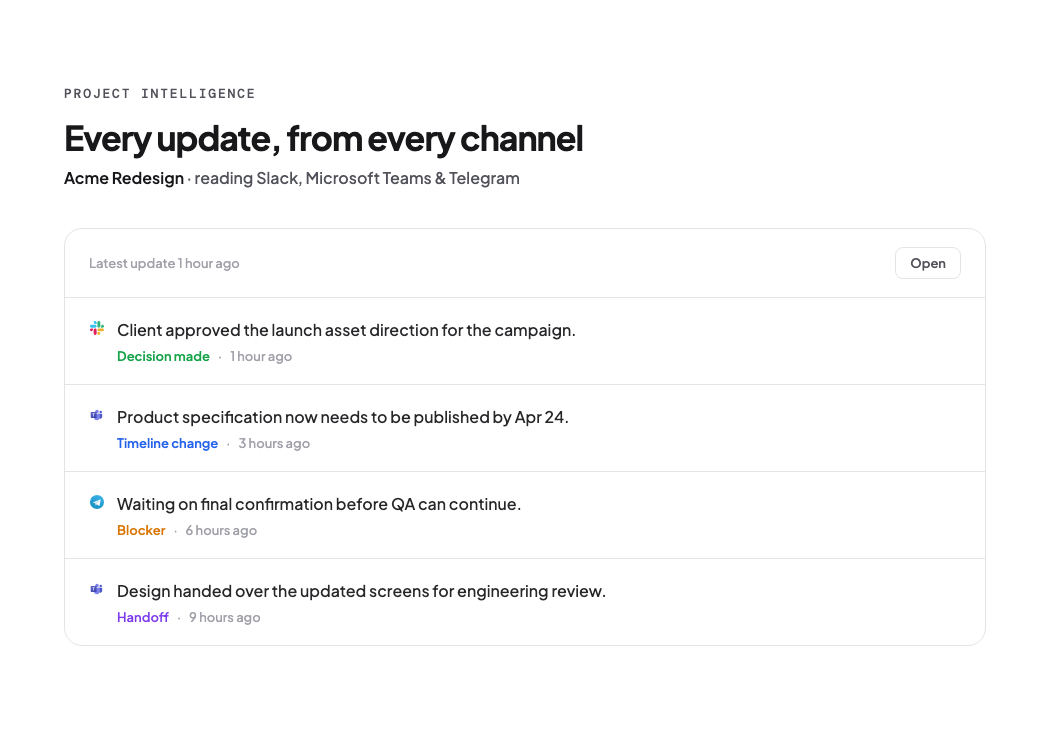
Notice what's absent from that formula: more meetings. The data doesn't say people want more status calls — it says they want regular, consistent communication and clarity about what's expected. The teams that hold engagement while going async are the ones where the work itself is transparent: anyone can see a project's current state, what changed, and what's next, without having to ask. That transparency is what turns "I think this is what I'm supposed to be doing" into "I know exactly where my work stands."
That's the gap Project Intelligence in Asa.Team is built to close: it pulls updates from the messaging platforms teams already use and turns scattered chatter into a coherent status view, so leaders keep the thread without adding another meeting or dashboard to maintain. When the team's project context is unambiguous, engagement stops bleeding out one unclear expectation at a time.
Frequently Asked Questions
What percentage of employees are engaged at work? In the U.S., 31% of employees were engaged at work in 2025, according to Gallup. Globally, the figure is 20%. Both numbers are at or near their lowest levels since 2020, and the U.S. figure matches the 10-year low recorded in 2024.
How many U.S. employees are actively disengaged? Gallup measured 17% of U.S. employees as actively disengaged in 2024 — the worst reading since 2014. The "not engaged" middle group makes up roughly half of the workforce, meaning only about three in ten workers are genuinely engaged.
Is employee engagement going up or down? Down. U.S. engagement peaked at 36% in 2020 and fell to 31% by 2024-2025. Global engagement declined for the second consecutive year in 2025, with no region of the world improving. South Asia dropped the most, by five percentage points.
What is the biggest cause of low employee engagement? The clearest signal in Gallup's data is declining clarity: only 46% of employees strongly agree they know what is expected of them at work, down from 56% in March 2020. Employees themselves point to communication — 35% said better communication would most improve clarity of expectations.
How much does low engagement cost? Gallup estimates low engagement cost the world economy roughly $10 trillion in lost productivity in 2025, or about 9% of global GDP.
Conclusion
The percentage of employees engaged at work is 31% in the U.S. and 20% globally — and both numbers have been falling since 2020. The declines trace to things leaders can actually act on: expectations that have gone fuzzy, people who feel unseen, and communication that happens everywhere except where it matters.
Look at the number you can control: how clearly your team knows what's expected, and how easily they can see where the work stands. If a project's status lives only in someone's memory or a thread nobody reads, that ambiguity is a direct cost to engagement. What would change on your team if the work were simply more visible?