Remote Team Burnout Signs Managers Miss (And How to Catch Them Early)
Remote team burnout rarely announces itself. The signs arrive as quiet pattern changes in async teams — here's how managers can spot them early and cut the friction driving them.
Remote team burnout rarely announces itself. No one sends a Slack message saying "I'm burning out" — the signs arrive as small, quiet changes that are easy to miss when you never see your people in person. A teammate's status update slips from a confident paragraph to a terse line. Their messages come later in the day. They stop offering opinions in threads they used to lead.
For a manager, each of those signals on its own looks like nothing. Together, they're the early arc of burnout in a distributed team — and by the time someone says the word "overwhelmed" out loud, the damage has usually been compounding for months.
The stakes are real: Gallup found that about two-thirds of full-time employees experience burnout on the job at some point, and burned-out workers are 2.6 times as likely to be actively looking for another job. Burnout also bleeds into performance long before anyone quits — burned-out employees are 63% more likely to take a sick day and report roughly 13% lower confidence in their own performance. This post breaks down the remote team burnout signs managers actually miss, the forces quietly driving them, and how leaders can catch distress before it turns into attrition.
Burnout is rarely a sudden collapse. It's a slow, quiet shift in how someone works — and it only becomes visible once you start watching the pattern instead of the mood.
Why burnout hides in remote and async teams
Burnout is an occupational phenomenon — the World Health Organization formally classified it in 2019 as a state of chronic workplace stress that hasn't been successfully managed. Notice what's absent from that definition: it doesn't require a visible meltdown. In an office, you'd notice a colleague arriving earlier and earlier, snapping in meetings, or staring blankly at lunch. In a remote team, the physical and behavioural cues simply aren't there.
What replaces them is text. And text is remarkably good at hiding exhaustion. An async update written at 11pm by a drained person can look identical to one written at 9am by an energised one — same formatting, same vocabulary. The content says "all good," so the manager records it as status and moves on. That's precisely the failure mode why project updates get lost in Slack: the medium flattens the signal that would otherwise warn you.
Then there's the "always-on" problem. Because remote work blurs the boundary between the office and home, the load doesn't visibly drain during a commute or wind down. Microsoft's Work Trend Index found 54% of employees felt overworked and 39% said they felt exhausted — and the always-available expectation only makes that worse. The exhaustion is real, but it's wearing invisible clothes.
The remote team burnout signs managers actually miss
Once you stop expecting a dramatic collapse, the early tell becomes pattern change. Here are the shifts worth watching for, in roughly the order managers notice them:
- Thinner updates. Richer status notes become one-liners, and context quietly disappears. It looks like laziness; it's usually depleted energy.
- Later response times and odd hours. Work spilling past midnight or arriving on weekends is a switch-off problem, not a scheduling quirk.
- Fewer opinions. The person who used to push back or volunteer stops engaging in threads — a withdrawal, not agreement.
- Busywork creep. They start defaulting to reactive "work about work" and stall on the deep, high-judgment tasks they used to own.
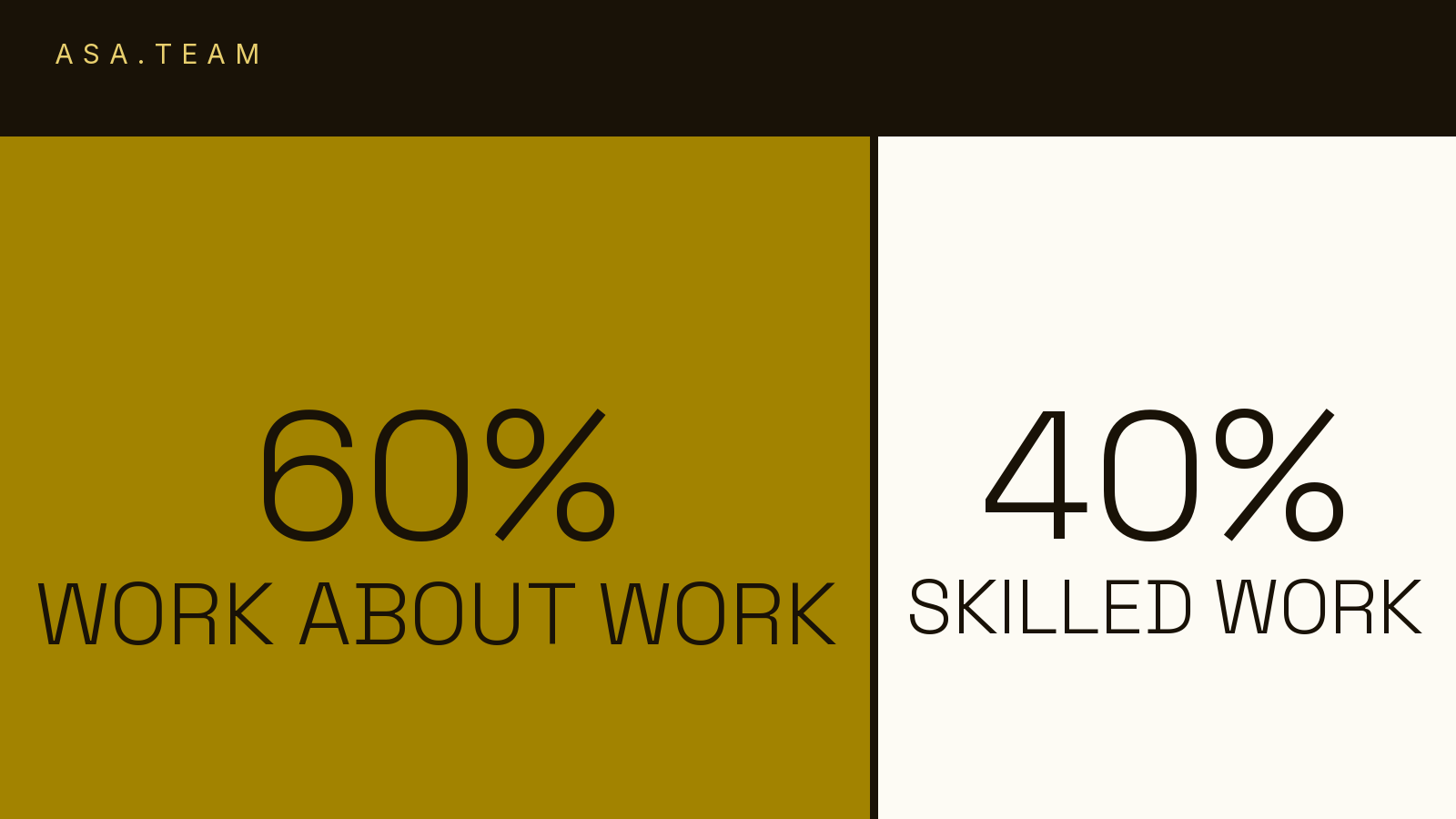
This last one is the strongest measurable signal. Asana's Anatomy of Work research found knowledge workers spend roughly 60% of their day on "work about work" — searching for information, chasing updates, switching between apps — rather than the skilled work they were hired for, and that this load has pushed people toward "chaos, confusion, and burnout" while making it harder to switch off at the end of the day. A sharp rise in status-chasing and busywork, paired with a drop in real output, is burnout's fingerprint in an async team.
None of these signs are about "bad attitude." They're the downstream cost of overload that leadership hasn't been able to see.
What's actually driving the overload
It's tempting to blame "long hours" or "lazy employees," but the strongest drivers are structural. Three forces keep stacking:
- Context-switching fatigue. Fragmented updates force people to re-derive the project state over and over. Every tool switch and status chase is a small tax — the cost of tool sprawl accumulates in the background, mostly invisible to leadership.
- Meeting and status-report load. Too much of the week goes to recounting work instead of doing it. As our breakdown of why status update meetings waste time shows, reporting overhead is a leading source of the "work about work" that empties people out.
- Ambiguous ownership. When nobody can tell who's responsible for what, everyone picks up the slack — and a few conscientious people quietly absorb it all.
Notice the common thread: much of the exhaustion isn't the work itself, it's the friction around the work. That's good news, because friction is more fixable than the actual substance of a heavy workload.
| Healthy pressure | Burnout warning |
|---|---|
| Updates stay informative even in busy weeks | Updates shrink to one line and lose context |
| Consistent, reasonable working hours | Late-night and weekend activity becomes routine |
| Active participation in team discussions | Withdrawal from threads and fewer opinions |
| Deep work delivered on time | Reactive busywork replacing real output |
| Takes time off and returns refreshed | Rarely switches off; feels guilty about rest |
What good looks like
Catching burnout early doesn't require more surveillance — it requires better visibility into the friction that produces it. The teams that handle this well stop relying on people to self-report and instead watch the load itself: how much time actually goes to status-chasing, whether hours are creeping past normal working windows, and whether the same few people keep absorbing ambiguous work.
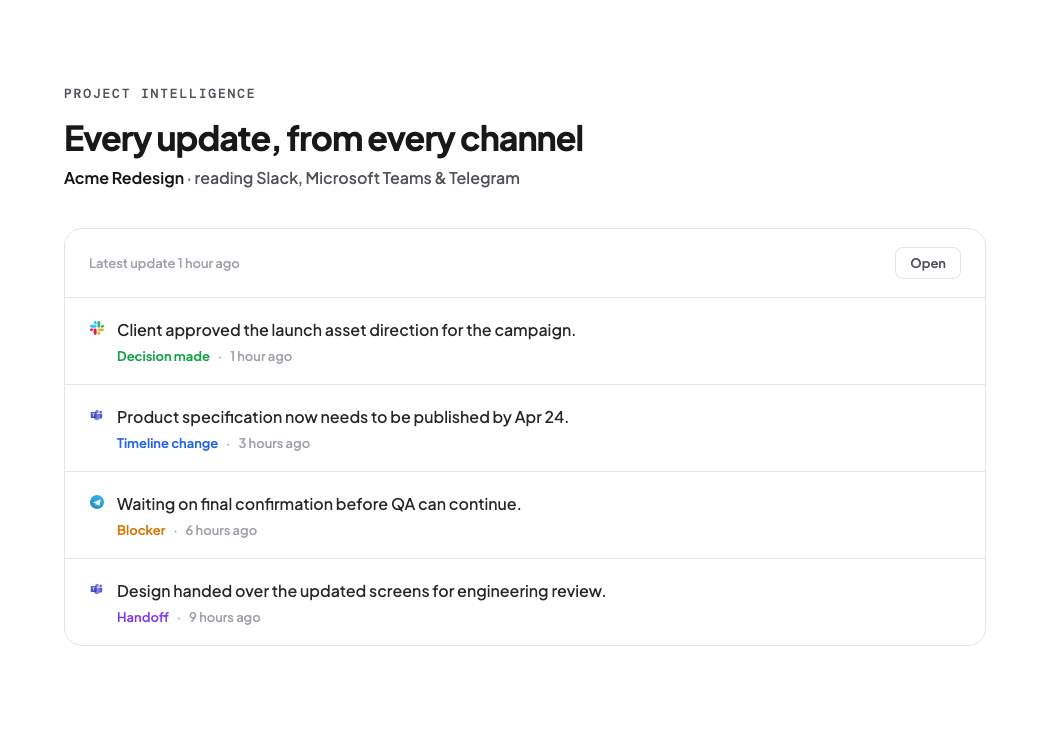
That's exactly where Project Intelligence fits. Instead of making leaders chase updates across Slack, Teams, Telegram, and WhatsApp, it surfaces project updates from all of them in one place — so the "work about work" shrinks and nobody has to ask "what's the status?" over and over. When a lead can see the whole picture without interrupting anyone's focus, the friction that silently burns people out has nowhere to hide.
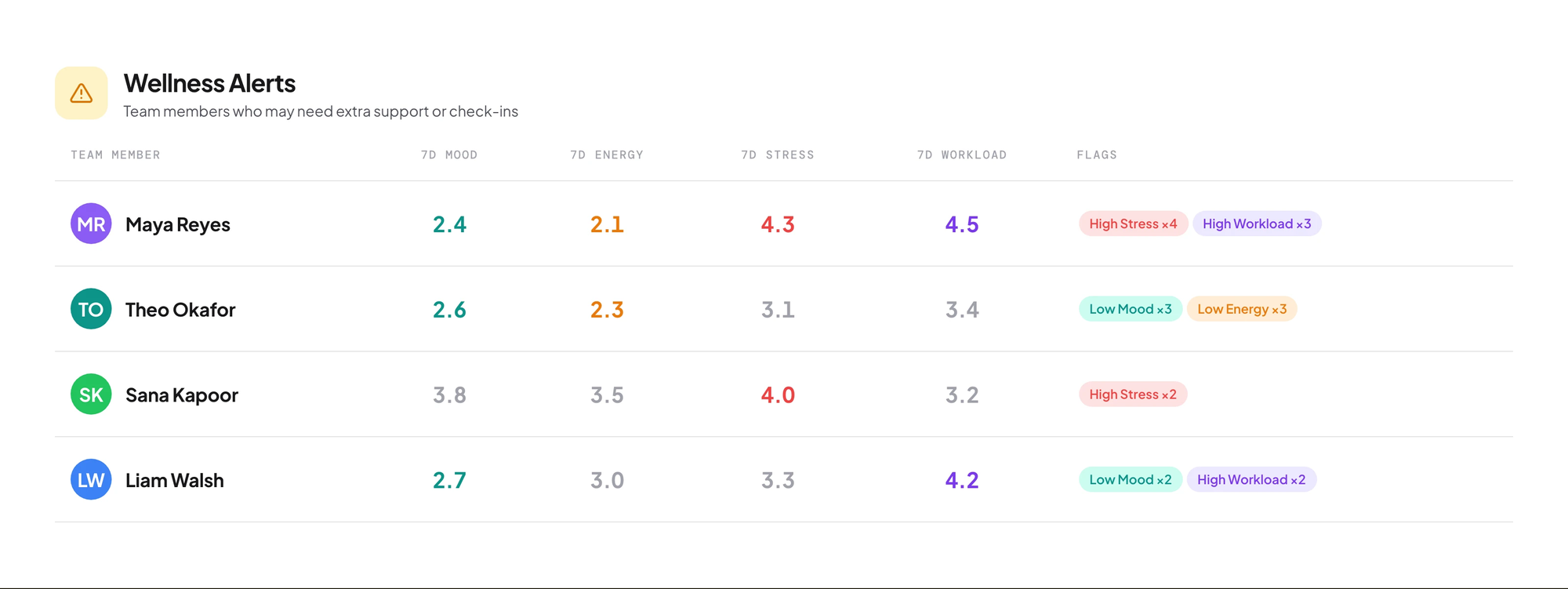
Asa's burnout alerts act on the same principle, flagging signal-deterioration patterns like unusual late-night activity before a person reaches the point of quitting.
None of this replaces empathy or a real workload conversation. But it turns "I hope everyone's okay" into something a manager can actually act on — early, calmly, and without a crisis.
Frequently asked questions
What are the most common remote team burnout signs?
The most common are thinning status updates that lose context, work creeping into late nights and weekends, withdrawal from discussions, and a shift from deep work toward reactive busywork. These are pattern changes over weeks, not single bad days.
Is remote work itself causing burnout, or is it something else?
Remote work doesn't burn people out on its own — it removes the boundaries and office cues that used to reveal and limit overload. The drivers are usually structural: excessive context-switching, reporting overhead, and ambiguous ownership. Microsoft's research found 54% of employees felt overworked, pointing to workload and friction rather than the location itself.
How can managers spot burnout when they rarely see people live?
Watch the evidence in the work, not the mood: update depth, response timing, participation, and whether output is shifting from deep to shallow tasks. Then watch the load itself — hours, status-chasing time, and consistently uneven distribution of work — because that's where the warning shows up first.
Can project-tracking tools actually help prevent burnout?
They help when they reduce friction. A tool that surfaces project updates automatically from wherever the team already communicates cuts the status-chasing that fuels "work about work," and can flag workload and activity patterns early. Tools are a support, not a replacement for real conversations about capacity.
Wrap-up
Remote team burnout is measurable before it's visible — it shows up as thinner updates, creeping hours, quieter threads, and a slow slide into reactive busywork long before anyone says the word. The managers who catch it aren't the ones with uncanny intuition; they're the ones who stopped relying on people to announce their own distress and started watching the friction instead.
The next time a normally detailed teammate sends a one-line update, resist the urge to file it as "all good." Ask what's changed. And ask yourself whether your reporting process is adding to their load or lifting it — because the teams that fix the friction tend to keep their people, and the teams that don't, find out too late. The question isn't whether your remote team will stress-test you; it's whether you'll notice quietly enough to do something while there's still time.