What Is the Average Time to Hire? The Three-Clock Benchmark
The average time to hire in 2026 is 46 to 63 days — but small firms average 83.5 days. The disagreement between the clocks is where the recoverable time lives.
Ask three recruiters what the average time to hire is and you'll get three different numbers. One will say 44 days, one will say 46, and one will swear it's closer to two months. They're all correct. The hiring timeline isn't one clock — it's at least three, and which one you're watching decides whether you think your hiring is fine or broken.
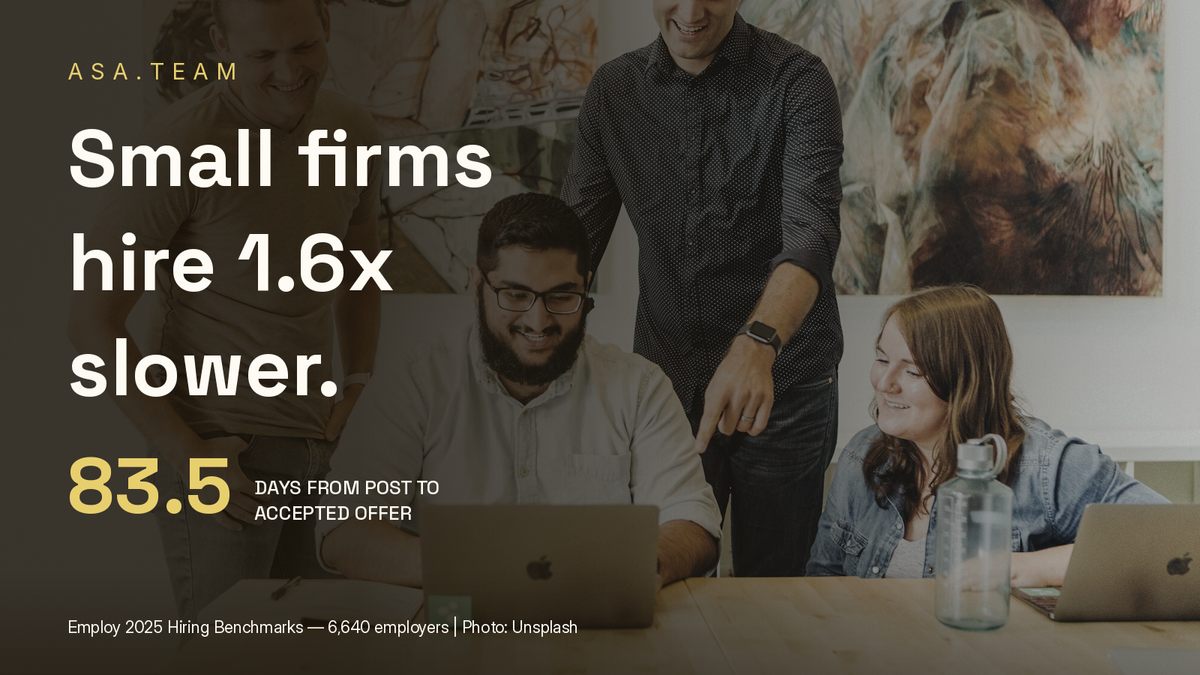
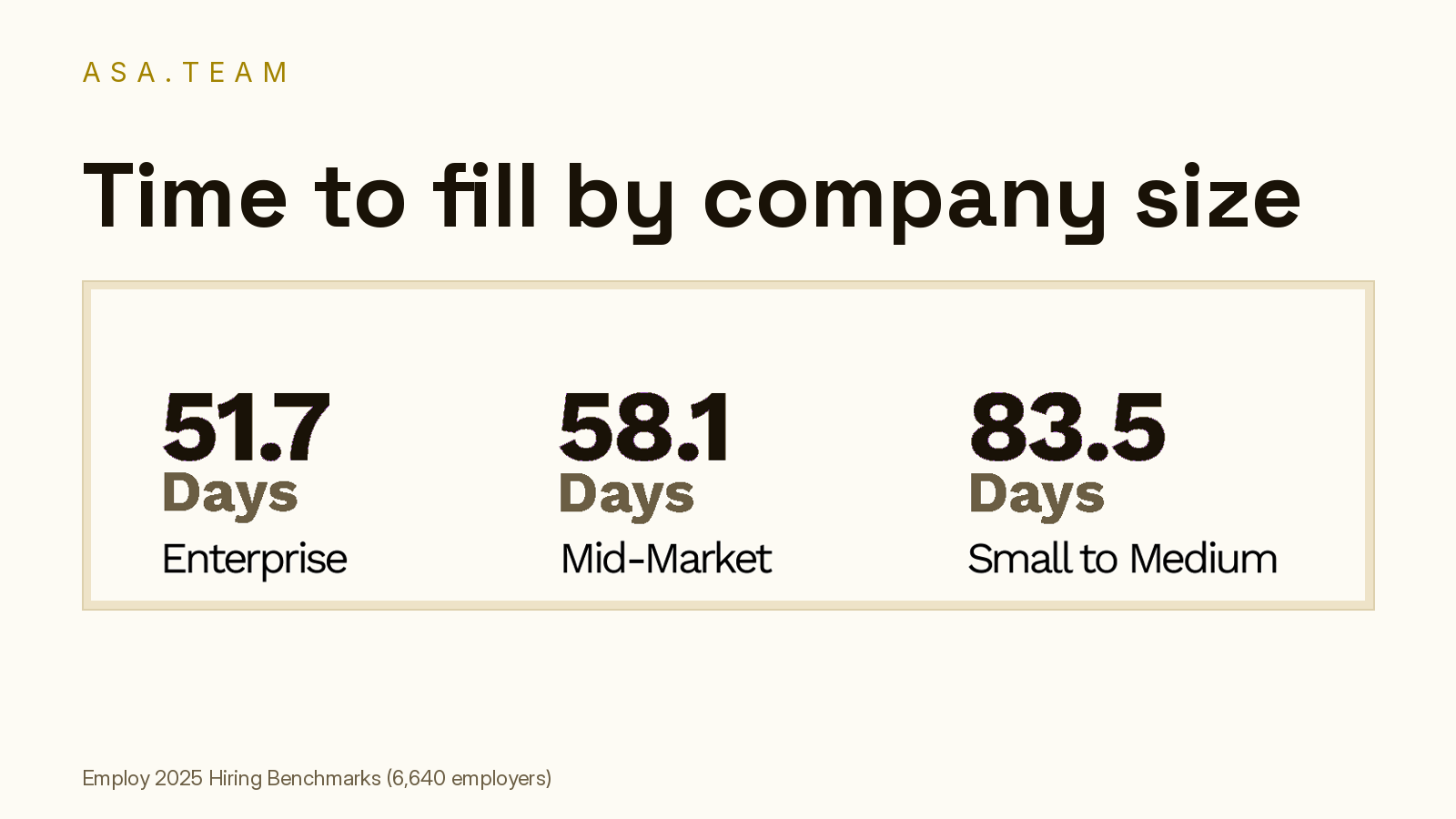
For a founder or a small team lead, this matters more than it does at enterprise scale. The latest benchmark data shows small and mid-sized companies take 83.5 days from posting to accepted offer, versus 51.7 days at enterprise companies — the small team is more than 60% slower at the one process it runs least often and can least afford to stall. Here's what the real numbers say, where the days actually go, and what a better hiring clock looks like.
Three clocks disagree about the average time to hire
The first thing to understand is that "time to hire" means different things depending on who's measuring. The Society for Human Resource Management has drawn the distinction for years: time to fill counts from the day the requisition opens; time to hire counts from the day the candidate enters your pipeline. Those two clocks routinely disagree by two and a half weeks on the same hire.
| Clock | What it measures | 2025–2026 benchmark |
|---|---|---|
| Requisition clock (time to fill) | Job posted to offer accepted | 63.5 days (down from 67.7 in 2024) |
| Candidate-interaction clock (time to hire) | Candidate's first touch to accepted offer | 46.2 days (45.7 in 2024) |
| ATS benchmark clock | Greenhouse customer roles, time to fill | 62 days; 194 applications per hire |
| Perception clock | What hiring managers feel | 93% say hiring takes longer than two years ago |
The first two figures come from Employ's 2025 hiring benchmark report, covered by HR Dive, spanning software and technology, business services, retail, hospitality and manufacturing. The gap between the 63.5-day requisition clock and the 46.2-day candidate clock is the first thing worth noticing: roughly two and a half weeks per hire pass while the opening technically exists but the candidate hasn't entered the process yet. That is dead time, and in a small company it's usually where a hiring project quietly stalls.
Greenhouse's own recruiting benchmarks put time to fill at 62 days, with 194 applications behind each accepted hire and 33% of roles ending up unfilled. And the perception clock is unambiguous: Robert Half surveyed nearly 2,200 U.S. hiring managers in June 2025 and found 93% said hiring takes longer than it did just two years ago, with 92% calling skilled talent hard to find. When almost everyone feels the process stretching, the averages aren't an artifact.
Small teams are the slow ones — and that's the whole story
The most important number in the 2026 hiring data is the one that splits companies by size. Employ's report found small- and medium-sized companies averaged 83.5 days between posting and accepted offer, while enterprise companies averaged 51.7 days. Small teams aren't slower because candidates move slower. They're slower because hiring is the one project at a small company with no project manager.
Inside an enterprise, hiring runs on rails: a recruiter owns the pipeline, an ATS enforces stage transitions, and decisions escalate on a schedule. Inside a ten-person firm, the same process lives in a founder's inbox, an interview-panel Slack thread, and a shared spreadsheet that everyone assumes someone else updated. Nobody chases the interview feedback because everyone knows the founder is heads-down on client work — so the requisition ages while the pipeline sits in limbo. Sound familiar? It's the same waiting-queue tax we measured in approval bottleneck statistics, just wearing a recruiting costume.
Seniority compounds the problem. The Resource's 2026 compilation aggregates these averages by level:
- Entry-level: ~46 days
- Mid-senior: ~60 days
- Manager: ~75 days
- Director: ~90 days
- Executive: ~120 days
Technical candidates now spend an average of 23.3 hours in interviews before an offer lands, according to the same compilation. Multiply that by the small-company premium and a single senior hire routinely eats a quarter of the year — while the founder's other five workstreams keep running. The vacancy itself has a cost curve too: every day the seat sits empty, the existing team absorbs the load, and overload quietly becomes the replacement cost problem all over again.
Where the days actually go
Take an 83.5-day small-company hire and open the hood. The interview loop itself is not the budget item — scheduling and interviews are visible, scheduled, and defended. The invisible days cluster in four places:
The pre-touch gap. The requisition exists, but nobody has owned it since the kickoff conversation. Twenty-plus days can pass between posting and first meaningful candidate contact, because sourcing is a task without a deadline.
Feedback collection. Four interviewers, four opinions, zero forced timing. Candidate feedback scattered across email threads and DMs is why decision meetings get postponed "until we hear from Dave." You've seen this movie — it's the same math as the shadow work around meetings: the work around the event costs more than the event.
The decision queue. The offer decision waits on the one person who has the full context: the founder. When that approval is one message in a busy channel rather than a tracked project state, it waits.
The offer-to-start drift. Candidate clock and requisition clock diverge most here — notice periods, renegotiations, ghosting. Employ's earlier research found that new hires who quit within their first 90 days cited a mismatch between what interviews promised and what the role delivered — slow, context-free processes damage retention too, and a cold handoff at the start of employment drags out the time-to-productivity clock that starts after day one.
The first 90 days are critical; once people connect with their teams and settle into their roles, they're far more likely to stay. — Employ 2025 hiring benchmarks report, via HR Dive
What good looks like
The teams that beat the 83.5-day average don't hire faster by scheduling more interviews. They hire faster by treating the open role as a first-class project — with an owner, a status, and a weekly cadence — instead of a side quest.
In practice that means four habits. One owner per requisition whose job is the pipeline, not the interviews. A feedback deadline: interview scorecards in within 24 hours of the conversation, or the loop stalls on purpose. A decision SLA: every candidate leaves each stage with a next step and a date. And a visible status: anyone on the hiring team can see where every candidate sits without asking. The parallel to client delivery should be obvious — if you wouldn't run a client onboarding on "everyone assumes someone else is chasing it," don't run hiring that way either.
The leverage point is the hiring working group itself. In most small teams, interview feedback lands in a Slack channel and interview scheduling happens over WhatsApp or Teams — which means the real hiring status already exists, it just lives in chat logs nobody re-reads. This is exactly what Project Intelligence does: it reads the update traffic across Slack, Teams, Telegram and WhatsApp and turns it into a live project status, so the founder sees "two offers out, one decision blocked on finance, feedback missing from one interviewer" without sending a single "any update?" ping. Applied to a hiring pipeline, it converts the 83.5-day mush of status-free waiting into a tracked board with visible blockers.
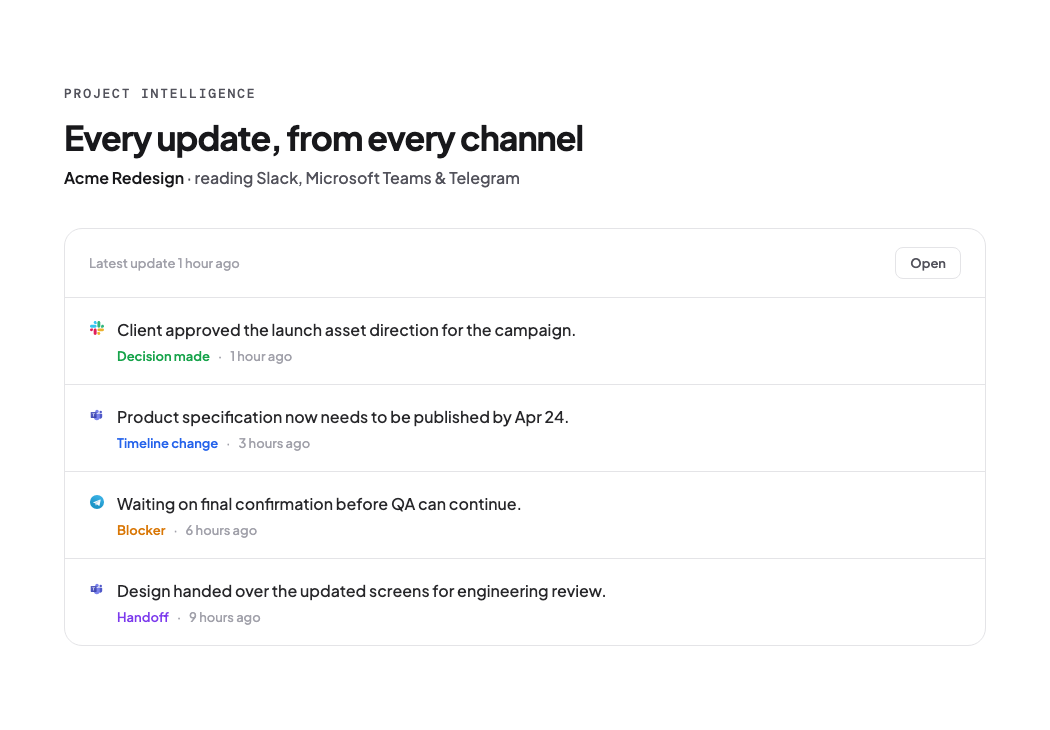
The point isn't that software adds discipline. The discipline is deciding the requisition is a project. The software just makes the status real enough that nobody has to chase it. If you want to see what that looks like on a real board, the product demo walks through exactly this view.
Frequently Asked Questions
What is the average time to hire in 2026? Expect roughly 46 days measured from the candidate's first interaction, and about 63 days from job posting to accepted offer. Small and mid-sized companies run materially slower at 83.5 days on average, while enterprise companies average 51.7 days.
What is a good time-to-hire benchmark for a startup? For non-executive roles, anything under 40 days from posting to offer accepted puts you ahead of both the SMB average and the enterprise average. Track it per requisition, not as a monthly average, so a single stalled search doesn't hide inside the mean.
What's the difference between time to hire and time to fill? Time to fill counts from the day the job opens to the day the offer is accepted. Time to hire counts from the day the hired candidate first entered your process. The gap between them — about two and a half weeks on current 2025 data — is time when the role exists but nobody is moving it.
Why does hiring take so long at small companies? Because no one owns the pipeline. Interview feedback, scheduling and offer decisions live in email and chat with no deadline attached, and the decision consistently queues behind the founder's client work. Treating the requisition as a tracked project with a status and an owner closes most of the gap.
Watch the right clock
The average time to hire is not one number, and arguing about which average is "real" misses the useful insight: the disagreement between clocks is where the recoverable time lives. The two-and-a-half weeks between the requisition clock starting and the candidate clock starting. The week a decision waits on one busy person. The feedback that never arrived. None of it is recruiting skill — it's project tracking applied to the project everyone forgets to track.
So here's the question worth stealing: if you posted your most important open role today and someone outside your company asked "what's the current status and what's blocked?", could anyone answer in under a minute? If not, your hiring process isn't slow because of the market. It's slow because it's invisible — and invisible work is always the work that takes 83.5 days instead of 40.
Sources
- Employ, 2025 Hiring Benchmarks Report (6,640 customers) — time to fill 63.5d avg (from 67.7 in 2024); 83.5d for 0–249 employees vs 51.7d for 1,000+; time-to-hire (first touch to offer) 46.2d.
- HR Dive, coverage of the Employ 2025 report — independent confirmation of the same figures.
- Greenhouse, Hire Standard benchmarks — 62 days to fill a role, 194 applications per hire.