How Often Do Employees Receive Feedback? The 30-Point Perception Gap
Gallup: 50% of managers say they give weekly feedback, but only 20% of employees say they get it. What the feedback frequency data really says — and what closes the gap.
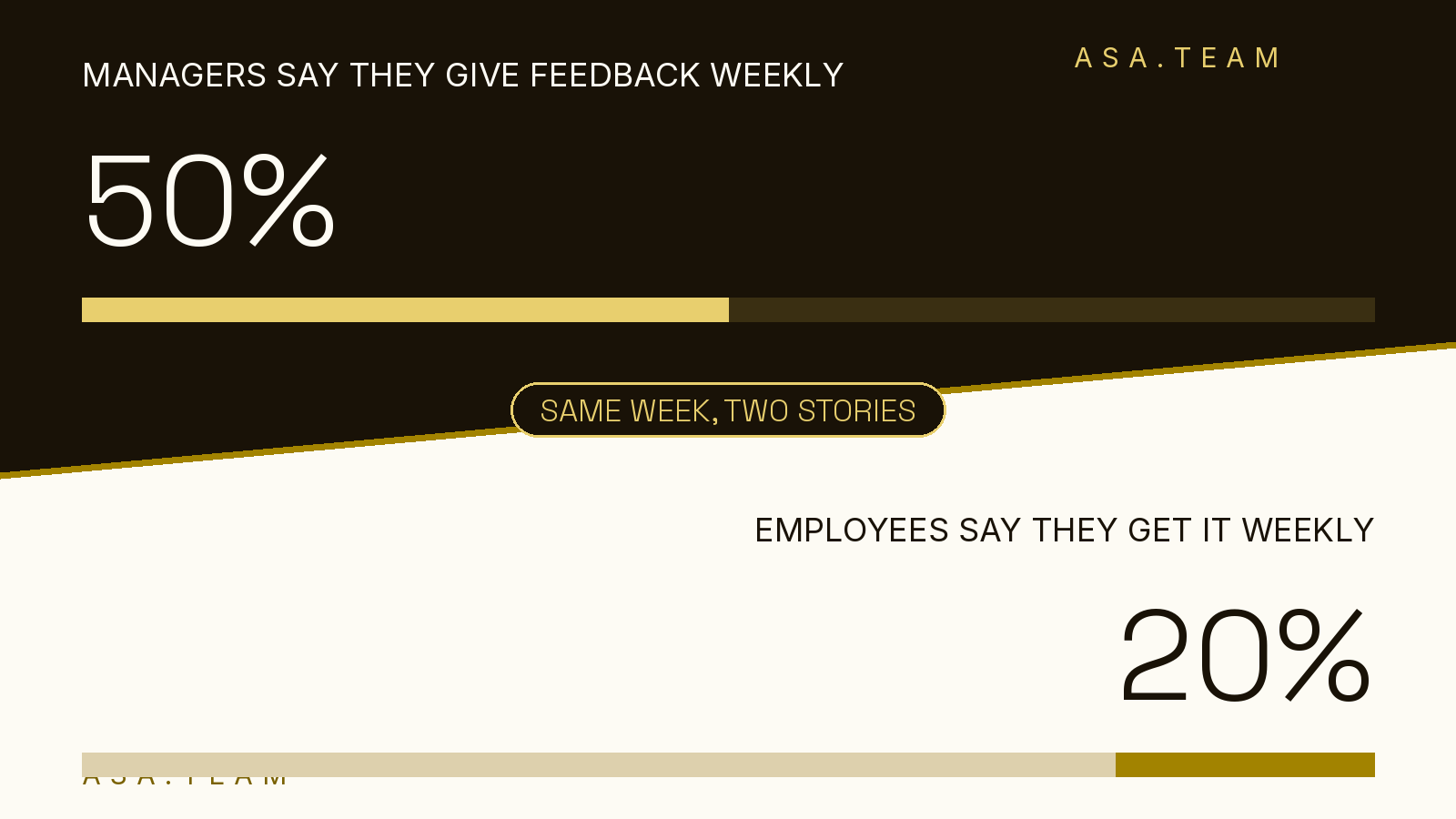
How often do employees receive feedback? Ask any manager and you'll get a confident answer — probably "weekly." Ask their team the same question on the same Friday and you'll get a different number entirely. Gallup put both questions to thousands of workers at the same organizations, and the answers barely overlap: 50% of managers say they give someone feedback every week, but only 20% of employees say they receive it. That's not a rounding error. It's a 30-point perception gap sitting inside ordinary management practice.
Most advice on this topic treats feedback as a frequency problem: schedule more check-ins, do more 1:1s, send more praise. The data says otherwise. Teams that give feedback more often don't automatically get better outcomes, and plenty of employees don't even want weekly input from their boss. The real problem is timeliness and visibility — feedback that arrives while the work still has an expiration date, grounded in what actually happened. This post breaks down how often employees receive feedback according to the survey data, why managers and employees disagree, and what actually closes the gap.
Managers think they're coaching. Employees don't feel coached.
Gallup's manager blind-spot study surveyed 2,729 managers and 12,710 employees at the same worksites and asked both sides the same questions. The results read like a comedy of errors. Fifty percent of managers said they give an employee feedback on projects or progress weekly; just 20% of employees at those same sites agreed. On recognition, 60% of managers said they acknowledge employees' good work weekly, while only 35% of employees said they receive that recognition.
The gap is largest among the managers who think they're strongest. Managers who rate themselves highly on development are the same ones whose teams report the least feedback. Gallup found that fewer than half of all employees strongly agree their manager pushes them to improve — a number that stays flat across industries and team sizes.
Two uncomfortable conclusions follow. First, self-reported feedback frequency is not a usable metric — the person giving the feedback is the least reliable witness to whether it landed. Second, "we have a feedback culture" is a claim a leadership team cannot verify from inside. If you want the real number, you have to ask the receiving side, anonymously, and compare. If you run distributed teams, the gap compounds: async work statistics show most team communication now happens in writing, in channels nobody is reading in real time, which makes it easy for a manager to broadcast and feel heard while nothing lands.
What the feedback frequency data actually says
Strip out the perception gap and the baseline frequency numbers are still grim. Gallup's analysis of employee feedback data found that nearly half of employees receive feedback only a few times a year or less often. Aggregated survey data compiled by Jobera puts weekly feedback receipt at 28% of employees, while 96% of workers say they want feedback in a timely manner.
Here's the twist most feedback-culture advice misses: employees don't uniformly want more feedback — they want more valuable feedback. In Gallup-Workhuman research, only 27% of employees said they prefer receiving feedback weekly from their manager, and just 19% prefer it daily. About 28% prefer it a few times per year. What 63% of employees do agree on is that they'd like more feedback than they currently get — specifically the kind tied to strengths and growth, not status pings about deadlines.
So the honest answer to "how often do employees receive feedback" is: about half the time, not enough to matter, from their own point of view — and the fix isn't mechanically raising the count. A weekly cadence of generic, memory-based check-ins scores the same as silence on the metrics that matter. Frequency only converts into performance when the feedback is specific and fresh.
What regular feedback actually buys you
When feedback is both regular and meaningful, the outcome data is hard to argue with. Gallup found that among employees who strongly agree they receive meaningful feedback at least once a week, 80% are fully engaged. Among those who don't strongly agree, fewer than half are engaged.
Compared with employees who receive feedback only once a year, those who receive it daily are 3.6 times more likely to be highly engaged. Weekly (not daily) feedback still captures most of the prize: compared with annual feedback, it's associated with 5.2 times higher work satisfaction, 3.2 times higher engagement, and 2.7 times higher self-rated performance. Employees who get meaningful feedback in the past week are also five times more likely to be engaged at work, 57% less likely to report burnout, and 48% less likely to be job-seeking. Adding specific recognition to the weekly feedback pushes engagement from 38% to 61%.
"Effective feedback has an expiration date." — Gallup Workplace
| Feedback pattern | What the data shows |
|---|---|
| Strongly agree: weekly meaningful feedback | 80% fully engaged |
| Don't strongly agree | Fewer than 50% engaged |
| Daily meaningful feedback (vs. annual) | 3.6x more likely to be highly engaged |
| Weekly vs. annual feedback | 5.2x satisfaction, 3.2x engagement, 2.7x performance |
| Meaningful feedback in past week | 57% less burnout, 48% less job-seeking |
| Receiving feedback a few times a year or less | Nearly half of all employees |
Read the table as a decay curve rather than a menu. The penalty isn't for missing a weekly ritual — it's for letting feedback expire. Fourteen percent is all Gallup recorded of employees who strongly agree that their organization's performance reviews motivate them to do something better. The annual review isn't feedback; it's archaeology.
Why the gap survives (and why reviews won't close it)
Managers aren't generally lying when they say they give feedback. They're working from a different evidence base. A manager remembers the 1:1 where they said "great job on the client call." The employee experienced a two-sentence comment, thirty seconds long, inside a meeting where they were also presenting three other things — and remembers the feedback on the bug they were told to fix. Vague praise and deadline questions don't register as feedback to the receiver, but they register as "we had a conversation" for the giver.
There's also a supply problem nobody talks about. To give feedback that lands, a manager needs to know what each person actually worked on this week — which projects moved, where someone unblocked a teammate, which deadline slipped and why. In most teams that raw material is scattered across Slack threads, Teams chats, email threads, and three project boards, and the manager simply doesn't have it. Without it, the weekly conversation defaults to status ("what's on your plate?") instead of feedback ("here's what I saw you do well and what to change"), and status conversations expire worthless.
This is also where cadence debates go wrong. How often you should have 1:1s is a scheduling question; whether those 1:1s contain real feedback is an information question. Doubling the meetings without fixing the information supply just doubles the number of status calls employees correctly ignore. The internal communication statistics tell the same story from the other side: most internal information flow is noise, and what people actually remember is work-specific and recent.
What good looks like
The teams that score well on these Gallup items share a boring habit: they treat feedback as a weekly conversation grounded in specific, recent work — not as a sentiment or a ritual. A manager opens the week by looking at what each person actually shipped and where each project stands, picks one or two observations that are worth saying, and says them while the work is days old. Fifteen minutes, per person, most weeks. The feedback sounds like "the way you reframed the pricing objection in the Acme thread bought us two weeks — do that in the Beta call too," not "good week."
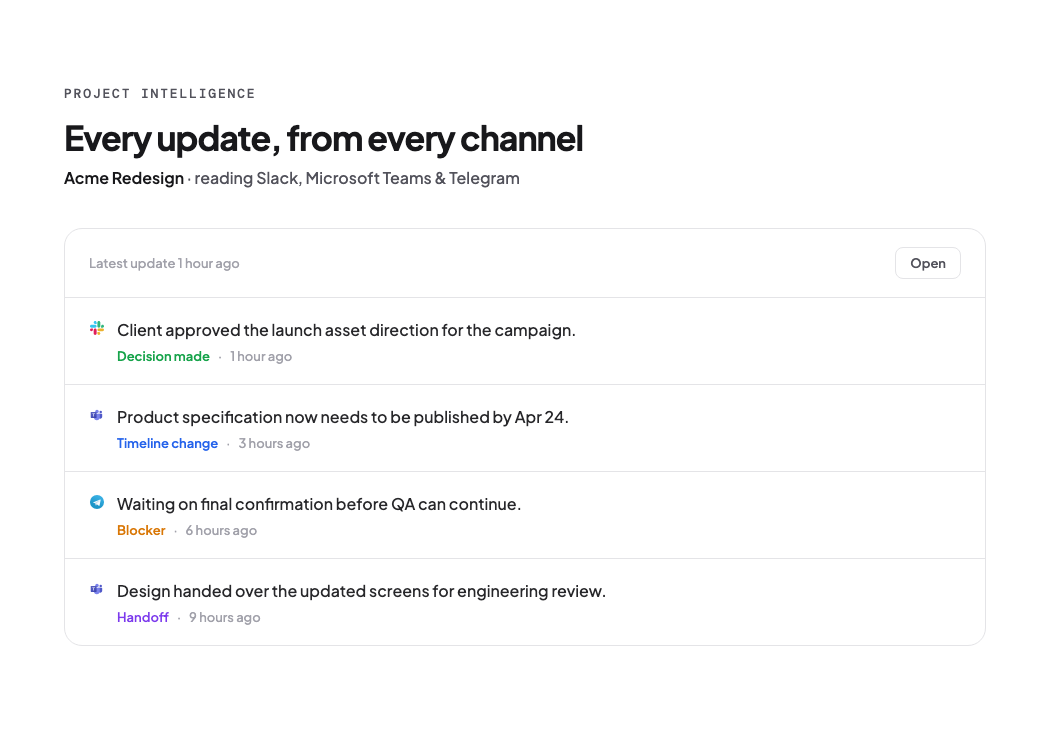
The information problem is the one worth engineering. When a leader can see the week's activity already assembled — decisions from the Slack channel, blockers raised in Teams, progress posted to the project group — the conversation starts from evidence instead of memory, and there's something worth commenting on for every person, not just the loudest. That's the premise behind Asa.Team's Project Intelligence: it reads your team's existing conversations across Slack, Microsoft Teams, Telegram, and WhatsApp and surfaces what actually moved in each project, so a manager's weekly feedback references real work from the last few days instead of whatever the manager happened to witness.
The question to ask instead
"How often should we give feedback?" is the wrong question, and the survey data explains why: only a quarter of employees want weekly input, but nearly all want feedback while it's still useful — and half of them currently get almost none. The right questions are narrower. When did each person on your team last hear something specific and useful from you? And what are you basing that conversation on — work you saw, or work you remember?
Track those two answers for a month and you'll know your real feedback frequency, which is the only number your engagement scores are actually built on.
Frequently Asked Questions
How often do employees receive feedback?
Nearly half of employees report receiving feedback only a few times a year or less, and about 28% report receiving it weekly, according to aggregated survey data. Managers, by contrast, claim weekly feedback at 2.5 times the rate their employees report receiving it (Gallup: 50% vs 20%).
How often do employees want feedback?
Less often than "more," more often than "annually." In Gallup-Workhuman research, 63% of employees want more feedback than they currently get, but only 27% prefer a weekly cadence and 19% want daily input. The preference is for specific, strengths-based feedback delivered promptly, not a fixed meeting schedule.
Does weekly feedback improve engagement?
Yes — when it's meaningful, not merely frequent. Employees who strongly agree they receive meaningful feedback at least weekly are 80% fully engaged, versus fewer than half of those who don't. Weekly meaningful feedback also correlates with 57% lower burnout and 48% less job-seeking compared with employees who receive none.
Why do managers and employees disagree about feedback frequency?
Because the manager and the employee are remembering different events. Managers count conversations they initiated; employees only count feedback that was specific enough to register. The blind-spot study found managers who rate themselves highest on developing others have the lowest-rated feedback on their teams.