45 Team-Building Games That Actually Bring Teams Together
From quick icebreakers to full-afternoon challenges — 45 team-building games for in-person, remote, and hybrid teams, with tips on making them inclusive and effective.

28 min read
Great teams aren't built in sprint reviews or status updates. They're built in the moments between — the shared laugh, the unexpected conversation, the challenge you solved together under pressure. Team-building games create those moments deliberately, and the research is clear: teams that invest time in connection consistently outperform those that don't.
Whether your team is in the same office, spread across time zones, or somewhere in between, this guide covers 45 team-building games organised by what your team actually needs right now — from fast five-minute icebreakers to full-afternoon challenges.
Running a distributed team? Read our guide on how to master remote team management before you dive in — it covers the context that makes these activities land.
Jump to section
- Benefits of team-building activities
- How to choose the right team-building game
- How to make team building inclusive
- Problem solving games
- Outdoor team building exercises
- Indoor team building games
- Remote and virtual team building games
- Team icebreaker games
- Bring your team together — and keep them there
- FAQs about fun team-building games
Benefits of Team-Building Activities
Before we get to the games themselves, it's worth being clear on why you're doing this. Team building that's framed as "a fun break" tends to feel like a checkbox. Team building framed around a specific outcome — building trust, improving communication, welcoming a new hire — tends to actually work.
Done well, regular team-building activities:
- Strengthen communication and active listening skills across the team
- Build the psychological safety that makes people take creative risks at work
- Surface leadership qualities and problem-solving instincts that don't show up in day-to-day tasks
- Improve collaboration and team productivity long after the game is over
- Reduce the coordination friction that silently slows teams down (read more: The Coordination Tax: Why Your Team Spends More Time Catching Up Than Moving Forward)
- Create shared memories — the invisible glue of high-trust teams
Ask yourself before planning any activity: what do I want people to walk away with? A new skill, a deeper connection to a teammate they rarely work with, a moment of genuine levity? The answer should shape everything about how you design the session.
How to Choose the Right Team-Building Game

Not all team-building games work for all teams. Here's what to weigh before committing to an activity:
Group size — Some fun team bonding games scale to dozens of people; others work best with four to six. Know your headcount before you plan.
Goals and skills — Do you want to improve communication skills, sharpen problem-solving, or simply raise morale after a hard sprint? A trivia challenge fosters friendly competition; a physical coordination game builds non-verbal communication. Match the game to the gap.
In-person vs. remote — For distributed teams, virtual team-building activities need to work across screens and time zones. For in-person teams, you have more options — including outdoor challenges and physical games. If you're managing a hybrid setup, read Remote Work Interruptions Are the Home Office Tax for context on what remote teammates actually need from shared time.
Time and energy — Quick icebreaker games fit neatly into the first ten minutes of a team meeting. Escape rooms and multi-hour challenges need a dedicated block. Don't underestimate setup time.
Voluntary participation — The best team-building activities are ones people want to join. Framing matters: optional, during work hours, with enough variety that different personality types can find their footing.
How to Make Team Building Inclusive
An inclusive team is more transparent, more engaged, and more likely to speak up when something's wrong. Team-building games should reinforce that culture, not undermine it.
- Consider all abilities. Physically demanding games or blindfold activities may not work for everyone. Always have an adaptation ready.
- Read your introverts. High-energy games with forced participation can be draining for people who are more internally oriented. Smaller groups and more reflective activities often work better.
- Don't assume everyone has the same cultural references. Games built around shared pop culture or local knowledge can quietly exclude teammates who are newer to the country, the company, or the team.
- Gather input beforehand. A short anonymous poll removes the guesswork and signals that you value people's preferences.
- Schedule during work hours. Activities that eat into personal time feel less like a perk and more like an obligation. Protecting work-hour time for team building is a signal about what the organisation values.
Problem Solving Games
These activities build the creative thinking and collaborative instincts your team uses every day. They're also some of the most revealing: how a team approaches an unfamiliar problem tells you a lot about how they'll handle real ones. For more on why this matters, see Why Daily Standups Miss the Blockers That Actually Derail Projects.
1. Your First Idea
Team size: 5–12 people
Time: 10–20 minutes
How to play: Present a problem — real or fictional — and ask everyone to immediately write down the first solution that comes to mind, no filtering. Collect all responses and review as a group. A fun variation: ask for the worst possible idea. You may be surprised how many turn out to be worth keeping.
Why this exercise is great: Overthinking is the enemy of innovation. Bypassing internal filters surfaces instinctive responses that are often more creative than anything produced by extended deliberation.
2. Spectrum Mapping
Team size: 5–15 people
Time: 30–60 minutes
How to play: Write two to four topics on a whiteboard. Give everyone sticky notes to capture their thoughts on each topic, then post them below the relevant heading. As a group, arrange the notes into a spectrum — majority views toward one end, outlier perspectives toward the other.
Why this exercise is great: Mapping the diversity of thought within your team surfaces both consensus and productive tension. Outlier ideas are often where the most interesting solutions live. This connects directly to how context loss drives misalignment on real projects.
3. Back of the Napkin
Team size: 6–24 people
Time: 15–20 minutes
How to play: Split into groups of two to four. Present each group with an open-ended problem — real, fictional, or environmental. Each group has one napkin and one pen to sketch or write their solution. Groups then pitch their napkin proposals to everyone else.
Why this exercise is great: Constraints force clarity. The napkin format rewards brevity and punishes over-engineering — qualities that make for better real-world problem solving too.
4. What Would "X" Do?
Team size: 5–10 people
Time: 45–60 minutes
How to play: Present a challenge and ask everyone to name a leader, innovator, or figure they genuinely admire. Each person then approaches the problem as if they were that person and presents their solution. Extra credit for committing to character.
Why this exercise is great: Perspective-taking breaks habitual thinking. Even a few minutes inside someone else's mental model can surface a solution that feels impossible from your own vantage point.
5. Create Your Own Game
Team size: 5–12 people
Time: 30–60 minutes
How to play: Each person invents an original problem-solving challenge and presents it to the group. It can be physical, mental, or purely creative. If time allows, actually play some of the invented games together.
Why this exercise is great: Designing a game well requires clear thinking about structure, fairness, and engagement — skills that map directly onto good project planning and team design.
6. Team Pursuit
Team size: 6–24 people
Time: 1–3 hours
How to play: Form competing groups of two to six and run a series of challenges: logic puzzles, skill tasks, and open-ended creative challenges. Buy a team pursuit kit or build your own series.
Why this exercise is great: A well-designed team pursuit gives every personality type a moment to contribute. The analytical thinker, the creative wildcard, and the fast strategist all find their role — which is exactly what strong cross-functional teams do on real projects.
7. Code Break
Team size: 8–24 people
Time: 1–3 hours
How to play: Work through a series of code-breaking puzzles together. Teams must find, decipher, and unlock codes to progress. Can be run indoors or outdoors, self-hosted or through a facilitated provider.
Why this exercise is great: Code Break requires creative thinking under time pressure and works well with large groups because teams compete in parallel rather than waiting for each other.
8. Escape Room
Team size: 3+ people
Time: 2–3 hours
How to play: Book your team into a local escape room. Pick a theme that fits your group's energy — historical mystery, sci-fi, thriller. If you're feeling ambitious, design your own.
Why this exercise is great: Solving an escape room under pressure reveals how your team communicates when the stakes feel real. You'll discover who leads, who problem-solves quietly, who keeps morale high — and you'll be talking about it for months.
Outdoor Team Building Exercises
Getting outside removes the professional distance that office environments create by default. These activities work especially well for larger groups, for teams that need a genuine reset, or for moments when you want people to interact with colleagues they don't normally work alongside.
9. The Minefield
Team size: 4–10 people
Time: 15–30 minutes
How to play: Scatter objects across a large open space — the minefield. In pairs, one person is blindfolded and must navigate from one end to the other guided only by their partner's words. The blindfolded person cannot speak. Stepping on anything means elimination.
Why this exercise is great: This is a trust exercise as much as a communication one. The guide must be clear and precise; the navigator must listen without seeing. It mirrors real dynamics in any team where some people hold context that others depend on.
10. Scavenger Hunt
Team size: 8+ people
Time: 45–90 minutes
How to play: Design a hunt with photo challenges, items to collect, and team tasks to complete. Make it company-specific — tasks tied to your office, product, or team's history. Offer prizes for the most creative team and the first to finish.
Why this exercise is great: A scavenger hunt rewards teamwork over individual performance. It's also a strong onboarding activity — structure it so new joiners learn about the company and the team simultaneously.
11. Egg Drop
Team size: 4–12 people
Time: 60–90 minutes
How to play: In groups of two or three, each team is given a raw egg plus materials — tape, straws, rubber bands, newspaper, balloons — and 60 minutes to build a structure that protects the egg from a two- or three-storey drop. Grand finale: gather everyone for the drops.
Why this exercise is great: Engineering under time pressure with a clear success metric. It reveals how teams approach iteration and rapid prototyping — and the finale is genuinely spectacular.
12. Earth Ball
Team size: 5–20 people
Time: 15–45 minutes
How to play: Stand in a circle and keep a balloon or beach ball in the air as long as possible. Nobody can touch it twice in a row. Count your record and try to beat it each round.
Why this exercise is great: Simple, physical, and surprisingly strategic. If the team is struggling, pause and invite them to plan a coordinated approach — the improvement after a brief strategy conversation is consistently satisfying.
13. Team Outing
Team size: Any
Time: Any
How to play: Plan a shared experience — a cooking class, museum visit, bowling night, 5K run, ping pong tournament. Format matters less than the environment: somewhere new, where casual conversation comes more naturally than professional performance.
Why this exercise is great: Formal settings reinforce professional distance. A good outing lowers those barriers in ways that benefit the working relationship for months afterward.
14. Volunteer as a Team
Team size: 5+ people
Time: Any
How to play: Organise a team volunteering day during regular work hours — a charity drive, community project, or local fundraiser for a cause your team genuinely cares about. Rotate the cause each quarter to reflect diverse interests.
Why this exercise is great: Doing good together produces a distinct kind of team bond. The shared sense of purpose — and the mood lift that comes with it — tends to carry into the workplace in ways that are difficult to manufacture any other way.
Indoor Team Building Games

Most of these can be run in a standard meeting room or office space. Scale the room for larger groups.
15. Build a Tower
Team size: 8–16 people
Time: 20–30 minutes
How to play: In groups of four or five, each team gets 20 dry spaghetti sticks, one yard of tape, one yard of string, and one marshmallow. Goal: build the tallest freestanding tower that supports the marshmallow on top. Twenty minutes on the clock.
Why this exercise is great: The marshmallow challenge reliably reveals how teams approach prototyping and decision-making under pressure. Teams that iterate quickly consistently beat those that plan endlessly — a lesson that maps directly onto real work. This connects to how rework loops trap teams in real projects too.
16. The Barter Puzzle
Team size: 4–12 people
Time: 1–2 hours
How to play: Give each group of three to four people a jigsaw puzzle of equal difficulty. Each puzzle is missing a few pieces, mixed into other teams' sets. Teams must negotiate, trade pieces, or even temporarily swap members to complete their puzzle. All decisions must be made collectively. First team to finish wins.
Why this exercise is great: Every decision becomes a group decision — not just within each team, but in negotiation with rivals. One of the strongest exercises for practising collaborative problem solving under realistic pressure.
17. Sneak a Peek
Team size: 4–20 people
Time: 30 minutes
How to play: Build a hidden Lego structure in a separate room. In groups of two to four, one person per team can sneak a 15-second look, run back, and describe what they saw. The peek-person rotates throughout. First team to replicate the structure wins.
Why this exercise is great: Because no single person sees the whole picture, teams must synthesise partial information into a coherent whole — exactly the challenge your team faces when project status lives in too many places at once.
18. Perfect Square
Team size: 4–12 people
Time: 15–30 minutes
How to play: In groups of four to six, everyone closes their eyes or puts on a blindfold, holds a section of a single length of rope, and must shape it into a perfect square on the floor — without looking. Only open your eyes when you're confident it's square.
Why this exercise is great: The results are almost always surprising. This is a listening and spatial communication exercise that proves how much we rely on sight for everyday coordination — and how much clearer instructions need to be when you can't see feedback.
19. Flip It Over
Team size: 6–8 people
Time: 20–30 minutes
How to play: Lay a towel or blanket on the floor and ask the group to stand on it. Without anyone stepping off or touching the ground outside the fabric, flip it completely over. Make it harder with a smaller fabric or more people.
Why this exercise is great: An impossible-sounding task that's solved through clear communication and creative constraint management. Reveals how teams negotiate competing needs — useful framing for anyone thinking about scope creep and decision authority.
20. Shipwrecked
Team size: 8–25 people
Time: 30 minutes
How to play: Your team is stranded and has 25 minutes to salvage limited supplies from a sinking ship. Place supplies (water, matches, food, rope, tarps) in the "shipwreck zone" in varied quantities. In pairs or small groups, teams must gather, rank, then negotiate and trade with other teams for what they need most.
Why this exercise is great: Exercises problem-solving, negotiation, and leadership under time pressure. Teams that approach it with a clear plan — rather than hoarding — consistently fare better.
21. Memory Wall
Team size: 5+ people
Time: 15–30 minutes
How to play: Write work-related themes on a whiteboard — "first day," "team celebration," "biggest win," "funniest moment." Give everyone sticky notes and ask them to write a favourite memory for one or more themes. Share aloud and build the wall together.
Why this exercise is great: Shared positive memories are bonding material. Works especially well to close a sprint, a work trip, or a long workshop — sends people home with energy rather than exhaustion.
22. Paper Plane Competition
Team size: 6–12 people
Time: 20–30 minutes
How to play: In groups of two to four, teams have 10–15 minutes to research, design, and build the best long-distance paper plane they can — and name their airline. Run the competition in a long corridor or outside. Farthest flight wins.
Why this exercise is great: Rapid design, delegation, and time management under light competitive pressure. The tight timeline makes it a useful metaphor for how teams handle scope when deadlines are real.
23. Turn Back Time
Team size: 5–10 people
Time: 20–30 minutes
How to play: In a calm setting, ask your team to sit and think of one memory they'd choose to relive if they could. Lead with your own story first — vulnerability is contagious. Give everyone space to share as much or as little as they choose.
Why this exercise is great: A deeper exercise than most. When a team is feeling burned out or disconnected, sharing personal high points that have nothing to do with work is a surprisingly powerful way to rebuild togetherness.
24. Team Flag
Team size: 6–20 people
Time: 30–45 minutes
How to play: In groups of two to four, design an emblem or flag that represents your team — its values, its personality, its identity. Each group presents their design and explains the choices behind it.
Why this exercise is great: The process of agreeing on symbols and values reveals how different subgroups see the team. It often surfaces the most interesting alignment conversations — which is exactly the kind of clarity that prevents the alignment gap from forming.
25. Pyramids
Team size: 8–24 people
Time: 30 minutes
How to play: In teams of four to six, lined up with 8–10 feet between each person, the first player builds a four-cup base pyramid. They and the second player carry it to the next station — if it falls, rebuild on the spot before continuing. Continue until the pyramid reaches the last station. Fastest team wins.
Why this exercise is great: A reliable mid-day energy reset that surfaces communication skills and coordination under light, enjoyable competitive pressure.
26. Sell It
Team size: 3+ people
Time: 45–90 minutes
How to play: Each person brings a random everyday object. In 30 minutes, they create a logo, slogan, and basic marketing plan for it, then pitch to the group. For larger teams, pair people up for the pitch.
Why this exercise is great: Particularly useful for non-marketing teams — it forces thinking about value, audience, and communication from a completely unfamiliar angle. It's also genuinely entertaining to watch.
27. Salt and Pepper
Team size: 6–20 people
Time: 45–60 minutes
How to play: Write pairs of naturally linked things on individual slips of paper — salt and pepper, peanut butter and jelly, left sock and right sock. Tape one to each person's back. Using only yes/no questions, everyone must figure out who they are and find their match.
Why this exercise is great: A natural mixer for large teams where not everyone knows each other. The yes/no constraint forces precise questioning and rewards clear communication.
28. Birthday Line-Up (Indoor Version)
Team size: 8+ people
Time: 10–15 minutes
How to play: Without speaking, your team organises into a line ordered by birthday — month and day only. Gestures and written communication are allowed; words are not. Add a time limit for extra pressure.
Why this exercise is great: Builds non-verbal communication skills and encourages creative problem framing toward a common goal. Also reliably reveals who naturally steps into a coordinating role.
Remote and Virtual Team Building Games

Distributed teams don't get the spontaneous interactions that build bonds in shared offices. Virtual team-building games fill that gap intentionally — and done well, they can be as connecting as anything you'd do in person. For practical context on the challenges your remote team faces day-to-day, read How to Master Remote Team Management.
Schedule virtual activities during core work hours so participation is inclusive across time zones and doesn't cut into personal time.
29. Online Group Game
Team size: 3+ people
Time: 30–60 minutes
How to play: Choose an online game your team can play together over video call. Jackbox Party Pack runs through a browser and anyone can join from their phone. Screen share the game and let the chaos unfold.
Why this exercise is great: Playing something completely unrelated to work creates a genuine, unscripted environment where people can just be themselves.
30. Virtual Trivia
Team size: 6–20 people
Time: 30–90 minutes
How to play: Host a trivia session at the start or end of a workday. Mix themes — company history, pop culture, geography, general knowledge. Rotate who hosts. Platforms like Kahoot or Mentimeter handle scoring automatically.
Why this exercise is great: Trivia rewards a breadth of knowledge, which means different people get to be the hero each round. Competitive, educational, and genuinely fun.
31. Photo Caption Contest
Team size: 5+ people
Time: 10–15 minutes
How to play: Before the call, share three to five funny or offbeat images. Ask everyone to submit their best caption for each. Compile into a quick slideshow and share at the start of your next meeting. Let the group vote for favourites.
Why this exercise is great: Low effort, high mileage. Creative thinking plus genuine laughter makes remote teams feel less remote.
32. Quarterly Challenge
Team size: 3+ people
Time: One month
How to play: Create an optional monthly or quarterly challenge — reading, journaling, a fitness goal, learning a new skill. Set up a dedicated thread or channel where participants can check in, share wins, and keep each other accountable. Make participation clearly optional.
Why this exercise is great: Optional challenges signal that you see your team as whole people, not just output. Shared experiences — even lightweight ones — are what separate genuinely connected remote teams from ones that feel like a collection of solo workers. Related: Async Leadership Fails When Every Ping Becomes Priority.
33. Lunch and Learn
Team size: 5+ people
Time: 30 minutes
How to play: Rotate hosting a casual midday session where one team member presents something they know — a tool, a book, a lesson from a recent project, or even a hobby. Keep it conversational and leave time for questions.
Why this exercise is great: Learning together is bonding, and these sessions build knowledge-sharing habits that directly improve how your team works together — making them one of the highest-return activities on this list.
34. Personality Test Swap
Team size: 5+ people
Time: Any
How to play: Send a personality assessment — Enneagram, CliftonStrengths, or 16Personalities — and ask everyone to share results in a team thread or at your next meeting. Discuss what surprised you and what didn't.
Why this exercise is great: Understanding how your teammates think and communicate is one of the most practically useful things a team can do. It often surfaces insights that improve collaboration for months.
35. Show and Tell
Team size: 3+ people
Time: 2–3 minutes per person
How to play: Ask everyone to bring one object to the next video call — something they're proud of or that brings them joy. A houseplant, a piece of artwork, a trophy, a beloved book. Two to three minutes per person to share the story behind their object.
Why this exercise is great: You'll learn things about your teammates that years of working together might not reveal — and it gives everyone a natural conversation starter for future interactions.
36. Virtual Coffee Chat
Team size: 3+ people
Time: 15–30 minutes
How to play: Schedule regular informal video calls — either small-group or randomly paired one-on-ones that rotate each week. Keep it strictly non-work. Weekly, bi-weekly, or monthly works depending on team size.
Why this exercise is great: Remote teams lose the spontaneous hallway conversations that build trust in shared offices. Intentionally replacing those moments is what separates high-trust distributed teams from disconnected ones. See also: Meeting Recovery Time Is the Hidden Cost Your Team Never Budgets For.
Team Icebreaker Games

Icebreaker questions and activities work for groups who have never met and for teammates who have worked together for years. They're a simple, low-stakes way to start a meeting well, welcome new team members, or shift the energy in a room that needs it.
37. Two Truths, One Lie
Team size: 3+ people
Time: 2–3 minutes per person
How to play: Each person shares two true facts and one convincing lie about themselves. The more surprising the truths and the more believable the lie, the better. The group votes on which statement they think is the lie.
Why this exercise is great: Works for any group, new or established. The details you surface become natural conversation starters that carry into daily work.
38. One Word Exercise
Team size: 3+ people
Time: 5–10 minutes
How to play: Introduce a meeting topic and ask everyone to write down the first word that comes to mind on a sticky note or in a shared doc. Collect and display all responses. Look for patterns — what does the collective reaction tell you?
Why this exercise is great: An efficient way to surface hidden feelings about a project or initiative before diving in. If the words are unexpectedly heavy, that's valuable signal worth addressing before you start.
39. Penny for Your Thoughts
Team size: 5+ people
Time: 2–3 minutes per person
How to play: Fill a bag with coins, making sure none are older than your youngest team member. Each person draws a coin and shares a memory or story from that year — anything from a childhood adventure to a career milestone.
Why this exercise is great: A low-pressure, surprisingly personal icebreaker. You can run multiple rounds to keep conversation going.
40. Mood Pictures
Team size: 5+ people
Time: 2–3 minutes per person
How to play: Prepare a variety of images before the session — landscapes, cityscapes, abstract shapes, people, animals. Spread them out and ask each person to pick the one that best reflects their current mood or expectations for the session. Each person shares their pick and explains why.
Why this exercise is great: Removes the pressure of having to articulate feelings from scratch. Gives your team a creative, low-stakes way to read the room at the start of a meeting or workshop.
41. Back-to-Back Drawing
Team size: 4+ people
Time: 5–10 minutes
How to play: Pair up and sit back to back. One person is shown a simple image — a bicycle, a house, a tree. Without naming the object, they describe it using shapes, sizes, and spatial relationships while their partner draws what they hear. Compare drawings to the original.
Why this exercise is great: Sharpens speaking clarity and active listening simultaneously. Seeing the gap between intent and interpretation is consistently illuminating — and usually very funny.
42. Code of Conduct
Team size: 5+ people
Time: 20–30 minutes
How to play: Write two categories on a whiteboard: Meaningful and Enjoyable. Ask the group to share what conditions need to be true for the upcoming project or workshop to tick both boxes. Record the agreed values as a written code of conduct visible throughout the project.
Why this exercise is great: Establishing group norms early creates psychological safety and shared accountability. It's also a direct antidote to the alignment gap — getting everyone's assumptions on the table before work starts rather than discovering disagreements mid-sprint.
43. Common Thread
Team size: 10+ people
Time: 30 minutes
How to play: In groups of three to five, find as many non-obvious things everyone has in common as possible. Favourite flavours are a start — push for deeper commonalities. Bring everyone back to share.
Why this exercise is great: Surfaces hidden similarities that routine work rarely reveals. Particularly effective for bridging divisions within a team or integrating new members.
44. Swift Swap
Team size: 10–20 people
Time: 10–15 minutes
How to play: Split into two groups facing each other. Team A has 20–30 seconds to observe Team B carefully, then turns around while Team B makes as many changes to their appearance as possible. Team A then gets 5–10 minutes to identify all the differences.
Why this exercise is great: A high-energy observation and communication game that works well as a mid-day reset. Requires time-sensitive coordination during the swap phase.
45. Charades
Team size: 8–10 people
Time: 10–25 minutes
How to play: Divide into two teams of four or five. One person per turn is privately shown a word or object and must act it out silently. The team has 30 seconds to guess. Rotate until everyone has had a turn.
Why this exercise is great: A timeless classic that needs zero prep, zero budget, and reliably generates genuine laughter. Works just as well in a boardroom as anywhere else.
Bring Your Team Together — And Keep Them There
Team-building games create moments of genuine connection. But the teams that sustain that connection are the ones who carry it into how they work every day — in how they communicate, how they handle blockers, how they make decisions together.
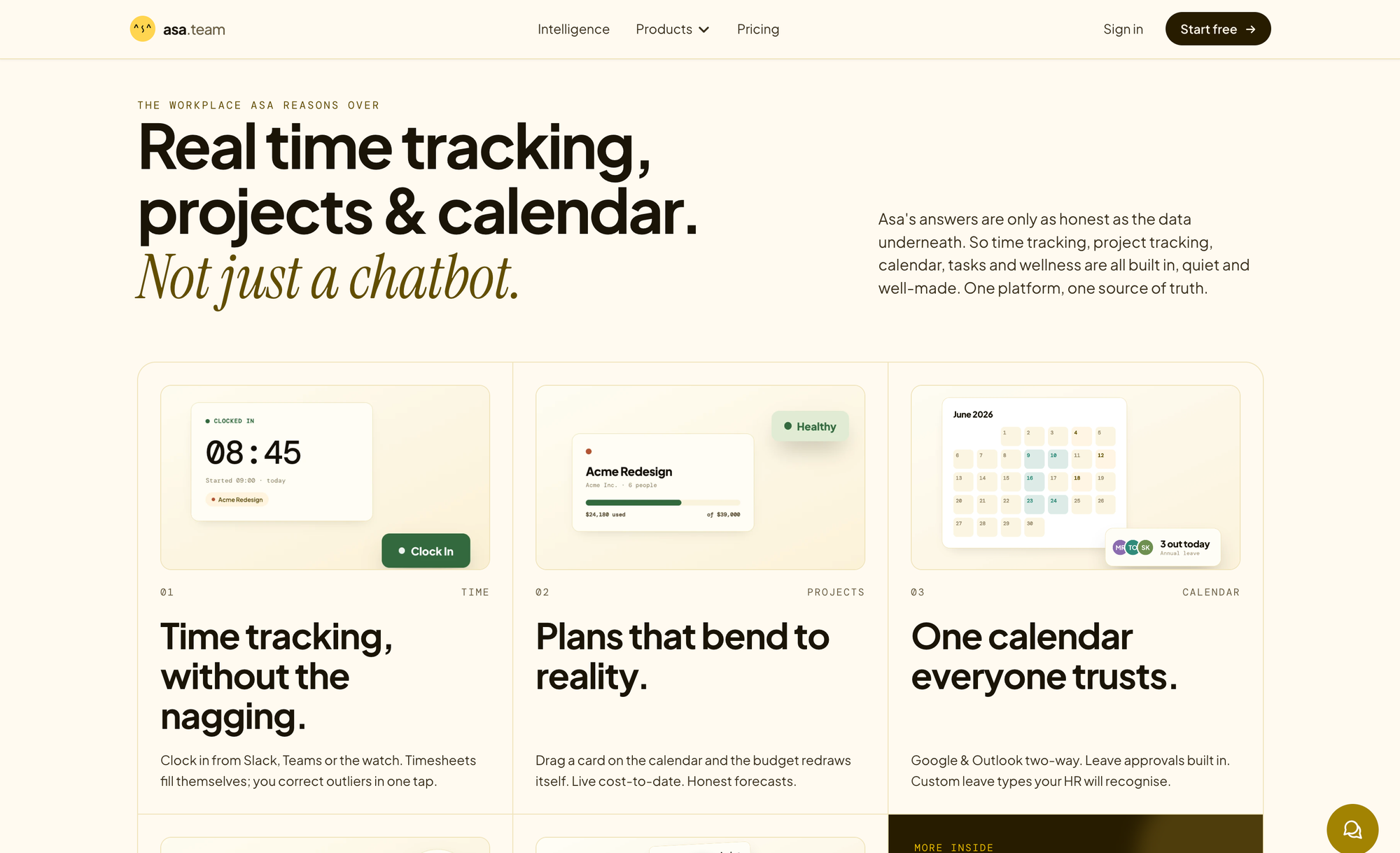
That's the gap Asa.Team is built to close. Whether your team is in one office, fully remote, or hybrid across multiple time zones, Asa.Team gives you the project tracking, async communication, and team visibility tools to make collaboration feel like the activity — not the exception.
- Struggling with distributed team management? Read How to Master Remote Team Management
- Want to understand where your team's time actually goes? Read From Timesheets to Team Intelligence
- Dealing with scope creep and unclear ownership? Read Scope Creep Isn't a People Problem — It's a Decision Problem
Ready to build a team that works together as well as it plays together? Try Asa.Team →
FAQs About Fun Team-Building Games

How often should teams play team-building games?
Once a month or once a quarter is a good baseline. Short icebreaker games can slot into weekly meetings; larger group activities are better suited to offsites or company events. The goal is regularity — connection built in sporadic bursts doesn't stick.
What's the ideal length for a team-building game?
It depends on the format. Quick team-building activities like icebreakers fit into 10–20 minutes. More structured group games for team building — escape rooms, team pursuit events — need 45 minutes to an hour or more to deliver their full value.
Should team-building games for adults be mandatory?
No. Mandatory participation undermines the psychological safety you're trying to build. Offer enough variety that different personality types can find something they'll genuinely enjoy — then make opting in feel like an obvious yes rather than an obligation.
What are the best team-building games for work?
Games that balance genuine fun with skills that transfer to everyday work. Escape rooms, back-of-the-napkin challenges, and the barter puzzle all develop real collaborative instincts. For lighter energy, trivia, charades, and scavenger hunts deliver consistently.
What are some easy office games for team building?
Low-prep favourites include Two Truths and a Lie, the One Word Exercise, and Swift Swap. These need nothing more than a whiteboard or a bit of floor space and consistently generate real conversation.
How do games for teams help with problem-solving?
Team games put people in unfamiliar situations where habitual thinking doesn't apply. Escape rooms, code breaks, and spectrum mapping build the creative thinking and collaborative instincts that show up in real work — especially when projects hit unexpected blockers.
What are some fun virtual team-building games?
Online trivia via Kahoot, Jackbox Party Games over screen share, photo caption contests, and virtual escape rooms all translate well to remote settings. Pair them with ongoing light-touch activities like quarterly challenges to keep momentum between sessions.
What are the best team-building games for employees across a whole organisation?
For large groups, activities that break people into smaller competing or collaborating units work best: team pursuit, scavenger hunts, and code break all scale well. For something more reflective, a memory wall or code of conduct exercise creates alignment that lasts well beyond the session itself.
What are the best team-building games for adults in a corporate setting?
Corporate team-building games land best when they mirror the skills your team actually uses: negotiation in Shipwrecked, design thinking in Build a Tower, communication under constraint in Perfect Square. For a lighter touch, trivia and charades require zero setup and reliably deliver.
More from the Asa.Team blog: