Async Standup vs Sync Standup: Which One Actually Protects Your Team's Focus Time
A 15-minute standup with 8 people costs two hours of team time before context switching. Here's what the data says about async vs sync standups, when each wins, and how to switch without losing the thread.
It's 9:14 a.m. Your team's standup was scheduled for 9:00, and you're four minutes in with six people still to circle. By the time the last person unmutes, the two engineers who care about deep work have already lost their morning — the first person to present heard everyone's update, and the last person to speak stumbled out of flow and won't recover it for another half hour. Nobody would call fifteen minutes of calendar time expensive — until you count everyone in the room and the cost of pulling them out of flow. That single daily ritual quietly taxes a team more than almost any other meeting on the books.
The fix isn't "fewer meetings for the sake of fewer meetings." It's choosing the right standup format for how your team actually works. The async standup vs sync standup choice is real, not a matter of taste — async standups, written updates posted on your own schedule, are the fastest-growing alternative to the live call. This guide walks through what the data says about each, when each wins, and how to make the switch without wrecking the alignment your standup is supposed to create. By the end you'll have a decision framework, not a template to copy blindly.
The hidden cost of the fifteen-minute sync standup
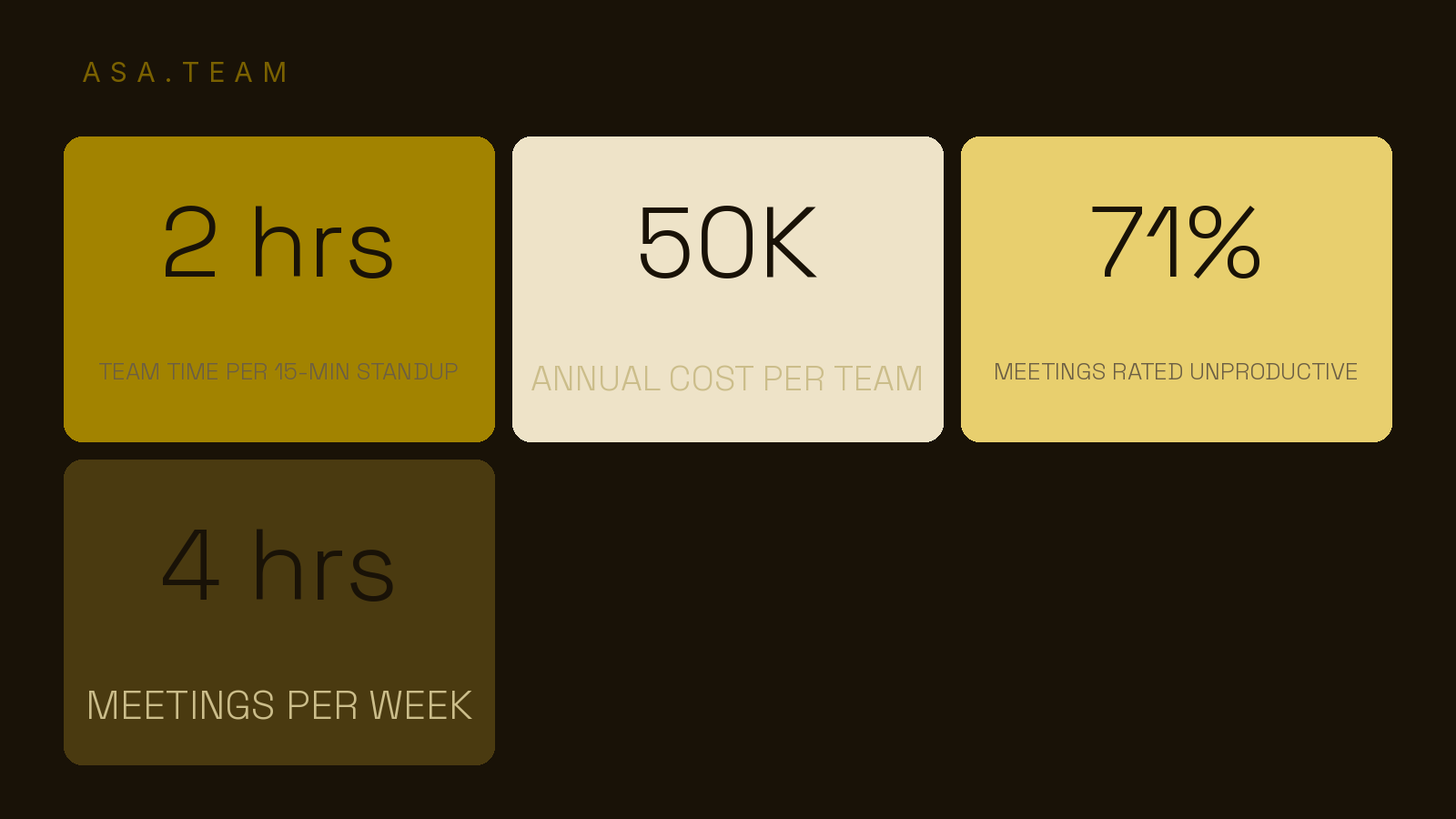
The paradox of the sync standup is that it looks cheap and isn't. A 15-minute meeting with eight people is two hours of team time before context switching is even counted — and for engineers, the interruption cost can be larger than the meeting itself, as a data-driven comparison of the two formats from scrumtool.io makes clear. That's not a fifth of a workday; it's a meaningful slice of every single morning.
Run the numbers on a whole year and the scale snaps into focus. A detailed breakdown from Meeting Toll estimates a daily standup costs a team between $50,000 and $150,000 per year in calendared time alone — before the "hidden productivity losses that often double the visible expense." When a meeting is the single largest unexamined line item in an engineering budget, it deserves real scrutiny, not routine acceptance.
And the cost isn't only time. Meetings sit on top of an already crowded week. Research compiled by Pumble finds the average employee spends around four hours per week in meetings and that unproductive meetings cost US professionals roughly $259 billion a year. A standup that runs long, drifts into status theater, or pulls people out of deep work feeds straight into that number.
The real cost of a standup isn't the fifteen minutes on the calendar — it's the two hours of multiplied team time plus every minute of flow it destroys.
Why teams are moving standups async
Async standups replace the live call with a written or recorded update each teammate posts on their own schedule. As StandupAlice frames it, they've emerged as a modern alternative for teams spread across time zones and flexible work styles — and they're reshaping how work gets coordinated rather than a passing trend.
The benefits show up precisely where the sync format hurts. For distributed teams, async removes the time-zone squeeze: nobody drags themselves onto a call at 7 a.m. to fit a single colleague. For focus-heavy teams, async protects the morning block that the sync standup routinely destroys. And there's a quieter structural win: written updates create a searchable record, so the answer to "what did that engineer say on Tuesday?" lives forever instead of evaporating with the call.
That searchable record matters more than it seems. When coordination happens in chats and threads rather than a wiped meeting, the project stops living in memory and starts living where the team already works. The connection to everyday project chaos is direct: the more of your status lives in a permanent channel, the less it decays the moment the meeting ends. A status that lives in a thread is still there on Thursday when the person who needed it finally has time to look — and that alone quietly removes a whole category of "wait, who's doing that?" rework.
There's also a fairness angle worth naming. In a sync standup, the loudest voice and the person who happens to be on the wealthiest time zone shape the conversation. Async evens the playing field: everyone writes the same structure, everyone gets read, and the quiet engineer's blocker surfaces with exactly the same weight as the talkative one's progress. For teams that have watched meeting-heavy colleagues dominate decision-making for years, that equalising effect is often the real reason async stick. It's the same reason async leadership as a broader philosophy keeps winning converts — it stops the calendar and the loudest room from deciding what matters.
None of this means async is frictionless. The discipline problem is real: updates that go unread are updates that don't count, and a channel that nobody reviews is worse than a meeting because it offers the illusion of alignment with none of the enforcement. That's the trade teams miss when they copy an async template from a blog post and declare victory.
Async standup vs sync standup: the trade-offs, side by side
| Dimension | Sync standup | Async standup |
|---|---|---|
| Team time (8 people, 15 min) | ~2 hrs / day, all at once | Minutes per person, spread out |
| Deep-work impact | Interrupts the morning block | Posted around focus time |
| Time zones | Forces a common slot | Everyone posts on their own clock |
| Record | Lost when the call ends | Searchable, permanent thread |
| Blocker speed | Immediate, if caught live | Fast, if someone reviews daily |
| Social connection | Built-in daily touchpoint | Needs deliberate effort |
Notice what the table doesn't say: async is not universally better. A sync standup shines when work is tightly coupled, when blockers come up that genuinely need live back-and-forth, or when a team is new and still building trust. The daily live touchpoint has real value — removing every live ritual can make remote work feel transactional, as the scrumtool analysis warns. Async is the better call when the team spans time zones, most updates don't need immediate discussion, or the meeting keeps cutting into productive flow.
Making the switch without losing the thread
The common mistake is treating async as a fire-and-forget channel. Async demands discipline: if nobody reads the updates or acts on the blockers, the process fails quietly — silently, and often for weeks. A clean handoff needs structure, not just a Slack channel.
Start with a defined submit window so updates land predictably rather than whenever. Keep questions short and specific. Most importantly, assign someone to review blockers every day — responsiveness is what makes async coordination feel as fast as a call. A good template keeps it tight: what you finished, what's next, and what's blocking you.
This is where a project-intelligence layer changes the game. The reason standalone async standups rot is that someone has to manually read every thread, spot the blocker, and chase it — and that someone is usually busier than everyone else. When updates written into Slack, Teams, Telegram, or WhatsApp get surfaced automatically, the reading-and-flagging burden disappears. Asa.Team's project intelligence pulls updates from exactly those channels and surfaces blockers and risks as they happen, so an async standup keeps the alignment you need without the manual triage that makes it fail.
What good looks like
Good async standup practice isn't "no meetings at all" — it's meeting the coordination need at the lowest possible cost. A team that moved async but kept a short live blocker review, or a weekly social check-in, gets the best of both: focus time preserved most days, live connection when it actually matters. The format becomes a dial you turn based on how coupled the work is, not a dogma. The real prize, though, is protecting the recovery window after each interruption — the silent cost that a live standup quietly red-lines for every person it pulls out of flow.
The other half of "good" is that the information survives. When your team posts updates where they already work, and the important signals — the stuck dependency, the slipping deadline, the person who's quietly off track — get pulled out automatically rather than hunted for, your project status stops being whatever the last meeting left in memory. That's the outcome the best async teams reach: alignment without a standing interruption.
Measure it the way scrumtool suggests — submission rate, blocker resolution time, meeting time saved, and team satisfaction — then adjust the follow-up process when it isn't working. If async saves time but blockers linger longer, the problem isn't async; it's that nobody owns the follow-up. Treat the format change as an experiment with clear metrics for one sprint, compare the quality of information, and let the data decide rather than a strong opinion in the room.
Frequently asked questions
Is async standup better than sync? Not universally — it depends on time zones, workload coupling, and team maturity. Async wins for distributed and focus-heavy teams; sync still helps tightly-coupled teams and when live blocker discussion matters.
How long should an async standup take? Each person should spend a couple of minutes writing their update. The point is that those minutes don't collide with everyone else's all at once, protecting the aggregate two hours a sync standup consumes.
Will we lose communication with async standups? Only if you abandon connection entirely. Keep a lightweight live or social touchpoint, and the async format protects focus without making the team feel transactional.
The bottom line
Your standup is probably costing more than you've ever counted — in multiplied team time, in destroyed morning focus, and in meetings piling onto an already overloaded week. Async standups put that cost back where it belongs, spread across the team's own schedule, with a searchable record that survives the day. But async only works if someone stays on top of the blockers — and that's exactly the work that automation should be doing for you.
So the question isn't "should we copy an async template?" It's: after you remove the standup from everyone's calendar, how will you guarantee the blockers don't go silent with it? If you can answer that, you've found the format that actually protects your team's time.