Remote Work Interruptions Are the Home Office Tax
Remote work interruptions drain deep work when pings, meetings, and home life collide. Build a calmer async system that protects focus.

Remote work was supposed to make the day calmer. No commute, fewer hallway interruptions, and more time for the actual thinking that makes projects move. Instead, a lot of teams got a different bargain: the calendar filled up, the message threads never stopped, and the quiet hours became too fragmented to use well. You can be technically at work all day and still finish with the feeling that nothing important moved.
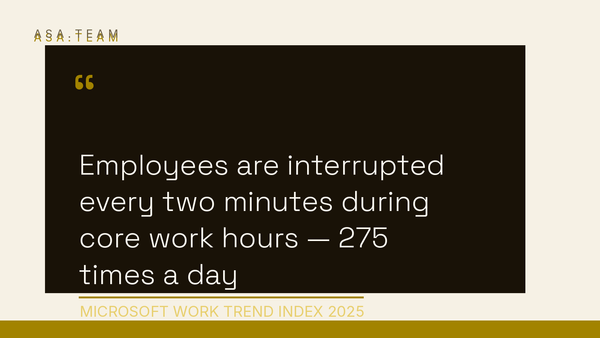
Microsoft’s Breaking down the infinite workday says the average worker receives 117 emails and 153 Teams messages a day, and that employees are interrupted every two minutes by a meeting, email, or notification. The same report says 48% of employees feel their work is chaotic and fragmented. That is why remote teams do not need a louder reminder to focus. They need a calmer operating model that protects attention, distinguishes urgent from merely visible, and accepts that home is already a context-switching machine.
Remote work interruptions are not a character flaw. They are what happens when a team builds its rhythm around constant availability instead of deliberate attention. Once the system assumes every ping can cut the line, people stop working in blocks and start working in fragments. The day may look full on paper, but the important work keeps getting pushed into the corners.
The interruption stack is bigger than your notification badge
In a remote team, interruption rarely arrives alone. A Teams ping pulls you out of a document, an email asks for a quick answer, a calendar invite lands in the middle of a focus block, and a ticket update appears in yet another app. Microsoft’s report shows that half of all meetings happen between 9–11 am and 1–3 pm, which are exactly the windows when many people have a natural productivity spike. It also says 57% of meetings are ad hoc calls without a calendar invite. The pattern is hard to miss: the workday is organized around interruption, and then everyone acts surprised when deep work gets harder.
The hidden cost is not just the time spent answering. It is the time spent restarting. Every switch forces the brain to reload the thread, reopen the context, and decide what still matters. By 11 am, Microsoft says 54% of users are active, making it the most overloaded hour of the day. Meetings, real-time messages, and app switching all collide at the same moment, so the workday starts to feel busy in a way that is hard to convert into progress.
And the workday does not end neatly when the calendar does. Microsoft says meetings after 8 pm are up 16% year over year, employees send or receive more than 50 messages outside standard hours, and nearly a third of active workers are back in email by 10 pm. That bleed into evenings matters because the problem is not just concentration during the day. It is recovery at night. A team that teaches people to stay reachable all the time is also teaching them that focus has no real boundary.
That is why remote teams can look productive while still losing momentum. The interruptions are frequent enough to feel normal, but frequent enough to destroy the length of attention required for the work that matters. A team does not need to be in crisis for this to happen. It only needs to accept interruption as the default price of being reachable.
The home office turns interruptions into stress, not just delays
The remote setting adds a second layer: home interruptions. A 2022 study in the Journal of Business Psychology looked at 391 couples and found that interruptions from family are a harmful stressor in remote work, with effects that spill into both the good and bad stress responses people experience. The study also found that breaks used for nonwork goals and self-care can buffer those effects. That is a useful reminder for leaders. The home office is not an empty room waiting to be optimized. It is a lived-in space that competes with work for attention.
That matters because many managers still picture remote focus as if it were a silent, sealed-off state. Real life is messier. A child asks a question, a delivery arrives, a roommate needs the kitchen, or the mental load of household logistics shows up just when a decision needs concentration. If a team expects uninterrupted attention without acknowledging those realities, it quietly turns normal human life into a performance test. Good leadership does the opposite: it builds around the fact that attention is shared, not infinite.
Once you see that pattern, the issue is not whether remote workers are disciplined enough. The issue is whether the system gives them enough uninterrupted time to recover from each interruption before the next one lands. Remote work can be flexible and humane, but only if the organization stops pretending that a calendar full of signals is the same thing as a day that actually supports thinking.
Work about work is the hidden tax on remote teams
Asana’s How work about work gets in the way of real work says knowledge workers spend 60% of their time on "work about work"—communicating about work, searching for information, switching between apps, and chasing status. The same article says 103 hours a year are lost to unnecessary meetings, 209 hours to duplicative work, and 352 hours to talking about work. It also says 88% of knowledge workers believe time-sensitive projects and large initiatives have fallen behind or through the cracks because of task volume. Those numbers are uncomfortable because they describe a world where coordination has quietly become a full-time job.
Remote teams feel that tax more sharply because the work is spread across more tools and more time zones, so every update needs to be reassembled before it can be trusted. That is good when the system is clear and terrible when it is fuzzy. If the latest decision lives in one app, the blocker in another, the customer note in a third, and the urgent reminder in a fourth, people stop making progress and start reconstructing context. The interruption is no longer just the ping. It is the fact that nobody knows where the real answer lives.
The result is a strange kind of busyness. People answer quickly, check more often, and still feel behind because they are spending so much of the day asking where the work is instead of doing the work. In that kind of environment, faster communication is not the same as better coordination. Often it just means more opportunities to interrupt the same people for the same information.
What good looks like when interruption is treated as a design problem
Better remote leadership starts by defining what can interrupt the day and what cannot. Not every message deserves a reply, and not every blocker needs a meeting. Teams need response windows instead of instant-response theater. They need escalation rules, a default assumption that most updates are asynchronous, and a shared understanding that urgency is reserved for actual risk, not for discomfort with silence.
- Urgent means consequential. If nobody’s paying attention right now, what breaks?
- Updates live in one obvious place. People should not have to ask twice for the current state.
- Ad hoc meetings are the exception. If the same question keeps becoming a call, the system is wrong.
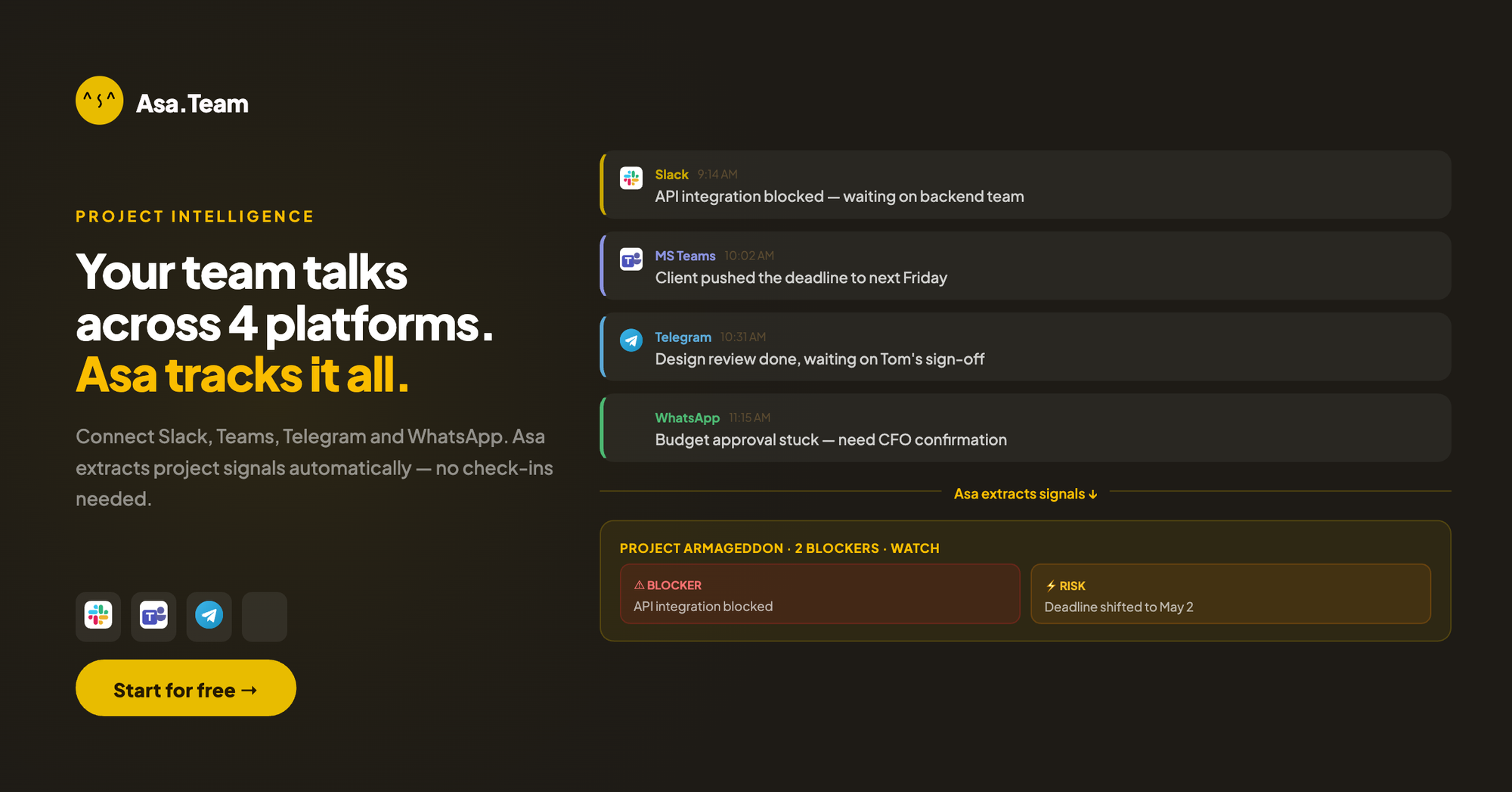
That is also where project intelligence earns its keep. Asa.Team surfaces updates from Slack, Teams, Telegram, and WhatsApp so leaders do not have to stitch the story together from scattered threads and half-read messages. The point is not to add another dashboard. It is to reduce the interruptions caused by uncertainty. When the latest project state is easy to find, people stop interrupting one another to ask for it.
The goal is not a perfectly quiet company. The goal is a company where attention is reserved for actual decisions, not constant rediscovery.
Conclusion: the best remote teams protect attention on purpose
Remote work interruptions are not proof that people are failing at discipline. They are a sign that the operating model has too many entry points for attention and too few protected stretches for real thinking. If the workday feels full but the important work keeps slipping, the answer is probably not "try harder." The answer is usually that the system is asking humans to do too much reorientation and not enough uninterrupted work.
The better question is whether your team has designed a day that can survive normal interruptions without shredding focus. If the answer is no, then the next productivity gain probably will not come from another app or another meeting. It will come from taking interruptions seriously enough to manage them. That is what makes remote work sustainable: not the absence of interruption, but the presence of a system that knows how to absorb it.
That is also why the healthiest remote teams do not celebrate availability as a virtue. They celebrate clarity, because clarity lets people leave the keyboard without worrying they missed the one thing that mattered. When the system makes urgent work obvious and routine work async, people can protect evenings, start fresh the next morning, and return to the deep parts of the job with less residue from the last interruption.