Meeting Recovery Time Is the Hidden Cost Your Team Never Budgets For
The real problem is not the meeting itself. It is the twenty minutes after the meeting when everyone is technically back at work but nobody has actually re-entered their work.

The real problem is not the meeting itself. It is the twenty minutes after the meeting when everyone is technically back at work but nobody has actually re-entered their work. A decision gets half-captured in the notes. Someone misses the detail that matters. The next task starts with a tab switch, a Slack check, and a search for the context that should have been preserved.
That is why some teams feel busy and still move slowly. They are not short on effort. They are short on recovery. If you never budget for the transition between one piece of work and the next, you will keep mistaking motion for progress. Meeting recovery time is not a soft preference; it is a real operating cost, and the teams that ignore it end up paying twice: once for the meeting, and again for the restart.
This post is about that restart. It is the part of the workday most calendars ignore, the part most managers never measure, and the part most teams feel as a vague sense of drag. Once you can name it, you can manage it.
Meetings do not end when the call does
A good meeting can still leave behind a bad handoff. The moment the call ends, people have to shift from listening mode to doing mode. That sounds trivial until you remember how much of modern work depends on context. If you were discussing scope, risk, ownership, or a customer issue, the next task is not a clean next step. It is a cognitive re-entry.
Research on virtual meeting fatigue makes that point directly. In Why am I so exhausted?: Exploring Meeting-to-Work Transition Time and Recovery from Virtual Meeting Fatigue, the authors note that ineffective meetings carry direct and indirect costs, including burnout and lost time for other work. Their conclusion is easy to read and harder to operationalize: people need recovery after workplace meetings, because the next task does not begin at zero.
That recovery is not only about tiredness. It is about mental context. When a meeting ends, the brain is still carrying the last argument, the unresolved question, or the half-finished decision. If the next task requires judgment, writing, or analysis, the first minutes go to reconstruction, not production.
The easiest mistake is to assume that everyone can bounce between modes at the same speed. Most people cannot, at least not without paying a cost. The more the team depends on fast transitions, the more it normalizes shallow work: short replies, vague notes, and a growing pile of things that “will make sense once I get back to it.”
This is why the old advice to “just keep the meeting short” misses the point. Short meetings can still create long recovery gaps if they are dense, unclear, or followed by more noise. What matters is not only the length of the call. It is whether people get enough time and structure to convert discussion into execution. If the meeting ends with ambiguity, you have not saved time; you have merely deferred the cost to the next hour.
The calendar hides the actual work tax
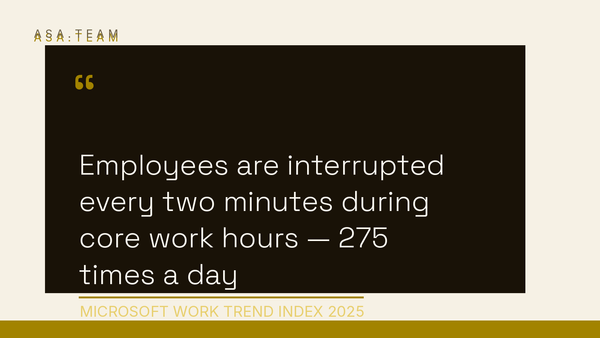
The calendar only shows scheduled time. It does not show how much of that time is spent getting back into work after interruptions. That is the hidden tax. Microsoft’s Breaking down the infinite workday report makes the scale of the problem hard to ignore. The page says the average worker receives 153 Teams messages per weekday, that half of meetings happen in the 9–11 a.m. and 1–3 p.m. windows, and that Microsoft 365 users are interrupted every 2 minutes by a meeting, email, or notification.
That is not a calendar full of work. That is a calendar full of interruptions. When the busiest parts of the day are also the noisiest, the team ends up using its best energy to keep up with the machinery of coordination. By the time someone reaches a document, a spreadsheet, or a customer problem, the day has already been broken into small, expensive pieces. The work still gets done eventually, but it gets done in fragments, and fragments are always more costly than flow.
Microsoft’s report also says that 54% of users are active at 11 a.m. That is a useful detail because it shows how the busiest hour of the day is not necessarily the best hour for output. In many teams, that window becomes a collision point: messages arrive, meetings overlap, and people try to do deep work in the cracks. The result is not speed. It is friction that feels normal because everyone is living inside it.
The practical lesson is uncomfortable but useful: if your team’s schedule is packed, you need to ask not “how many meetings do we have?” but “how much recovery time do those meetings consume?” If the answer is unknown, you are probably underestimating the real cost of coordination. The meeting count may look healthy while the actual workday is being eaten alive by handoffs.
Most teams already track enough operational metrics to know when delivery is at risk. What they rarely track is the invisible overhead that makes delivery slower before anyone sees the slip. Recovery time belongs in that conversation. So does the amount of time lost to reopening tabs, replaying conversations, and rebuilding a thought that was interrupted halfway through.
Why collaboration keeps growing until nothing is left
Collaboration is valuable. Over-collaboration is not. In Collaborative Overload, Rob Cross, Reb Rebele, and Adam Grant write that time spent in collaborative activities has ballooned by 50% or more. That is a lot of hidden overhead for work that is supposed to make execution easier. If every project requires more meetings, more follow-ups, and more clarification than the work itself, the organization is quietly spending the team’s attention budget before it has bought any progress.
The problem is not that people talk too much. The problem is that every additional touchpoint demands another context switch. A status question turns into a clarification thread. The clarification thread turns into a meeting. The meeting turns into a follow-up. By the time the day is over, everyone has participated in the project without making much forward motion on the project.
Atlassian’s context switching guide puts it plainly: context switching creates mental fatigue and increases the likelihood of errors as the brain struggles to refocus. Their recommended fixes are familiar for a reason: batch similar work together, minimize interruptions, and protect deep-focus blocks. Those are not trendy habits. They are responses to how attention actually works.
Think about the hidden chain reaction. A quick Slack ping interrupts a document. The document loses momentum. The author later revisits the draft and needs ten minutes to re-enter the idea. Another ping arrives before they finish. None of the interruptions feels dramatic in isolation. Together, they create a workplace where almost nothing gets finished in one pass.
That is the real tax of collaboration overload: it multiplies the number of partial states. Every partial state needs a return trip. Every return trip carries a cost. If your team is constantly asking people to move from one mental mode to another, it should not be surprising when quality slips or deadlines get fuzzy.
What good looks like
Good teams do not treat every meeting as a reset button. They design the end of the meeting so the next block of work has somewhere to land. That means a written decision, an owner, and a recovery buffer before the next call or the next deep task. It also means being realistic about when people can be expected to respond. A fast reply is useful only when it does not destroy the work that was already in progress.
- A meeting produces one clear outcome, not three competing interpretations.
- Follow-up happens in writing whenever possible.
- People get a buffer after dense meetings before they are asked to switch modes.
- Response-time expectations are explicit instead of implied.
GitLab’s handbook takes the same idea in a more operational direction. In How to embrace asynchronous communication for remote work, the team recommends shifting to async updates so people can address messages on their schedule rather than reacting in the moment. It also stresses clear expectations around response times and status indicators when someone is in focused work mode. That is what healthy collaboration looks like: fewer demands for instant reply, more clarity about when a reply is actually needed.
This matters even for teams that are not fully remote. Async is not a remote-work ideology. It is a way of respecting human attention. When people can process updates on their own schedule, they spend less of the day reassembling context and more of it actually using context. The payoff is not just comfort. It is better decisions, fewer mistakes, and less time lost to rework.
That is also where project visibility matters. If updates live in different channels, the team spends more time stitching together the story than acting on it. Asa.Team helps by surfacing project updates from Slack, Teams, Telegram, and WhatsApp so leaders can see blockers, decisions, and progress without forcing another sync just to reconstruct the thread.
Conclusion
Meeting recovery time is one of those costs that hides in plain sight. It is small enough to ignore on any single day and large enough to distort an entire quarter. The meeting itself may be useful. The problem is everything it leaves behind when the team is expected to resume at full speed with no transition.
Once you see recovery time as a budget item, a lot of frustrating behavior becomes easier to explain. Slow follow-through is not always laziness. Missed details are not always carelessness. Sometimes the team is simply trying to do serious work in the middle of a schedule that never lets it re-enter the work cleanly.
The better question is not whether your team meets enough. It is whether your team gets enough uninterrupted time to turn those meetings into output. If the answer is no, you do not need more urgency. You need better recovery.
So the next time a meeting ends, ask the only question that really matters: what will it take for the team to truly get back into the work?