Billable vs Non-Billable Hours: The Difference Deciding Your Real Profit
You agree to 40 hours a week for a client, then wonder why the hours you invoice never match the hours you actually worked. Here’s why billable vs non-billable hours is your real profit leak.
You agree to 40 hours a week for a client, then wonder why the hours you invoice never match the hours you actually worked. Every founder on client work knows the feeling: you clocked out exhausted, yet half the day seems to have vanished into emails, internal calls, and "quick" proposal tweaks that no one is paying you for.
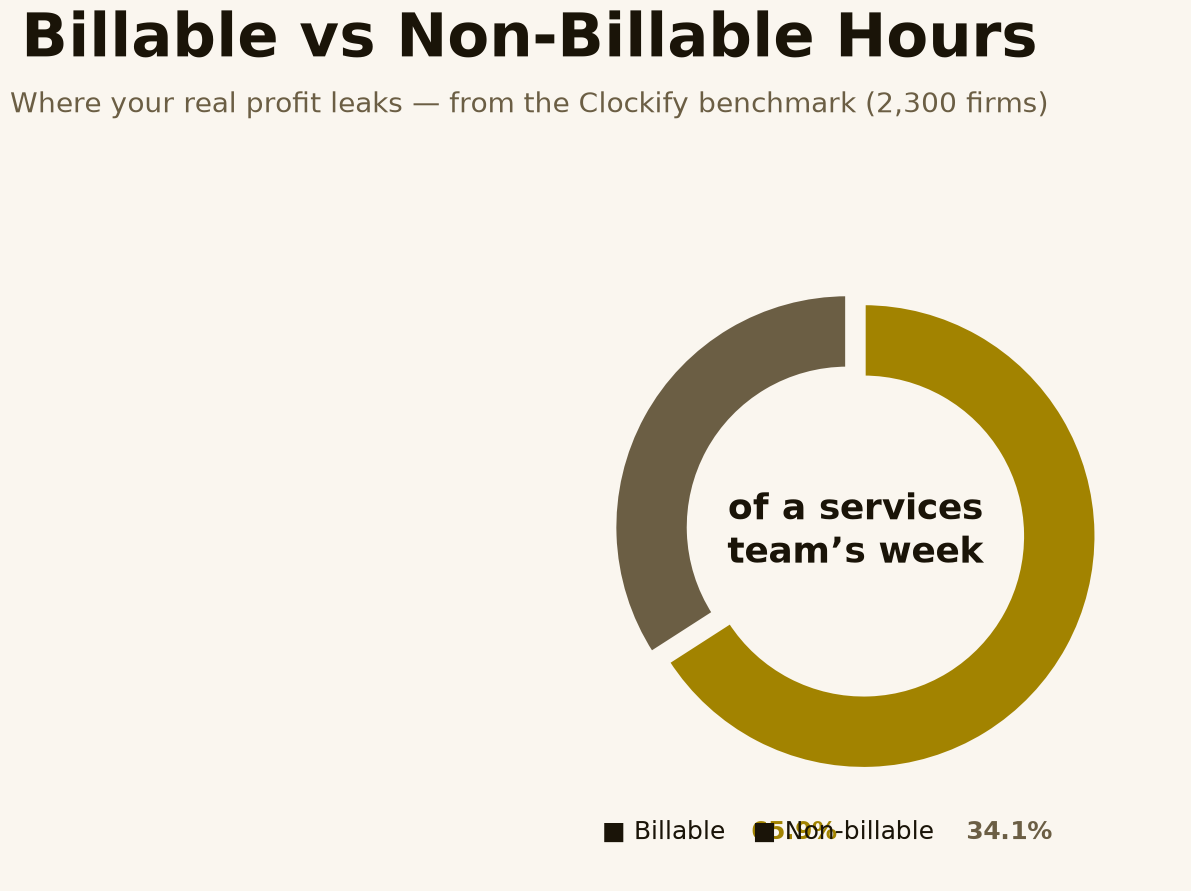
The core leak: 65.9% of a services team\u2019s week is billable \u2014 the other 34.1% is work you do but never get paid for. You can\u2019t fix what you never track.
It is tempting to blame the client or the rate. But the gap between hours worked and hours billed is not a pricing problem — it is a classification problem. Most teams cannot tell you where the hours went because they never decided which hours were billable and which were not. The result is that overhead quietly gets priced into your own capacity, and you absorb it as lost profit.
In this post we break down billable vs non-billable hours, show you where the hours actually go with real numbers, and give you a realistic benchmark so you can stop guessing and start billing what your time is worth.
What counts as billable hours
Billable hours are the time you can directly invoice to a client. Toggl defines billable hours as time spent working on a client's project, and Clockify puts it plainly: billable time is the work you can charge for — calls with clients, building the actual deliverable, and sending them updates on that project.
Non-billable hours are everything else. Training, internal meetings, bookkeeping, proposals for work you have not won yet, and the administrative glue that keeps the business running. Clockify's description of non-billable time is blunt: it "can drain your wallet if not managed properly," even though it is essential to operating smoothly.
In practice the boundary is fuzzier than it looks. A lawyer drafting a contract for a client is billing. A lawyer writing an internal memo about a regulation is not. A designer comping a landing page for a paying customer is billing. A designer polishing their own portfolio is not. An accountant preparing a client's year-end return is billing; the same accountant rebuilding their spreadsheet workflow is not. Every professional makes these calls dozens of times a day, and the calls compound into the difference between a profitable year and a flat one.
None of this means non-billable work is bad. The mistake is treating it as invisible. A healthy services team budgets for internal work explicitly — it knows it is spending four hours a week on proposals and six on training, and it prices deals knowing that reality. A struggling team never writes those numbers down, so its overhead shows up silently as thinner margins and longer weeks.
Billable work keeps the lights on; non-billable work keeps the business alive. Confuse the two and you quietly fund your own overhead out of your own pocket.
Where the hours actually go
The leak is bigger than most founders assume, and there is real data behind it. Clockify's time-tracking data across 2,300 US firms found that 65.9% of work hours are billable and 34.1% are non-billable. Roughly a third of the average workweek never makes it onto an invoice.
Freelancers fare worse. FreeRateSuite's breakdown of real freelancer data puts the average freelancer at about 25 billable hours out of a 40-hour week — a 60% utilization rate. The other 15 hours split across client communication that is not billed, proposals and estimates, invoicing and bookkeeping, learning new skills, marketing, and internal planning.
Run that through a concrete scenario and the pain becomes obvious. Imagine a solo consultant charging $150 an hour who bills 25 of 40 hours. On a 48-week year that is $180,000 of billable revenue. But the 15 un-billed hours are also worth $45 an hour on paper — meaning that consultant is paying themselves a $108,000-a-year second job in admin, proposals, and bookkeeping, and never seeing a dollar of it.
Here is the uncomfortable part. A large slice of that non-billable time is not even real internal work. Asana's Anatomy of Work Index found that knowledge workers spend 60% of their time on "work about work" — chasing updates, attending unnecessary meetings, and switching between tools. That is time nobody billed and nobody used to actually build anything.
Chasing updates across tools is the silent killer of billable time. It looks like work, feels like work, and produces nothing you can invoice.
How to measure your real utilization rate
Measuring this is simple arithmetic, not a gut feeling. Your billable utilization rate is your total billable hours divided by your total working hours, multiplied by 100. Clockify's formula is exactly that: (total billable hours / total actual hours) x 100.
Once you can calculate it, you need a benchmark to compare against. Industry targets vary widely. Clockify lists typical billable hours per year of 2,000–2,500 for law, 1,664–2,080 for consulting, and roughly 1,200–1,600 for PR and marketing firms, where marketing work often runs closer to half of the working year.
Here is where most teams get an uncomfortable, honest answer. The 2025 Professional Services Maturity Benchmark cited by Clockify reports consultant billable utilization at 68.9% — below the 75% most firms consider healthy. Most consulting teams are losing a quarter of their potential billable capacity before they even begin to look for new business.
You only need to track one week to get a working number. Log every hour, tag it billable or not, and divide. If you land below 60%, you do not have a pricing problem. You have a visibility problem — and you cannot manage what you cannot see.
Small changes that put hours back on the clock
The welcome truth is that non-billable time is not a fixed cost. It responds to deliberate choices about how the team works, and the leverage is bigger than most people expect. The changes are not exotic.
- Kill meeting defaults. When a client update can be written in two sentences, an internal meeting about it is pure non-billable burn. Replace status meetings with written, asynchronous updates that people can read in seconds.
- Batch the admin. Freelancers lose hours to inbox-driven work because every email interrupts a billable deep-work block. Set one or two windows a day for admin and protect everything else.
- Track everything, even the work you do not bill. You cannot improve a utilization rate you cannot see. Time that is never tracked simply disappears from your margin without a trace.
- Put an actual number on non-billable internal tasks. If training and marketing are eating 15 hours a week, that is real capacity. Decide deliberately how much you want it to be, instead of letting it drift upward unnoticed.
The pattern behind all of these is identical: non-billable time shrinks when information stops being chased by hand. The less time your team spends hunting for statuses, the more time it spends on work that actually pays.
Consider what a single recurring status meeting costs a small firm over a year. A half-hour sync with five people is 2.5 hours a week, or roughly 120 hours a year at 48 working weeks. At a blended $100-an-hour cost that is $12,000 a year spent mostly relaying information everyone could have read in writing in five minutes. Now multiply that across every project and every weekly meeting, and the 15 un-billed hours in a typical week start to look entirely avoidable.
Billable vs non-billable at a glance
| Billable hours | Non-billable hours | |
|---|---|---|
| What counts | Client calls, deliverable work, project updates | Training, internal meetings, proposals, bookkeeping |
| Do you get paid? | Yes \u2014 directly invoiced | No \u2014 absorbed as overhead |
| Healthy share | ~68\u201375% utilization | ~25\u201332% |
| If left untracked | Looks great on paper | Silently eats your margin |
What good looks like
A founder running client work at a healthy clip looks different from one who is perpetually underwater. They know their utilization rate within a few points, without running a special report. They rarely sit in a "status" meeting. And they can say, on any given morning, where each client project actually stands and who is waiting on whom — without opening five apps and reading a thread.
That last piece is where the discipline pays off hardest. A large share of the 60% of "work about work" Asana flagged is simply the cost of finding out what is happening: chasing updates across Slack, Teams, email, and a project tracker that is always a day stale. Project intelligence collapses that cost — surfacing updates, blockers, and handoffs from the conversations your team already has, in one place, so nobody has to chase. When status stops being a scavenger hunt, more of the week stays billable.
Good looks like a team that spends its energy shipping client work, not reconstructing what happened last week.
Frequently asked questions
What is the difference between billable and non-billable hours?
Billable hours are time you can directly invoice to a client; non-billable hours are everything else \u2014 internal meetings, training, proposals, and admin. The split matters because non-billable work quietly erodes your real profit.
What is a healthy billable utilization rate?
Industry benchmarks put healthy utilization around 68\u201375% for consultants (2025 PSM Benchmark) and 60% for solo freelancers. Below that, overhead is eating margin.
How do I measure my utilization rate?
Divide billable hours by total hours worked in a week, then track it over time. Most teams can\u2019t even report this today because they never distinguished billable from non-billable in the first place.
Do I need time-tracking software to fix this?
You need a way to classify hours at the source. Time tracking that flags categories as billable vs non-billable is the practical first step; once you can see the split, you can act on it.
Conclusion
Billable vs non-billable hours is not a bookkeeping detail. It is the difference between a services business that quietly funds its own overhead and one that is slowly giving away a third of its capacity. Track the split, calculate your true utilization rate, and treat "work about work" as the leak it actually is.
Here is the question worth sitting with this week: if you removed every hour you spent just trying to find out what was happening in your projects, how many billable hours would come back to you? That number is your real growth lever — and it is bigger than you think.