WhatsApp for Project Management: Why It Fails (and What Actually Works)
WhatsApp for project management usually starts as an accident — and it becomes a consistent liability the moment a project has real moving parts. Here is why updates get lost in chat, and what a team needs to finally answer "where are we?"
WhatsApp for project management usually starts as an accident. Someone makes a group chat to finalize a deliverable, adds the client, and by Friday the whole project lives inside a thread that scrolls past birthdays and memes. Status is wherever the last message happened to land. The timeline is a guess. And when anyone asks what actually got decided, the answer is the same everywhere: "it's in the WhatsApp group, scroll up."
This is the most common way small teams and solo operators run projects, and it is a consistent failure. WhatsApp is a chat app built for conversation, not for task ownership, accountability, or tracking. It works brilliantly until the project has more than a few moving parts — and then the same convenience that made it the default becomes the reason nothing ships on time. The thesis of this post is straightforward: WhatsApp for project management fails not because the app is bad, but because chat is the wrong shape for project data. The fix isn't a better group chat. It is a structure that survives the scroll.
The Convenience That Sets the Trap
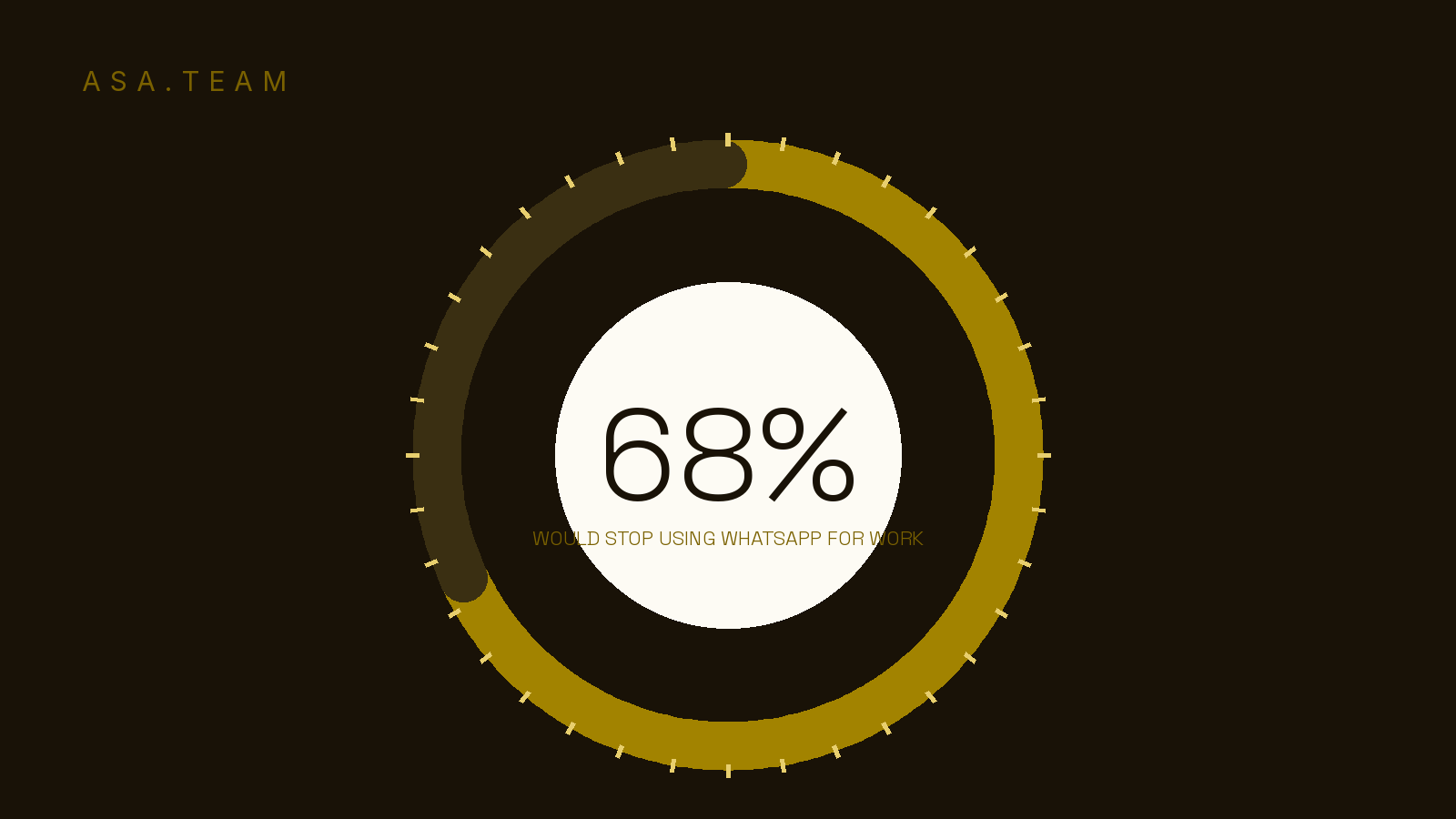
The case for WhatsApp is real, and it deserves a straight answer. It is already installed on everyone's phone. There is no login prompt, no training, no second tool to open. For a team of two or three people shipping something quick, chat-based coordination genuinely works — you assign, someone replies, it happens. Google's own research on frontline workers found that 53 percent use messaging apps like WhatsApp up to six times a day for work — not because they want to, but because it is the fastest path to an answer. 68 percent said they would stop using the apps if they were given proper internal tools. That gap is the whole story: WhatsApp wins on friction, not on fit.
The convenience is real. The trap is that it scales badly. Project management is not one conversation; it is a ledger of decisions, owners, and deadlines that needs to outlive feelings-of-the-day. A chat thread is a conversation that forgets. What teams are actually doing when they run projects on WhatsApp is storing deliverables, deadlines, and decisions in a conversation designed to erase them. Everything works until the moment someone needs to know what happened last Tuesday, and the answer requires scrolling.
Where WhatsApp Breaks Down
The failure is not abstract. Applied Project Management put it plainly: "Yes, we talked about this — check your WhatsApp group" has become the default answer to every project question. Timelines live in WhatsApp. Requirement documents get shared in WhatsApp. Accountability for who finished a task is a scroll through the group messages. And when those messages are the only record, the system stops being manageable and starts being a liability.
What exactly disintegrates:
- Decisions disappear into the scroll. Requirements discussed across fifty messages, with a person joining midway and another leaving before the decision, do not produce a requirement. They produce a guess.
- Accountability evaporates in a group. When everyone sees everything, no one owns anything. "Someone should handle the vendor contract" assigns ownership to a cloud. Missed deadlines are common.
- There is no history — just an archive. You cannot show what is pending, overdue, blocked, or done. You can only hunt through an unsearchable stream at the exact moment a client asks.
The project management team at No Office makes the costs explicit: WhatsApp gives you no task assignment, no priorities, no reporting, and no visibility into progress. Every one of those is a thing a project needs and a thing a chat thread structurally can't provide. The moment a project depends on you remembering a single buried decision, the group chat has already failed.
The Real Cost: You Cannot Answer "Where Are We?"
Strip away all the abstractions and the actual price of WhatsApp for project management is a single repeated question that nobody can honestly answer: where are we? The leader asks, "How's the launch going?" and gets five opinions from a thread that has swallowed three weeks of mixed context. The client asks for a simple status and the person with the real picture has to dig through messages and reconstruct it from memory, hoping nothing slid.
This is not a WhatsApp-organizational problem — it is a context problem, and every chat-based tool shares it. Flowhubr put the core limitation in one clean line: WhatsApp was built for conversation, not for task ownership, accountability, or structured tracking. When all updates arrive as flat scrolling messages, every "where are we" answer is an act of archaeology. And the mix of personal and work life on top makes it worse — one user described their chat as "really 91 percent work-related, mixed into my personal life". The wrong information is not just buried; it is buried under everything else.
A WhatsApp group chat is a conversation. A project is a record. Confusing the two is how deadlines quietly disappear.
The compounding cost is that leaders feel the friction and compensate the wrong way. A team with no visible shared state falls back on reminder messages, more group chats, and "any updates?" follows thread after thread. That is the same coordinator-and-chase cycle that makes async teams lose project updates in Slack and drift apart when there's no standing rhythm. The moment a tool cannot answer "where are we?" without hunting, the project has two jobs: the real work, and the work of reconstructing its own status.
What Good Looks Like: Let the Updates Come to You
The fix is not to bolt a second system on top of WhatsApp and force a migration. The strongest teams don't pull people out of the thread to log their own updates somewhere else; they let the updates that already live in WhatsApp become the project view, without relying on anyone to repeat them.
This is precisely what Project Intelligence does. It reads the updates your team already writes across WhatsApp, Slack, Teams, and Telegram and turns them into a current, cross-platform project view. Nobody prepares a special report, and nobody gets pulled into another sync to say where the project stands. The status that already exists in the chat gets reshaped into a single thread of record.
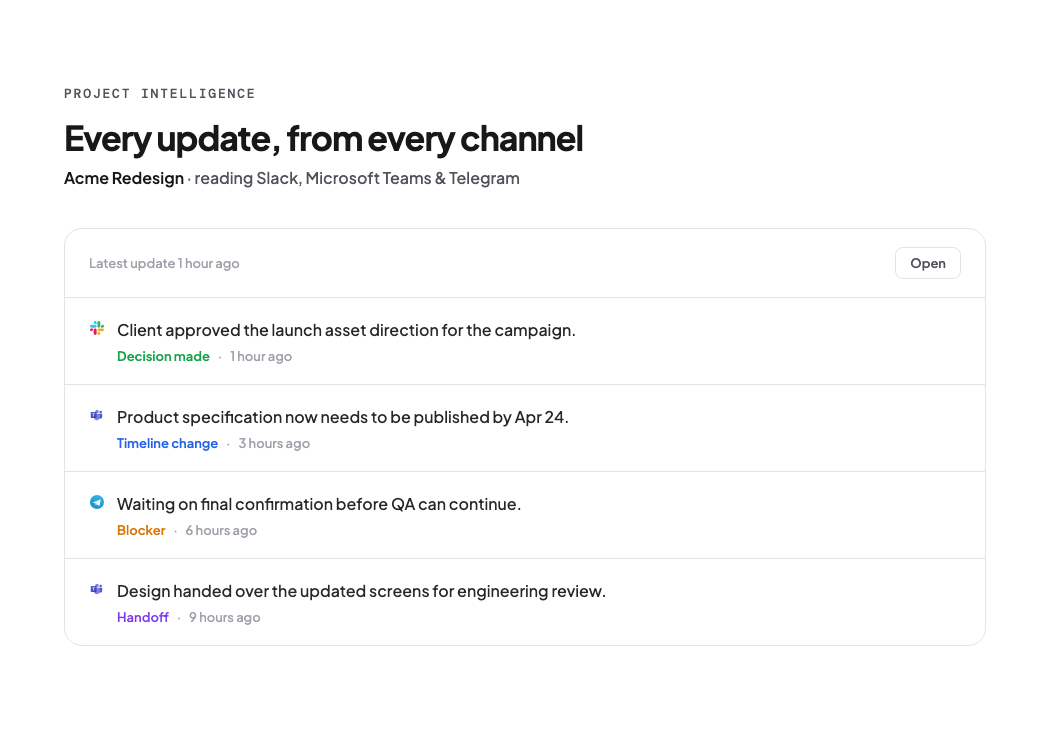
Benchmarked side by side with the group chat:
| WhatsApp group chat | A live project view |
|---|---|
| Status lives in whatever message was last | Status is assembled from every update, in order |
| "Where are we?" means scrolling and guessing | "Where are we?" is answered without asking anyone |
| Decisions buried in memes and personal messages | Decisions surface from the updates that matter |
| Deadlines exist only in memory | Deadlines and blockers are visible at a glance |
| Accountability diffuses across everyone | Ownership is clear from the thread of record |
The change is not a new app for your team to adopt. It is the same WhatsApp habit, with the crucial upgrade: the updates stop being the report to be transcribed and start being the data itself — the source of a shared, up-to-date view. That is the difference between a group chat and project as a system that survives the scroll. For a small team or a lone operator juggling a half dozen apps and workflows, it is the difference between hoping and knowing.
Is WhatsApp Ever a Legit Project Tool?
Be fair: there are two places WhatsApp earns its keep in a project. The first is as a notification layer — a place where updates you already track elsewhere inform people that something changed. The second is as a lightweight reporting channel for a small, well-scoped initiative where the whole team already knows the plan and just needs to nudge. In both cases, the thread is a complement, not the system of record. The failure is only when the chat becomes the sole place the truth lives, and every open question in the project resolves to a scroll.
If a project's status can only be answered by someone digging through a group chat, it is not a handled project — it is a hope. The purpose of moving your status off the thread is not to be more organized for its own sake. It is to make "where are we?" a question with an answer that does not depend on anyone's morning mood.
Frequently Asked Questions
Is WhatsApp a project management tool? Not a real one. WhatsApp is a messaging tool that allows you to know project data — ownership, deadlines, priorities, and progress — only by asking whoever holds the picture. For lightweight coordination, that reasoning can work. For a project with real scope, it is structurally insufficient.
Why is WhatsApp not good for teams? Because the attributes that make it a communication tool — a single fast scroll of messages, no hierarchy, no ownership, no history of the project state — are exactly the attributes a project tool must have. Updates get lost, accountability gets fuzzy, and the project state is whatever the last message said.
How do people use WhatsApp for work today? Often by accident: a quick group chat that becomes the de facto system of record. Many frontline and small-team workers use WhatsApp or similar apps to coordinate precisely because it is already on their phones and the answer is fast — even when they'd prefer a proper internal tool.
Should I replace WhatsApp for team communication? For chat with your team, no. Replace it as the system of record over project status. Keep WhatsApp where conversations belong — and move where you keep track of "where are we" to a view that updates itself from your existing conversations. full Betika review