What Percentage of Employees Are Micromanaged? The Real Numbers
59%, 79%, or nearly 3 in 4? The micromanagement numbers disagree because they measure different things. Here is what each clock really says about your team.
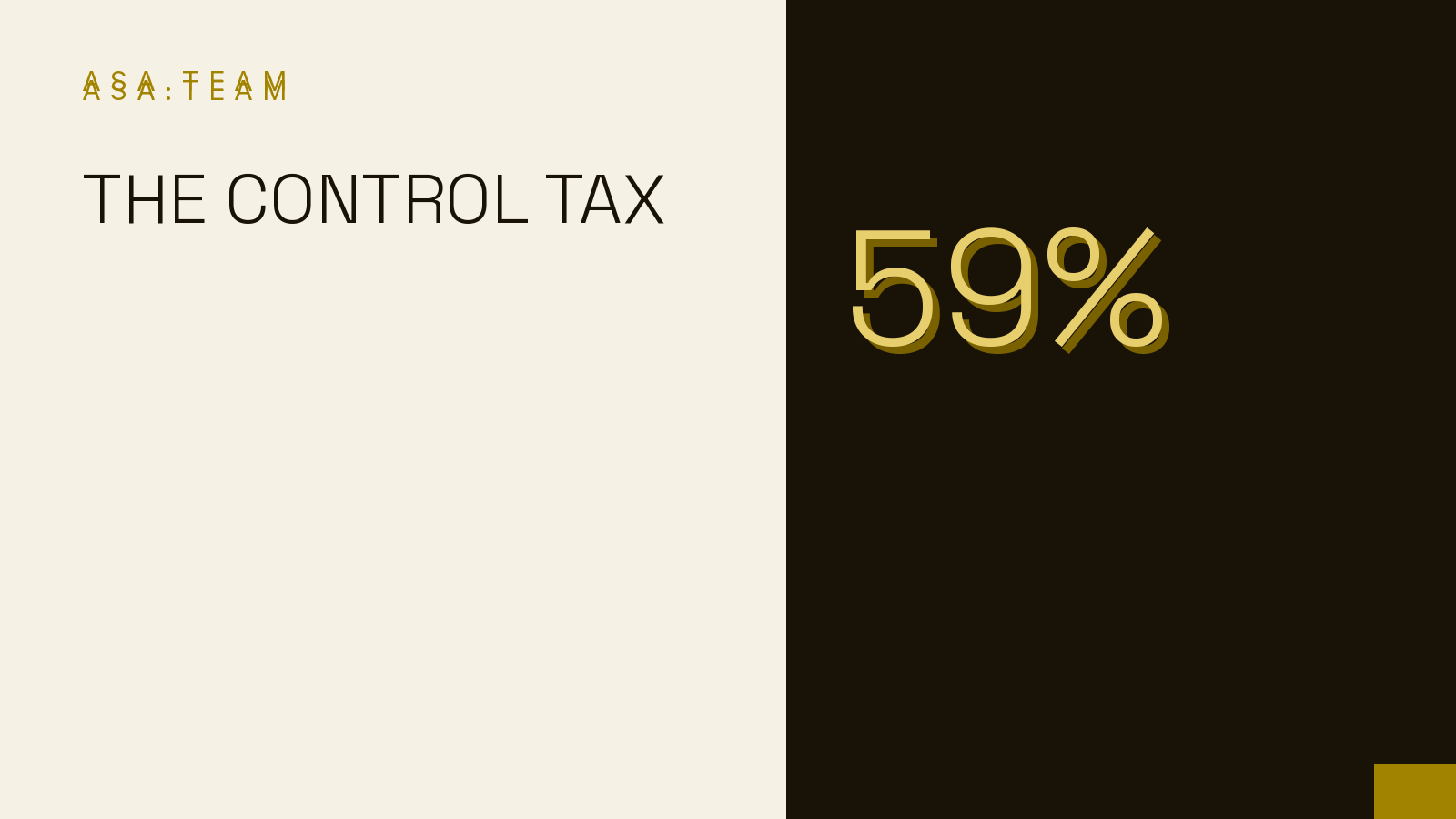
If you have ever searched what percentage of employees are micromanaged, you probably noticed the numbers refuse to agree. One survey says 59%. Another says 79%. A third implies roughly three in four workers consider it a disqualifying red flag. None of these are wrong — they are measuring different things, and the disagreement itself is the most useful finding in this entire data set. Micromanagement is not one behavior you can count like office chairs. It is a spectrum of control, and the answer shifts depending on whether you ask workers "have you ever?", "is it happening now?", or "would you quit over it?". This post opens all three clocks and reconciles them, because for a founder or team lead the question that matters is not "is my team being micromanaged?" but "how much control is costing me in trust, output, and turnover?"
The short version: the majority of knowledge workers have been micromanaged at some point, the people doing it rarely identify as micromanagers, and the cost shows up exactly where project chaos already lives — in the gap between what a manager thinks is happening and what is actually happening.
The three clocks: why one number is never the answer
The most-cited prevalence figure comes from Accountemps, the staffing arm of Robert Half. In a survey of workers, 59% said they had worked for a micromanager at some point in their career — and of those, 68% said it decreased their morale and 55% said it hurt their productivity (Robert Half press release). Note the question: have you ever. That clock measures lifetime exposure, and it quietly understates what is happening inside a typical organization today.
The wider clock comes from a survey compiled by management researcher Harry Chambers and reported by Weekdone: 79% of employees claimed they had been micromanaged at one point or another. Same lifetime framing, harsher wording, bigger number. When people hear "micromanaged" rather than "worked for a micromanager," more of them raise their hands — because the behavior is easier to recognize than the label.
The narrowest, most decision-relevant clock is the red-flag clock. A Monster.com survey of job seekers reported that nearly 3 out of 4 workers say micromanagement raises the biggest red flag about a workplace, and 46% say they would leave a job because of it (HR Dive). This clock measures consequence, not exposure — and it is the one that shows up in your retention numbers.
| Question asked | Result | What it measures |
|---|---|---|
| "Have you ever worked for a micromanager?" | 59% | Lifetime exposure (Accountemps / Robert Half) |
| "Have you ever been micromanaged?" | 79% | Recognition of the behavior itself (Chambers survey) |
| "Is micromanagement a deal-breaking red flag?" | ~75% red flag; 46% would quit | Behavioral consequence (Monster.com survey) |
Read together, the spread says something uncomfortable: most workers have felt the behavior, roughly three in four treat it as a warning sign, and almost half have one foot out the door because of it. The disagreement between the numbers is not a data-quality problem. It is a definitional one — and defining the term honestly is the first thing most managers never do.
What micromanagement actually costs
Micromanagement is usually defended as a quality-control mechanism. The research treats that defense with less patience. Beyond the 68% morale and 55% productivity hits in the Robert Half data, the turnover arithmetic is where the bill arrives. 70% of employees say they consider quitting when micromanaged, and 30% follow through (Management Consulted). And the trigger is not subtle: GoodHire's survey of American workers found 82% would quit because of a bad manager, with a manager who micromanages rated among the most irritating traits — tied with one who expects work outside working hours (GoodHire).
For a founder running five workstreams, this is not an HR abstraction. Every departed employee takes project context with them — the half-written decisions, the client history, the reason the deadline moved twice. That context loss is the same failure mode we write about in why project updates get lost in Slack, just arriving from the management side instead of the messaging side.
The tighter the grip, the more the organization pays for control it does not actually get. Micromanagement does not buy visibility — it buys compliance, and compliance is the cheapest thing a team can fake.
There is a second, quieter cost: the manager's own time. A manager who re-checks every task is running two jobs — the strategic one and the surveillance one. If you have ever wondered how many hours disappear from leadership into "just checking," that is this tax, and it compounds across every direct report. The same math behind status update meetings wasting time applies here: reporting that exists to reassure a manager, rather than to inform one, is pure coordination overhead.
Why managers do it: anxiety, not malice
Here is the part most micromanagement articles skip: the people doing it rarely believe they are doing it. Weekdone's survey summary found 91% of managers were unaware that employees had changed jobs because of their micromanagement behaviors. The behavior is visible from below and nearly invisible from above — which is why culture-only interventions ("trust your team more!") tend to fail. The problem is not that managers are bad people. It is that they are anxious, and the anxiety has a structural cause.
ExpressVPN's large survey of remote work, conducted with Pollfish across 2,000 employers and 2,000 employees, mapped the anxiety directly to the surveillance response. 74% of employers said they feel a lack of control over their business, and 69% said they feel uneasy about remote work because they cannot observe employees in person. 59% said they do not trust employees to work without digital supervision — and 80% have deployed monitoring software to do something about it (ExpressVPN).
Read that chain carefully: uncertainty about project status → loss of felt control → surveillance. Micromanagement is what happens when a leader has no legible source of truth about the work. The hovering is a symptom. The disease is invisible status.
And the surveillance, in turn, produces exactly the theater the manager was trying to avoid. The same ExpressVPN survey found 56% of monitored employees feel stress and anxiety about being watched, 25% have researched ways to fake online activity, and one in four would accept a 25% pay cut to avoid surveillance. When people optimize for looking busy instead of being productive, the manager's uncertainty never actually resolves — it just gets more expensive. This is the burnout pipeline we covered in remote team burnout signs, seen from the control side: constant scrutiny erodes autonomy, and autonomy loss is one of the most reliable burnout generators in organizational research.
What good looks like: visibility without surveillance
The alternative to micromanagement is not laissez-faire. It is not "hope they tell you." It is a system where project status is legible without being requested — where the work itself emits enough signal that a leader can see progress, blockers, and drift without opening a fifth check-in meeting or installing a keystroke logger.
In practice, "good" looks like three habits. First, the team's updates live where the work happens — Slack, Teams, Telegram, WhatsApp — and get read as status, not just chatter. Second, exceptions travel to the manager instead of the manager traveling to the exceptions; nobody has to ask "where is this at?" because the answer accumulates on its own. Third, the manager's input lands at decision points, not checkpoints — which is the difference between accountability and surveillance, and the exact line GoodHire's respondents were describing when they ranked micromanagers alongside out-of-hours demands as the fastest route to resignation.
This is where tooling finally earns its keep. Asa.Team's Project Intelligence surfaces project updates from the platforms your team already writes them in — Slack, Teams, Telegram, WhatsApp — and turns them into a single, current picture per project, so a leader sees what is actually happening without asking anyone. The goal is not more monitoring; it is the opposite. When status is pulled from the work instead of pried out of people, the manager's anxiety (74% feel a lack of control — remember) gets a real answer, the surveillance reflex loses its fuel, and the 59%-then-79% population of micromanagement survivors gets to work without a hover.
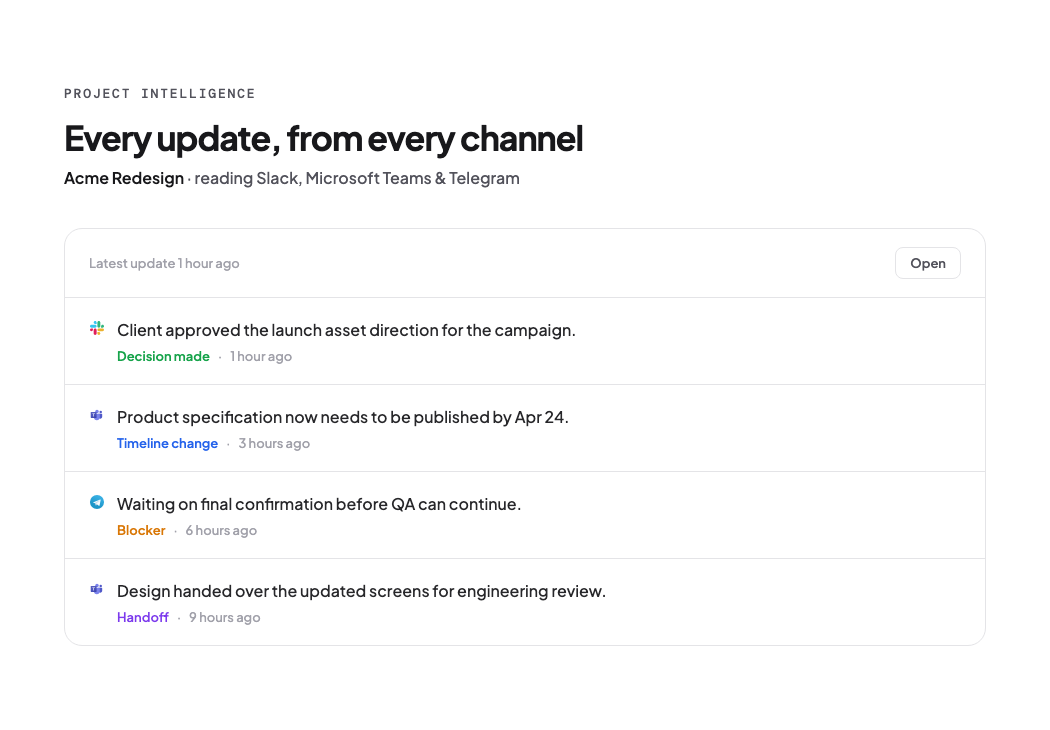
The test of the shift is simple: if your team stopped sending status reports tomorrow, would you still know the state of every project? If the answer is no, the visibility is being manufactured by human reporting labor — which means it can be faked, gamed, or burned out. If the answer is yes, you have moved from control to intelligence, and the micromanagement question stops being a culture question and becomes a plumbing question.
Frequently Asked Questions
What percentage of employees are micromanaged? It depends on the question. 59% of workers say they have worked for a micromanager (Robert Half / Accountemps); 79% say they have personally been micromanaged at some point (Chambers survey); and nearly 3 in 4 call it their biggest workplace red flag, with 46% saying they would quit over it (Monster.com). All three are real — they measure exposure, recognition, and consequence respectively.
Do managers know they are micromanaging? Usually not. In the Chambers-survey reporting, 91% of managers were unaware that employees had changed jobs because of their micromanagement behaviors. The behavior is obvious from below and nearly invisible from above.
Does employee monitoring stop micromanagement? The evidence says it is micromanagement, just digitized. 80% of employers use monitoring software, yet 72% of monitored employees say it does not improve their performance, 25% research ways to fake activity, and 1 in 4 would take a 25% pay cut to avoid it (ExpressVPN survey).
Is micromanagement the same as caring about quality? No. Quality oversight intervenes at decision points; micromanagement intervenes at task level, continuously. The measurable difference is that the first one raises output and the second one lowers it — 55% of affected workers report lost productivity.
The uncomfortable question for your team
The data agrees on one thing under all the definitional noise: micromanagement is common, expensive, and almost always driven by a leader who cannot see the work clearly enough to relax. 59% of your people have lived it, 79% will recognize it if you describe the behavior instead of the label, and nearly half of your best candidates have a "would I quit over this?" answer already loaded in their head. So the question worth sitting with is not whether you are micromanaging. It is whether your team's status lives in a system you trust — or in check-ins you are afraid to stop.
If your visibility runs on pinging people, you are not managing; you are paying a coordination tax in human attention. The fix is not another reporting ritual. It is making the work legible so that trust is something you can afford to give. Ask yourself honestly: when did you last learn something about a project from the project itself?