How Many Notifications Does the Average Person Get a Day?
How many notifications does the average person get a day? By the time you finish reading this sentence, odds are one just lit up near you — Slack, Teams, a Telegram channel,
How many notifications does the average person get a day? By the time you finish reading this sentence, odds are one just lit up near you — Slack, Teams, a Telegram channel, a WhatsApp group. You don't remember turning them all on. You just remember that sometime around 2019, your phone stopped being a tool you check and became a thing that pings you.
Researchers have actually counted, and the short answer is: far more than you think — and almost none of it is for you.
Across every study published in the last few years, the number lands between 46 and 146 notifications per day, depending on what you count. That is a distraction every 6 to 20 minutes, all day, every day, for the average adult. For people running projects, the count skews worse, because work chat does not clock out.
This is not a "put your phone in a drawer" sermon. It is a look at what the real numbers say, why your project updates keep getting buried in the noise, and what teams actually do when they stop living inside their notification badges.
The honest number: how many notifications people really get
The first thing you learn when you read the actual research is that "how many notifications" depends entirely on what you count. Studies measure push notifications, phone pickups, screen unlocks, or total alerts across every app — and they get very different answers.
The most widely cited figure comes from Business of Apps, which reports that the average U.S. smartphone user receives 46 push notifications per day. That alone is one alert every 20 minutes during a 16-hour waking day — before a single email or work message is counted. A 2026 roundup by browwwser Research cites an 80–100 per day average across all devices, drawn from RescueTime and mobile analytics firms.
The higher counts come from studies that include every channel. The 2026 Computers in Human Behavior study on notification distraction noted that participants received more than 100 notifications per day on average. And a musicMagpie study found the average person receives 146 notifications daily — one every ten minutes, with Gen Z averaging 181.
| What's counted | Daily average | Source |
|---|---|---|
| Push notifications (US smartphone) | 46 | Business of Apps |
| All device notifications | 80–100 | RescueTime / browwwser Research |
| All app notifications (study sample) | 100+ | Computers in Human Behavior (2026) |
| All notifications, all devices | 146 (every 10 min) | musicMagpie / Workplace Insight |
| Gen Z daily count | 181 | musicMagpie / Workplace Insight |
None of these counts include the office layer. Add Microsoft's finding that the average worker receives 117 emails a day, plus Slack or Teams messages, plus calendar alerts, and the real working total for a knowledge professional is comfortably north of 100 — with a meaningful share of it arriving during hours that used to belong to deep work.
The average person is interrupted by notifications 80 to 146 times a day. Only 10–15% of them are genuinely time-sensitive or require action (RescueTime data via browwwser Research).
What each ping actually costs
The volume is only half the story. The other half is what a single notification does to a brain that was two paragraphs into something important.
The 2026 Computers in Human Behavior study found that a smartphone notification disrupts concentration for about seven seconds — even when the phone is not touched and the alert is not opened. In an experiment with 180 participants, even fake, blurred notifications measurably slowed mental processing on a Stroop task. Seven seconds sounds small. Multiply it by 100 notifications and you get 12 minutes of pure cognitive fog before you act on anything.
The recovery cost when you do check is worse. UC Irvine researcher Gloria Mark's work, covered by Gallup, found it takes an average of 23 minutes and 15 seconds to return to a task after an interruption — the figure behind the famous "23 minutes" statistic, and one Mark has consistently reproduced in field studies of knowledge workers. Her conclusion from that research: "We don't have work days — we have work minutes that last all day."
Put the numbers together and the arithmetic is brutal. One hundred notifications a day, seven seconds of fog each: 12 minutes of scattered thinking. Twenty of those notifications actually lure you away: at 23 minutes to re-focus each, that is nearly eight hours of fragmented attention across a single workday — which is why so many people end the day exhausted without having finished a single thing that mattered.
And the checking habit has compounded on itself. Asurion's research found Americans now check their phones 352 times a day — once every two minutes and 43 seconds — nearly four times the 96 checks recorded in 2019. That is not 352 moments of intention. It is 352 micro-interruptions, most of them triggered by an alert or the phantom expectation of one.
Why team projects feel the noise worst
Notification overload is not evenly distributed. It lands hardest on the people who coordinate work, because they are signed into the most platforms and the most channels.
Slack alone is enormous: more than 1.5 billion messages are sent through Slack every day, its 47 million daily active users spend over 90 minutes per workday actively engaging, and remain signed in for an average of nine hours. Microsoft's work-trend research shows the same shape: the average worker receives 117 emails daily, most skimmed in under 60 seconds. Multiply that across Slack, Teams, Telegram, and WhatsApp, and a project lead is effectively monitoring a pager that never stops.
The specific failure mode for projects is what we've covered before: project updates get lost in Slack because a status message is just one move in a river of messages, and Slack notification overload becomes the default state. The update that matters — "the client approved the new scope" or "the build is blocked on the API key" — sits one screen below a meme, and by the time you scroll back to it, someone has replied four times and the context is already stale.
That is the real cost of the daily notification count. It is not just lost attention. It is lost project status: the single most expensive piece of information a team produces, competing for the same seven-second slice of your attention as a GIF reaction.
What good looks like
The teams that win on focus do not try to out-discipline the ping. They restructure the flow so the signal does not have to shout.
First, they treat notifications as a budget, not a feed. Default everything off, then consciously re-enable: mentions of you, direct messages, and alerts on a small set of truly critical channels. If a channel does not need a response within the hour, it does not need your attention — it needs a digest.
Second, they move project status out of the chat river entirely. The best teams make the update the artifact: a status lives in one place, changes are visible, and people are pulled to it only when something actually changed. This is exactly the problem Project Intelligence was built to solve — Asa.Team surfaces the updates, blockers, and risks from your team's Slack, Teams, Telegram, and WhatsApp conversations and brings them together into one calm view, so you are not diving into every channel to reconstruct what happened.
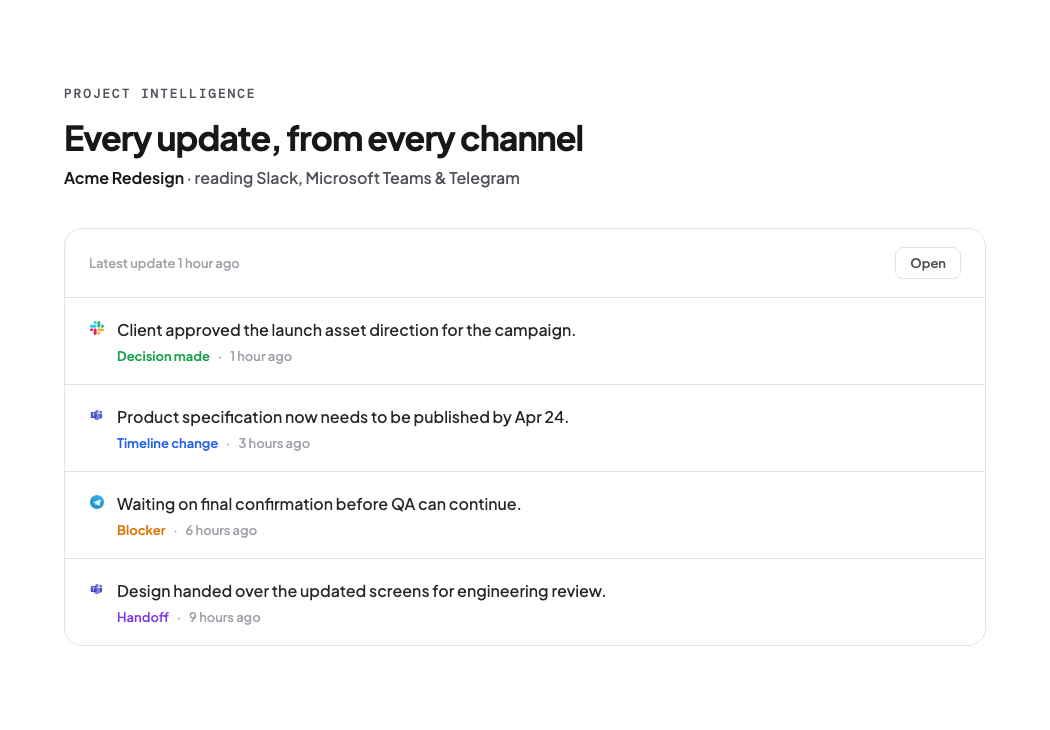
It is a different mental model: your job is not to monitor twelve chattering rooms. Your job is to review the handful of updates that actually changed, decide, and move on. The notifications that used to own your day become a weekly review — and the seven-second fog and the 23-minute re-focus tax mostly disappear, because the interruptions you allow are the ones you chose.
How many notifications should you tolerate?
There is no single healthy number that fits every role. The useful question is not "how many is too many" but "how many of mine require action." If the actionable share of your notifications is under 15%, you are not managing your attention — the platforms are managing it for you, and they are winning.
Audit one day. Count what actually pinged you, and count how many required a response. Then cut everything else off at the source, and give the updates that matter a home that is not the chat feed.
The average person gets 80 to 146 notifications a day and acts on 10 to 15% of them. The average project lead gets the same noise plus a dozen channels of project traffic. The difference between a team that ships calmly and a team that is always "catching up" is rarely talent — it is how much of that 100-odd ping daily allowance they let the chat river spend.
Frequently asked questions
How many notifications does the average person get a day?
Studies put it between 46 and 146 per day depending on what is counted: 46 push notifications (Business of Apps), 80–100 across all devices (RescueTime data), 100+ in a 2026 Computers in Human Behavior sample, and up to 146 for all channels including work messaging (musicMagpie).
How long does it take to refocus after a notification?
UC Irvine's Gloria Mark found it takes an average of 23 minutes and 15 seconds to return to a task at the same level of focus after an interruption. The 2026 Computers in Human Behavior study also found a single notification disrupts concentration for about seven seconds even if you never touch your phone.
Are most notifications actually important?
No. Research compiled by RescueTime and cited by browwwser Research found that only 10–15% of notifications are genuinely time-sensitive or require action. The other 85–90% is noise competing with real work for the same limited attention.