Slack Notification Overload Is Making Your Project Feel Busier Than It Is
If you lead a team long enough, you learn to fear the quiet more than the noise. A Slack channel can be full of green dots, reaction emojis, and quick acknowledgments while the actual project barely moves.

If you lead a team long enough, you learn to fear the quiet more than the noise. A Slack channel can be full of green dots, reaction emojis, and quick acknowledgments while the actual project barely moves. Everyone looks responsive. Everyone looks engaged. And somehow the delivery date still slips.
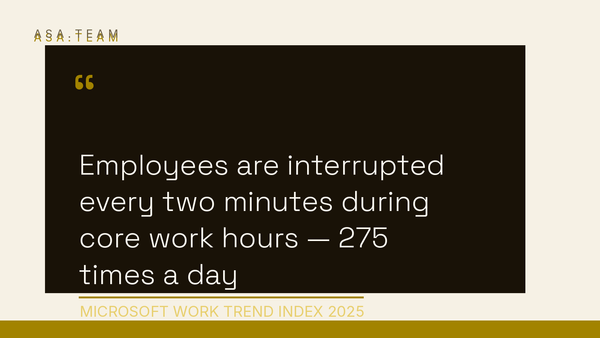
That gap is not a mystery of talent. It is a side effect of constant interruption: the feed rewards immediacy, but project progress depends on continuity. Microsoft’s Work Trend Index says employees using Microsoft 365 are interrupted every 2 minutes by a meeting, email, or notification, which is about as hostile to deep work as it sounds. The result is a familiar illusion: the room feels busy, so the work must be moving. This post is about why that illusion is so persuasive, and why Slack notification overload turns status into theater.
Every ping resets the room
The problem with Slack is not that it exists. The problem is that each message arrives like a tiny interruption that asks your brain to retask itself. By itself, one ping feels harmless. Ten pings feel normal. Fifty pings feel like the job. But the workday is not made of individual pings; it is made of attention, and attention is expensive.
Microsoft’s research on the infinite workday shows how extreme the rhythm has become. The page says that employees are interrupted every two minutes by a meeting, email, or notification. It also says that by 11 a.m., message activity surges and 54% of users are active, creating the most overloaded hour of the day. That is not a calm operating environment; it is a relay race in which the baton changes hands before anyone can run a clean lap.
In a Slack-heavy team, that matters because the channel becomes a proxy for progress. A quick reply feels like movement. A rapid emoji reaction feels like alignment. But neither one proves that someone has solved the problem, cleaned up the dependency, or made the decision that unlocks the next step. The feed can make a team look coordinated while hiding the fact that no one has had a long enough stretch to think.
That is why notification overload is so dangerous. It does not merely waste time; it changes the kind of time people have. The day is chopped into fragments, and fragments are hard to convert into the kind of sustained work that produces real status changes. A project can look lively in Slack and still be stalled in reality.
The brain does not switch cleanly
People love to say they are multitasking because it sounds efficient. In practice, the brain is not flipping between tasks at full fidelity. It is paying a switching cost every time it leaves one thread and returns to another. The biggest lie in modern collaboration is that fast response equals fast progress. Often, fast response just means fast interruption.
A PubMed review on task switching in emergency medicine makes the point bluntly: multitasking, defined as performing two tasks simultaneously, is not possible except when behaviors become completely automatic; instead, people rapidly switch between small tasks, and that switching disrupts the primary task and may contribute to error. The setting is clinical, but the mechanism is universal. Whether you are reading Slack, answering a client, or triaging a blocker, every context switch carries a tax.
Another PubMed review, a meta-analysis of 68 studies on interrupting-task modality, found that the way interruptions are delivered affects response time and accuracy. In other words, not all interruptions are equal, and not every channel is equally suited to every kind of message. That matters for teams because the wrong medium can make a message feel urgent when it should have been deliberate, or make a decision feel casual when it should have been documented.
This is the part leaders often miss. Slack is not only a communication tool; it is an interruption machine with social gravity. If you are in a culture where quick replies are rewarded, people begin to optimize for visible responsiveness. They check in before they have thought. They answer before they have confirmed. They keep the thread alive because silence can feel risky. The channel fills with motion, but the motion is often just task switching in public.
That is how projects lose precision. Each interruption slightly distorts what people remember, what they prioritize, and how they describe the work. By the time the update reaches the manager, it has been filtered through several tiny resets. The final status may still sound confident, but confidence is not the same thing as clarity.
Status in Slack decays faster than status in the work
There is a reason status updates feel freshest in the moment and weakest a day later. Slack optimizes for recency, not truth. A thread can be active while the real decision is still missing. A conversation can be lively while the underlying dependency remains untouched. And because the feed never stops moving, yesterday’s update gets buried before anyone has had time to verify it.
Microsoft’s research on brain breaks adds an important counterweight: back-to-back virtual meetings are stressful, and short breaks help people recover. The article also notes that status check-ins and informational subjects may be better handled via document collaboration, a Teams channel, or email. That is a useful clue for any team drowning in Slack. Not every question deserves a live reply. Not every update deserves a new thread. Some things need a place where they can breathe.
That distinction matters because status is not just information. Status is a shared mental model. When the model lives in a chat feed, it becomes fragile. People remember the last message, not the whole arc. They remember the loudest thread, not the most important one. They remember what was said quickly, not what was decided carefully. Once that happens, managers start asking for repeated updates because they do not trust what they saw the first time. The team responds with even more updates. The cycle deepens.
Interruptions make this worse because they break the thread that would otherwise preserve context. A person steps away to answer a ping, comes back, and reconstructs the conversation from fragments. The reconstruction is good enough for a reply, but not always good enough for a decision. Multiply that across a team and you get a project that is always almost current, but never quite current enough.
That is why I think the best teams treat Slack as a routing layer, not a record of truth. The feed is useful for signals, nudges, and quick coordination. It is terrible as the only home for decisions, dependencies, and blockers. If the project’s real state only exists in people’s heads and half-finished threads, then the channel is not visibility. It is latency.
What good looks like
Better teams do not eliminate communication. They reduce the number of times communication has to interrupt cognition. They make sure the important parts of the project live somewhere durable, while the chat layer is used for alerting, context, and escalation. The aim is not to make people quieter. The aim is to make the work easier to find when it matters.
That starts with a simple rule: if a message changes the plan, it should be easy to find later. If it only confirms the plan, it should not need five follow-up pings. If it is a blocker, it should be visible to the people who can remove it. And if it is merely informative, it should not be packaged like an emergency. Once teams make those distinctions, they stop forcing Slack to be everything at once.
This is where a project intelligence layer becomes genuinely useful. Asa.Team surfaces updates from Slack, Teams, Telegram, and WhatsApp so leaders do not have to reconstruct the story from scattered pings. The point is not more surveillance; it is less guessing. When the important signals are gathered into one place, managers can spend less time re-reading chat and more time removing the constraint that is actually slowing delivery.
Good systems also make room for recovery. If people are interrupted every two minutes, the answer is not to ask them to type faster. The answer is to reduce needless interruption, protect a few uninterrupted stretches, and move status into formats that survive attention drift. That is especially important for founders and operators who are already carrying too many threads in their head. A cleaner information system is not a luxury. It is part of execution.
Conclusion
Slack notification overload feels like momentum because it keeps everyone busy, visible, and reacting. But busyness is not the same as progress, and visibility is not the same as clarity. Once interruptions start arriving every couple of minutes, the team spends more energy re-entering the work than advancing it.
The more honest question is not whether your team responds quickly. It is whether your team can still think clearly long enough to finish the work that matters. If your project needs a dozen pings to look alive, what does it need to actually move?