The Bystander Effect in Project Teams: Why Group Ownership Is the Riskiest Kind
When a task belongs to everyone, it belongs to no one. Here's why unclear team task ownership silently stalls projects — and how to fix it.

8 min read
Your sprint ends. During the retro, someone asks about the API error-handling spec that was supposed to ship with the feature. Everyone looks around the room. "I thought Jake was handling it." Jake thought the team was. The ticket existed. It was groomed. It was even labelled "In Progress" — assigned to the team account nobody checks.
The feature shipped without it. Nobody dropped the ball on purpose. The work just disappeared into the gap between shared responsibility and actual responsibility.
This isn't a character flaw or a process failure. It's the bystander effect — a documented psychological phenomenon — operating silently inside your project team. Understanding it by name is the first step to closing the team task ownership gaps that stall projects, erode delivery confidence, and frustrate even high-performing teams.
- What the bystander effect actually is — and why it lives in your backlog
- The three moments ownership silently disappears
- Group ownership vs. clear ownership: what it looks like in practice
- Why "everyone is responsible" produces the same result as "no one is responsible"
- How to close the ownership gap: a practical checklist
- The ownership audit: five questions to ask your team this week
What the bystander effect actually is — and why it lives in your backlog
In 1968, psychologists John Darley and Bibb Latané ran a series of experiments that changed how we understand group behaviour. They found that people are less likely to act in an emergency when others are present than when they're alone. The more witnesses, the lower the chance any single person intervenes. They called it the diffusion of responsibility: when many people share accountability for an outcome, each individual feels less personally obligated to act.
The effect doesn't require an emergency. It shows up anywhere a task has no single named owner.
Maximilien Ringelmann observed the same dynamic even earlier, in 1913. In his rope-pulling experiments, individuals working alone pulled harder than people in groups — not because they were less capable, but because effort felt shared. With eight people on the rope, combined output was roughly 49% of what those eight people could have produced individually. More hands, less ownership, less effort. Modern meta-analyses by Karau and Williams across 78 studies confirm the effect is "moderate in magnitude and generalisable across tasks and subject populations."
In a project context, it looks like this:
- A Jira ticket assigned to a team or squad account, not a person
- A Slack message that got 👍 reactions but no "I'll take this"
- A dependency that "the other team" was supposed to flag
- A decision made in a meeting that everyone assumed someone else would document
Each of these is a small, invisible bystander moment. Left uncorrected, they accumulate into a delivery problem nobody can easily explain.
The three moments ownership silently disappears
Ownership doesn't usually evaporate all at once. It leaks at predictable points in the work cycle.
1. Kickoffs — "the team will figure this out"
The typical project kickoff builds excitement and establishes direction. What it rarely produces is a complete ownership map. Scope is decided. Timeline is set. And then a class of work — the integration tests, the stakeholder comms, the API contract — gets mentally filed under "we'll sort this as we go." Because everyone in the room heard "we'll sort this," nobody writes their name next to it.
This is the earliest and most recoverable form of ownership loss. It costs almost nothing to fix at kickoff. It costs significant rework to fix after a missed milestone.
2. Handoffs — the invisible border zone
Work moving between two people or two teams creates a brief, dangerous moment when it technically belongs to neither. The sending side considers it done; the receiving side hasn't fully picked it up. In that gap, questions don't get answered, blockers don't get flagged, and context quietly disappears.
This is especially acute in async-first or remote environments, where the handoff lacks the friction of a physical desk walk-over that would make the transition legible. No one "sees" the handoff happen, so no one notices when it doesn't.
3. Async communication — reactions aren't owners
A message lands in a channel. It's read by eight people. It gets six 👍 emojis and two 👀. Nobody replies "I've got this." Later, everyone assumes the person who sent the 👀 is handling it. The 👀 person thinks the same about the 👍s.
Async tools make it easy to signal awareness without committing to action. That gap — between "I saw this" and "I own this" — is where the bystander effect lives in modern teams.
Group ownership vs. clear ownership: what it looks like in practice
| Situation | Group ownership | Clear ownership |
|---|---|---|
| Task assignment | Assigned to "Backend Team" or squad account | Assigned to a named individual with an explicit due date |
| Blocking issue surfaces | Message sent to channel, awaiting response | Owner pinged directly, response expected by EOD |
| Handoff between teams | "Let us know if you need anything" | Named contact on each side; explicit transition confirmation |
| Decision made in meeting | Captured in notes, no action item attached | Action item logged with owner's name and deadline |
| Status update due | Assumed someone updated the tracker | One person owns tracker updates; cadence is pre-agreed |
| When something slips | "I thought someone else was watching this" | Owner flags proactively, escalates through defined path |
Why "everyone is responsible" produces the same result as "no one is responsible"
The data here is bleak and consistent.
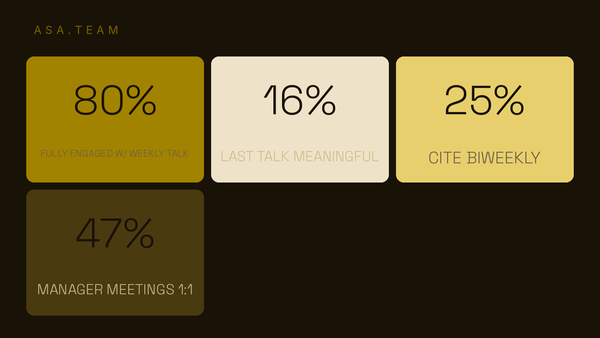
According to Gallup's 2025 employee engagement survey of 17,660 U.S. workers, only 47% of employees strongly agree that they know what is expected of them at work. That means more than half of your team, on any given day, may be uncertain whether they're the person responsible for a given piece of work — or whether someone else is handling it.
Project failure data compounds this: 37% of project failures stem from unclear goals and objectives — the single leading cause. Unclear goals and unclear ownership are two sides of the same coin: when neither is pinned to a specific person, both tend to drift.
The phenomenon extends into engineering specifically. A 2023 study by researchers at Meta examining code review behaviour found that team assignment — rather than individual assignment — created measurable bystander delays in code review. When a diff was assigned to a team, reviewers were slower to act, each assuming another team member would pick it up. Randomly assigning one recommended individual produced a large, statistically significant reduction in review time. One change — from group ownership to singular ownership — fixed a problem that tooling alone couldn't touch.
The problem isn't that your team doesn't care. It's that the human brain treats shared responsibility as permission to step back — not from laziness, but from a deeply wired social instinct that assumes distributed presence means distributed effort.
This is also why the alignment gap persists even after your best planning sessions. Agreement in a meeting is surface-level alignment. Unless someone leaves that meeting knowing they personally own the next step, the agreement evaporates into a shared assumption that nobody can act on.
And when things go wrong — and they will — the retro produces the familiar forensics of cross-team dependency failures: "we assumed they were tracking it," "nobody told us it was blocked," "I thought that was on your side." These aren't communication failures. They're ownership failures wearing the costume of communication.
How to close the ownership gap: a practical checklist
The fix isn't more process. It's more precision. These changes take minutes to implement and make ownership visible at every stage of a project.
Before kickoff
- Name the Directly Responsible Individual (DRI) for every work stream — not the team, not the pod, not "engineering". One human name per deliverable. Apple popularised the concept; the discipline behind it is universal.
- Run a dependency sweep: list everything that requires input from another team or person, and assign a DRI on your side and a named contact on theirs. If you don't yet know who the contact is, make finding that contact the first DRI task.
- Audit your backlog for team-assigned tickets. Any ticket without a named individual is invisible work — it exists but nobody owns it. Assign it or move it to triage before the sprint starts.
During the sprint
- Replace "the team will handle this" in standup with a name. If nobody volunteers, make the assignment explicit before moving on — even a temporary assignment beats ambiguity.
- When something surfaces in Slack that needs action, end your message with a direct attribution: "@person — can you own this by Thursday?" Emojis don't create owners. Explicit asks do.
- At the sprint midpoint, do a five-minute orphan check: scan the board for tickets without a named owner or without a recent update. Assign or escalate immediately rather than waiting for the retro to surface them.
At handoffs
- Require a handoff confirmation — an explicit message or comment from the receiving party acknowledging they've picked up the work. No implicit transfers. If the confirmation doesn't arrive within 24 hours, the sending DRI follows up.
- Log the transition point in your tracker: "As of [date], ownership transferred from [Person A] to [Person B]. Next step: [action]." This single comment prevents the contested handoff narrative in the retro.
After decisions
- Close every meeting or async decision thread with a named action item and a deadline. Decisions without owners are intentions, not plans. If your team is accumulating decisions that resurface as repeated arguments, unclear ownership at the action item level is almost always the root cause.
The ownership audit: five questions to ask your team this week
Before making process changes, diagnose where ownership is already breaking down. Run through these questions for your current sprint:
- Which tickets are assigned to a team or group account rather than a person? List them. Every one is a bystander risk.
- For every cross-team dependency this sprint, who owns the relationship on your side? If you can't name a person in under five seconds, there isn't one.
- What decisions were made in the last two weeks that haven't been documented with a named owner? This is where the next round of misalignment is already being created.
- Which Slack threads from the last sprint received reactions but no "I'll own this"? Search your most-used channel. You'll find at least one piece of work that fell through.
- Does every person on the team know, right now, what they are personally responsible for delivering before Friday? If the answer isn't an unambiguous yes, ownership is diffused.
These questions are uncomfortable to answer honestly. That discomfort is the signal. If your team can answer all five cleanly, your ownership hygiene is above average. Most teams find two or three gaps in the first ten minutes.
The shift that actually changes things
Group work is valuable. Collective intelligence, distributed skill, shared context — all of it makes teams better than individuals. But the mechanics of execution require singular accountability. You can design, debate, and decide as a group. You cannot own as a group.
The bystander effect isn't a critique of your team's commitment. It's a reminder that good intentions distributed across five people produce a fraction of the output those five people would generate if each one knew exactly which piece was theirs. Making ownership visible — one name per task, one person per handoff, one DRI per decision — is the lowest-cost, highest-leverage change available to most teams right now. The discipline to name the person before the work begins is all that's required. Tooling that surfaces who owns what — and flags gaps when no one does — makes this discipline easier to sustain at scale.
Frequently asked questions
What is the bystander effect in project management?
The bystander effect in project management is the tendency for tasks to go undone when they're assigned to a group rather than to a named individual. Each team member assumes someone else is handling it. The more people nominally responsible, the less likely any one person acts — a direct application of the diffusion of responsibility principle identified by Darley and Latané in 1968.
How does unclear task ownership cause project delays?
When no single person is accountable for a task, blockers go unreported, handoffs fail silently, and work falls through the gap between "I thought they had it" and "I thought you had it." Research shows that unclear goals — which overlap significantly with unclear ownership — account for 37% of project failures. Delays compound because by the time the gap is visible, it's usually too close to a deadline to fix cleanly.
What is a Directly Responsible Individual (DRI)?
A DRI is one named person who is accountable for a decision, deliverable, or piece of work. The concept — popularised by Apple — doesn't prevent collaboration. It ensures there is always one person who can be asked "what's the status?" and who bears responsibility for the answer. Teams that apply the DRI model consistently report fewer ownership gaps, faster decision resolution, and less time spent in retros reconstructing what went wrong.
How do I fix ownership gaps in an async or remote team?
In async environments, ownership gaps are harder to spot because there's no physical room to notice someone hasn't acted. Fix them by requiring named action items on every async thread before it closes, auditing your tracker weekly for team-assigned tickets, and making handoff confirmations explicit rather than assumed. The rule of thumb: if someone could read a Slack thread tomorrow and not know who owns the next action, the thread isn't closed yet.
Sources and further reading
- Gallup: Anemic Employee Engagement Points to Leadership Challenges (2025 survey, 17,660 U.S. workers)
- Simply Psychology: Social Loafing — Ringelmann Effect and Karau & Williams Meta-Analysis (1993, 78 studies)
- Rigby et al. (2023): Improving Code Reviewer Recommendation — Bystander Effect in Code Review at Meta
- Quixy: Important Project Management Statistics (37% of failures from unclear goals)